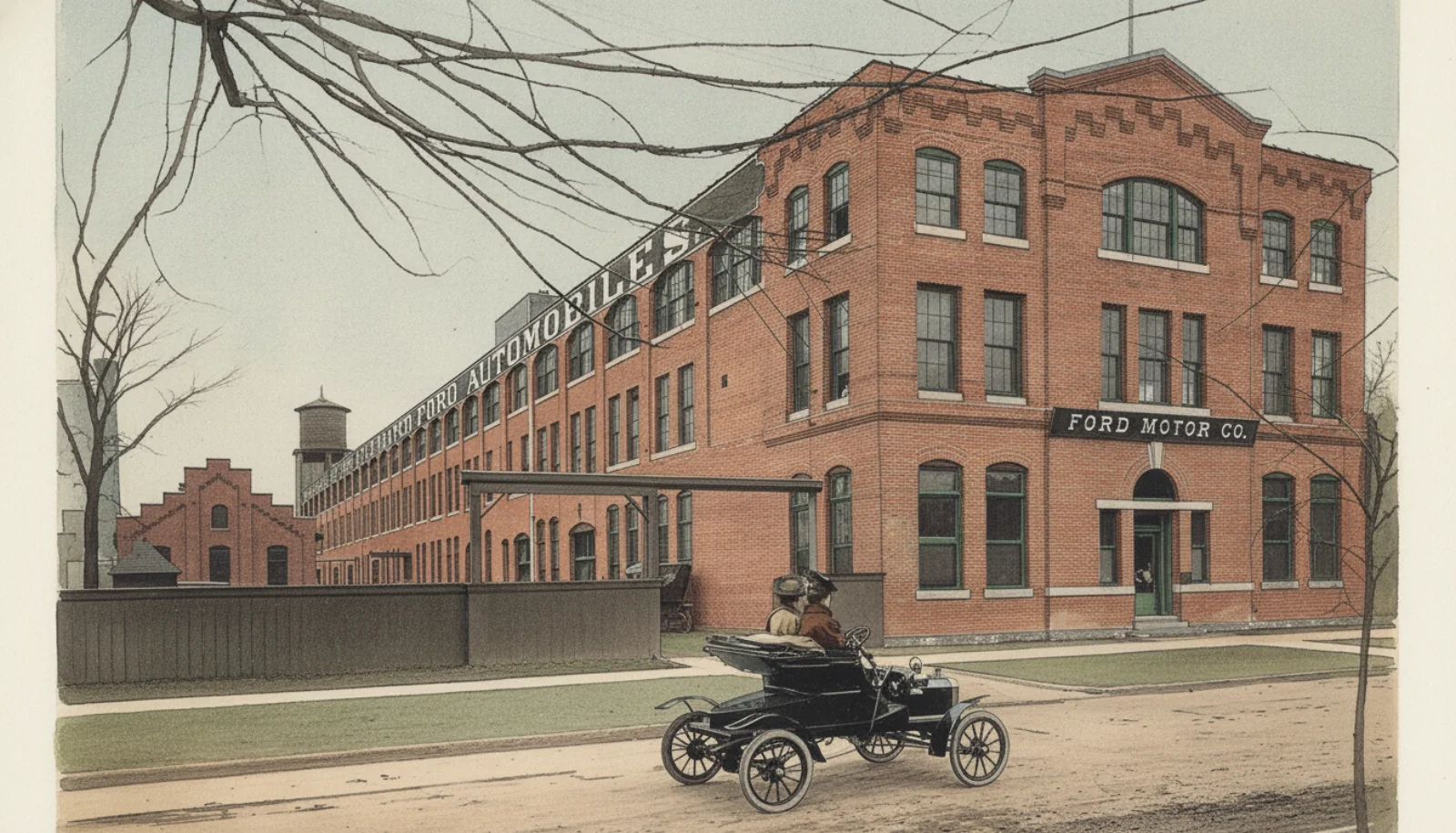
Ford Motor Company outgrew its rented Mack Avenue shop within a year of its founding and in 1904 put up a purpose-built factory on a city block in Detroit's Milwaukee Junction rail district. Designed by Field, Hinchman & Smith on the pattern of a New England textile mill, it is a long, narrow three-storey brick building with timber floors and posts and, unusually for its day, a sprinkler system. Ford began moving in during October 1904 and from then until the end of 1909 assembled its Models B, C, F, K, N, R and S here, with offices, machining, component assembly and final assembly stacked floor by floor.
The plant is where Ford changed from an assembler of bought-in parts into a manufacturer. Model N production from 1906 brought engine, transmission, axle and magneto work in-house, interchangeable parts and progressive machining, and made Ford the largest American car producer. In 1907 a locked experimental room on the third floor became the drawing office for the Model T, and the first production Model T was finished here on 27 September 1908. The building also saw a one-day industry record of 101 cars in June 1908 and a crude towed-chassis trial of assembly-line methods that summer. Demand for the Model T forced the move to Highland Park, where final assembly went in January 1910; Ford left the building entirely in October 1910.
Studebaker bought the plant in January 1911, numbered it Plant No. 10, joined a new service building to it in 1920, and used it intermittently for car assembly, including the Erskine in 1927 to 1929 and the Rockne from December 1931. 3M bought it in 1936, and later owners used it for work clothes and linen businesses. A preservation nonprofit bought it in 2000 and has run it as a museum since 2001. It was listed on the National Register in 2002 and designated a National Historic Landmark in 2006.
Opened
Closed
- Status
- repurposed
- Models built
- 11
- Components
- 7
- Peak workforce
- 1,655 (1909)
- Location
- 42.3692, -83.0656
- Also called
- Piquette Avenue Plant, Studebaker Plant No. 10, Ford Piquette Avenue Plant Museum
Cars built here
- 1904–1906Ford Model BCalendar years. Production at Piquette began in fall 1904 and ran until April 1906 (NHL nomination). Four-cylinder touring car; assembled on the third floor.
- 1904–1905Ford Model CCalendar years. Fall 1904 to December 1905 (NHL nomination). Two-cylinder runabout that replaced the Model A.
- 1905–1906Ford Model FCalendar years. Introduced February 1905, produced until April 1906 (NHL nomination).
- 1906–1908Ford Model KCalendar years. Introduced April 1906. A 1907 floor plan shows Model K assembly on the second floor; the NHL nomination says photographs suggest K assembly moved to the Bellevue Avenue Plant by 1908 or earlier, while Wikipedia says the K Roadster was among the last models built in summer 1908. Dodge Brothers made the K's engine and most key components.
- 1906–1908Ford Model NCalendar years. July 1906 to June 1908 (NHL nomination). Wikipedia gives about 7,000 built in all.
- 1907Ford Model RIntroduced April 1907 (NHL nomination); a 1907 model-year offering dropped for model year 1908 (Wikipedia).
- 1907–1908Ford Model SCalendar years. Runabout from July 1907, Roadster from April 1908 (NHL nomination); the S Roadster was among the last models built in summer 1908 before the Model T changeover (Wikipedia).
- 1908–1910Ford Model T · 12,000Calendar years. First production car completed 27 September 1908; final assembly moved to Highland Park in January 1910. Units are the museum's figure ('the first 12,000'); Wikipedia says the first 14,000 US-built cars came from here.
- 1911–1926Studebaker Studebaker automobiles (models not identified in sources)Calendar years. Studebaker bought the plant in January 1911 and used it for car assembly as Plant No. 10 until vacating it in 1926 (NHL nomination). No source opened names the models assembled in this period.
- 1927–1929Studebaker ErskineCalendar years, per the NHL nomination.
- 1931–1933Rockne Rockne (Studebaker)Plant No. 10 returned to production in December 1931 to assemble the Rockne, which lasted two years (NHL nomination); Wikipedia gives 1933 as the end of Studebaker car production here.
Parts made here
- Engines (machining and assembly) · 1907–1910Model N engines were first made at the leased Bellevue Avenue Plant (1906–1907); from early 1907 Ford consolidated work at Piquette and by late 1908 made virtually all its engines here, machining castings bought from independent foundries.
- Transmissions · 1907–1910Transmission manufacture began at Piquette in 1907 (NHL nomination).
- Rear axles · 1908–1910Assembled on the second floor during Model T production; virtually all axles made here by late 1908.
- Flywheel magnetos · 1908–1910Assembled by women in the Winding and Insulating Department on the second floor; magneto assembly space existed from 1904.
- Heat treatment of vanadium-steel parts · 1907–1910Heat-treating building added late 1907.
- Body trimming, painting and varnishing · 1904–1910Third-floor operations from 1904. Bodies themselves were bought from outside body companies.
- Engine testing and paint shop buildings · 1906–1910Authorized late 1906 at a cost of $14,000.
Pictures
Milestones
- 1904
Ford buys the Piquette Avenue site (April); construction starts 10 May; Ford moves in from October.
- 1905
Model F introduced in February; Ford employs 300 men and assembles 25 cars a day in April.
- 1906
Model K (April) and Model N (July) introduced; Ford becomes the largest US car producer.
- 1907
Experimental room on the third floor begins Model T design in January; heat-treatment building added late in the year.
- 1908
Record 101 cars in one day on 4 June; towed-chassis assembly-line trial in July; first production Model T completed 27 September.
- 1909
Model T orders suspended for two months from 1 May; calendar-year output reaches 17,771 cars.
- 1910
Model T final assembly moves to Highland Park in January; Ford leaves Piquette by October.
- 1911
Studebaker buys the plant (January) and raises the rear loading dock to second-floor level.
- 1920
Studebaker Detroit Service Building, designed by Albert Kahn Associates, completed next door and linked to the plant.
- 1926
Studebaker vacates the plant as production shifts to South Bend.
- 1927
Erskine assembly at Plant No. 10 (to 1929).
- 1930
Building used as the Studebaker Lodge emergency shelter for homeless men, 20 January to 30 June.
- 1931
Rockne assembly begins in December.
- 1936
Sold to Minnesota Mining and Manufacturing (3M).
- 1968
Sold to the owner of Cadillac Overall Company.
- 2000
Model T Automotive Heritage Complex buys the 1904 building (April).
- 2001
Opens as a museum on 27 July.
- 2002
Listed on the National Register of Historic Places.
- 2006
Designated a National Historic Landmark on 17 February.
- 2008
Restored front façade unveiled on the Model T's 100th anniversary, 27 September.
Sources
- National Historic Landmark Nomination: Ford Piquette Avenue Plant (NPS Form 10-900) — National Park Service
- Our History — Ford Piquette Avenue Plant (Model T Automotive Heritage Complex)
- Ford Piquette Avenue Plant — Wikipedia
- Ford Model K — Wikipedia
- Ford Model N (with Models R and S) — Wikipedia
- Coordinates are the Wikipedia article's coordinates for the building (42.3692, -83.0656).
- Street number conflict: the NHL nomination gives 411 Piquette Avenue; Wikipedia and the museum use 461 Piquette Avenue.
- Model T count conflict: the museum says the first 12,000 Model Ts were assembled here; Wikipedia says 14,000. The NHL nomination gives 10,607 Ford cars for the year to 30 September 1909 and 17,771 for calendar 1909 but no Piquette-only Model T total. The museum's figure is used.
- Workforce: the NHL nomination gives an average of 1,655 Ford employees in Detroit for calendar 1909 (Ford called it the 'home plant', presumably Piquette). Earlier figures: about 300 in fall 1904, 300 in April 1905, estimates of 700 (1906) and 450 (1908), and 609 on the October 1908 payroll. Wikipedia's 300–700 range omits 1909.
- Model K: sources disagree on whether K assembly stayed at Piquette through 1908 or moved to Bellevue Avenue by 1908; the span is given as 1906–1908 with the doubt noted.
- Studebaker's car models assembled here between 1911 and 1926 are not named in any source opened.
- 'closed' is set to 1933, the last year of car assembly per Wikipedia; the building itself stands and has been a museum since 2001.