Datsun240Z (S30)
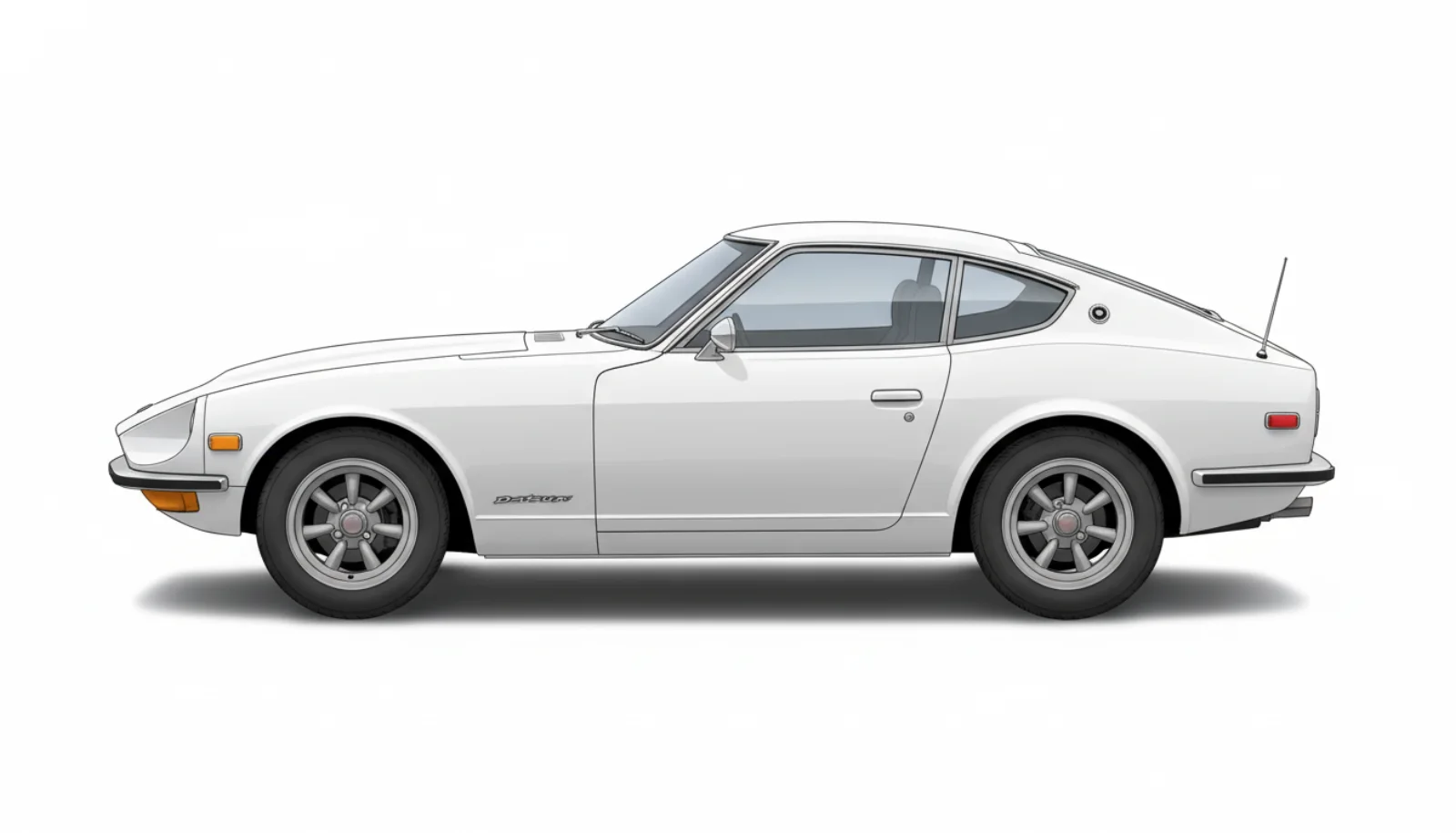
New Sight Orange · 918 · 1970–1973not offered in 1969
Screen approximation of the factory paint
Model year
Generation
240Z and first-series Fairlady Z
Built in 1969
Built in all, 1969–1978
est.
Serial numbers, 1969
240Z left-hand drive: prototypes, test and show carsHLS30-00001 → HLS30-00012
240Z left-hand drive, Series I (hatch vents)HLS30-00013 → HLS30-20533
240Z right-hand drive (export), first seriesHS30-00003 → …
Price new, 1969
¥1,850,000
Japan · sticker price, almost double the basic Fairlady Z
Origin
Japan
Front-engine, rear-wheel drive
Nissan's six-cylinder, all-independent fastback coupe, sold as the Fairlady Z in Japan and as the Datsun 240Z, 260Z and 280Z abroad.
Sports car38 sources
How it launched in 1969
- 01Production prototypes were built from May 1969; regular production began in October 1969 at Nissan Shatai.
- 02Announced in Japan on 18 October 1969 as the Fairlady Z and Z-L (2.0 L L20) and the Fairlady Z432 (twin-cam S20), with the export Datsun 240Z shown alongside.
- 03The 240Z went on sale in the US on 22 October 1969 at $3,526 as a 1970 model: 2.4 L L24 with twin Hitachi SU-type carburettors, four-speed manual, struts all round, front discs.
- 04543 export 240Zs were built in 1969: 540 left-hand-drive HLS30 and 3 right-hand-drive HS30. HLS30-00001 to 00012 were prototypes, test and show cars; HLS30-00013 was the first sold to the public.
- 05Production was halted in December 1969 while the crankshaft was redesigned.
- 06The units figure is all S30-series cars built in calendar 1969, home market included.
240Z and first-series Fairlady Z, 1969–1973
The original short-bumper cars. Export 240Zs ran through four production series that US owners call Series I to IV, defined by the chassis-number breaks Nissan printed in its parts catalogue (HLS30-00013, 21001, 46001 and 120001). Japan had the 2.0-litre Fairlady Z and Z-L, the twin-cam Z432 and, from late 1971, the Fairlady 240Z, 240Z-L and 240ZG. The units figure is Nissan's cumulative S30-series production to the end of calendar 1973, home market and export together; it includes the first 260Zs built from July 1973.
Built, this generation 192,549
Body styles by year
Trim lines and engines, 1969
| Line | Power | Torque | 0–60 mph | Top speed | Weight |
|---|---|---|---|---|---|
2.0 L L20 SOHC inline-six, twin Hitachi SU-type carburettors | 128 hp | 127 lb-ft | — | — | 2,260 lb |
2.0 L S20 DOHC 24-valve inline-six, three Mikuni-Solex 40PHH carburettors | 158 hp | 131 lb-ft | — | 130 mph | 2,293 lb |
Fairlady Z / Fairlady Z-L (S30-S / S30, Japan)
1969–1973
- Engine
- 2.0 L L20 SOHC inline-six, twin Hitachi SU-type carburettors
- Displacement
- 1,998 cc
- Layout
- I6 · naturally aspirated · RWD
- Power
- 128 hp (130 PS JIS; 125 PS JIS from 1973)
- Torque
- 127 lb-ft
- 0–60 mph
- Not documented
- Top speed
- Not documented
- Weight
- 2,260 lb
- Gearboxes
- 4-speed manual; 5-speed manual; 3-speed automatic
- Length × width × height
- Not documented
- Wheelbase
- Not documented
- Body styles
- Two-seat hatchback coupe
- Price new
- Not documented
- Built
- Not documented
What this line added
- Z-L was the luxury specification; the base Z (S30-S) did without some of its carpeting, sound-proofing and equipment
- Wing-mounted mirrors and extra rear bumper rubbers, as required for the home market
Factory colors, 1969
0 of 30 documented colors were offered this year. Pick one to repaint the page.
Interiors, 1969
Units built by year
Left- and right-hand drive
The split is not documented.
No left/right-hand-drive split is published for the whole S30 run. For the export 240Z of 1970-73, Nissan's figures show 4,287 right-hand-drive HS30 cars for Australia and Great Britain out of 164,616; all Japanese-market cars were right-hand drive but are not counted separately by model.
Nissan Heritage Collection: "global sales over 520,000 units" for the S30 over nine years. Nissan's public-relations production table (reproduced in Katayama and Matsuo's Fairlady Z Story) shows 484,734 S30-series cars built through the end of calendar 1977; its 1978 line (91,220) also includes the S130 that replaced the S30 that year.
Price when new
Lowest list price each year in United States, in USD of the day. Not adjusted for inflation.
Serial number ranges
| Series | Drive | Years | From | To |
|---|---|---|---|---|
| 240Z left-hand drive: prototypes, test and show cars00001-00003 engineering prototypes, 00004-00005 US road-test cars returned to Japan, 00006-00008 press and show cars later raced; 00009-00012 unaccounted for. | LHD | 1969 | HLS30-00001 | HLS30-00012 |
| 240Z left-hand drive, Series I (hatch vents)Start per Nissan parts catalogue (from October 1969). End is the last Series I car reported to the Internet Z Car Club, built January 1971, not a factory figure. | LHD | 1969–1971 | HLS30-00013 | HLS30-20533 |
| 240Z left-hand drive, Series IIStart per Nissan parts catalogue (from January 1971). The last Series II number is not documented; the first 1972-specification car reported is HLS30-43496. | LHD | 1971 | HLS30-21001 | … |
| 240Z left-hand drive, Series III (1972 model year)Start per Nissan parts catalogue (from September 1971). End is the highest 1972-model car reported, not a factory figure. | LHD | 1971–1972 | HLS30-46001 | HLS30-101398 |
| 240Z left-hand drive, Series IV (1973 model year)Start per Nissan parts catalogue (from July 1972). End is the highest number reported, built August 1973. | LHD | 1972–1973 | HLS30-120001 | HLS30-172767 |
| 240Z right-hand drive (export), first seriesPer Nissan parts catalogue (from October 1969). HS30-00001 and 00002 were prototypes; regular right-hand-drive production began in January 1970. | RHD | 1969–1970 | HS30-00003 | … |
| 240Z right-hand drive (export), from January 1971Per Nissan parts catalogue. | RHD | 1971 | HS30-00501 | … |
| 240Z right-hand drive (export), from September 1971Per Nissan parts catalogue. | RHD | 1971–1972 | HS30-01501 | … |
| 240Z right-hand drive (export), from July 1972Per Nissan parts catalogue. | RHD | 1972–1973 | HS30-14001 | … |
| Fairlady 240Z, Japanese market, built 1971Calendar-year body numbers as reported on the Classic Z Car Club forum from Nissan Shatai records. | RHD | 1971 | HS30-10001 | HS30-10436 |
| Fairlady 240Z, Japanese market, built 1972 (five-digit numbers)Numbering then switched to six digits. | RHD | 1972 | HS30-10437 | HS30-12045 |
| Fairlady 240Z, Japanese market, built 1972 (six-digit numbers) | RHD | 1972 | HS30-100001 | HS30-100800 |
| Fairlady 240Z, Japanese market, built 1973With an unexplained gap between HS30-101537 and HS30-102001. | RHD | 1973 | HS30-100801 | HS30-103262 |
| 260Z two-seater, left-hand drive260Z production started in July 1973; RLS30-00020 is recorded with a 07/73 build date. The end of the range and the change-over point to the heavy-bumper cars are not documented. | LHD | 1973–1974 | RLS30-00001 | … |
The car
The S30 was Nissan's replacement for the Fairlady roadster: a steel monocoque fastback with a rear hatch, MacPherson struts at all four corners, front disc brakes and an overhead-cam straight-six taken from the L-series saloon engine family. It was styled in-house by Yoshihiko Matsuo's small sports car studio and pushed through a sceptical management largely by Yutaka Katayama, who ran Nissan's US sales company and wanted a sports car built around American tastes. Bodies were built by Nissan Shatai at Hiratsuka, alongside the last roadsters.
Production began in October 1969. Japan received the 2.0-litre Fairlady Z and Z-L and the twin-cam Fairlady Z432, which used the Skyline GT-R's S20 engine; export markets received the 2.4-litre Datsun 240Z, with chassis prefix HLS30 for left-hand drive and HS30 for right-hand drive. The US list price at launch was $3,526, and the US and Canada took roughly 97 per cent of the 240Zs exported between 1970 and 1973. The 2.4-litre engine did not reach Japanese showrooms until November 1971, together with the long-nosed Fairlady 240ZG homologation model.
US safety and emissions rules shaped everything after 1972. The 1973 240Z gained set-out bumpers and emissions carburettors; the 1974 260Z brought a 2.6-litre engine, heavier bumpers during the year and a long-wheelbase 2+2; the 1975 280Z, sold only in North America, went to 2.8 litres with Bosch L-Jetronic injection. Other export markets kept the 260Z until 1978, and Japan kept the 2.0-litre Fairlady Z, fuel-injected from 1975 and recoded S31 from July 1976.
Nissan's heritage collection puts worldwide sales of the S30 at more than 520,000 over nine years. Works 240Zs won the East African Safari Rally outright in 1971 and 1973 and finished third on the 1972 Monte Carlo Rally, and in the US the car won the SCCA C Production national title every year from 1970 through 1979.
- Class
- Sports car
- Layout
- Front-engine, rear-wheel drive
- Origin
- Japan
- Designers
- Yoshihiko Matsuo (head of Nissan's Sports Car Design Studio), Akio Yoshida (design), Hisashi Uemura (production engineering)
- Also known as
- Nissan Fairlady Z, Datsun 260Z, Datsun 280Z, Nissan Fairlady 240Z, Nissan Fairlady Z432, Nissan Fairlady 240ZG, Nissan S30
- In production
- 1969–1978
Milestones
- 1967
Nissan management approves the Z project for production (November).
- 1969
First production prototypes built in May; regular production starts in October.
- 1969
Announced in Japan on 18 October as the Fairlady Z, Z-L and Z432; the Datsun 240Z goes on sale in the US on 22 October at $3,526.
- 1970
First shipment reaches the US in January; John Morton wins the SCCA C Production championship in a BRE 240Z.
- 1971
Edgar Herrmann and Hans Schuller win the East African Safari Rally on the 240Z's first attempt.
- 1971
Fairlady 240Z and long-nosed 240ZG go on sale in Japan (November).
- 1972
Rauno Aaltonen and Jean Todt finish third overall on the Monte Carlo Rally.
- 1973
Shekhar Mehta and Lofty Drews win the East African Safari Rally; the last 240Z is built in August.
- 1974
260Z and the long-wheelbase 2+2 introduced.
- 1975
Fuel-injected 280Z introduced for North America.
- 1976
Japanese-market Fairlady Z becomes the S31 with NAPS emissions equipment (July).
- 1978
Black Pearl edition; the S130 280ZX replaces the S30.
Pictures
Illustrations are generated from period references and shown in the selected factory color; they are not photographs.
Where it was built
Where the cars went
- United States, 1970: Units produced for the US in calendar 1970, per Nissan's 1978 Datsun 280ZX book.
- United States, 1971: Units produced for the US in the calendar year.
- United States, 1972: Units produced for the US in the calendar year.
- United States, 1973: Units produced for the US in the calendar year.
- United States, 1974: Units produced for the US in the calendar year: 40,172 two-seaters and 9,499 2+2s.
- United States, 1975: Units produced for the US in the calendar year: 40,216 two-seaters and 11,594 2+2s.
- United States, 1976: Units produced for the US in the calendar year: 45,766 two-seaters and 13,792 2+2s.
- United States, 1977: Units produced for the US in the calendar year; the source table has no separate 2+2 line for 1977.
- United States, 1978: Calendar-year sales reported by Nissan Motor Corporation USA; may include some early 280ZX.
- Canada, 1970–1973: 240Zs produced for Canada, per Nissan.
- Canada, 1974–1977: Sum of the yearly two-seater and 2+2 lines for Canada in Nissan's table.
- Australia, 1970–1973: 240Zs produced for Australia, per Nissan.
- Australia, 1974–1977: Sum of the yearly two-seater and 2+2 lines for Australia in Nissan's table.
- United Kingdom, 1970–1973: 240Zs produced for Great Britain, per Nissan.
- United Kingdom, 1974–1977: Sum of the yearly two-seater and 2+2 lines for Great Britain in Nissan's table; the 1976 two-seater cell is blank.
- France, 1970–1973: Left-hand-drive 240Zs, per Nissan.
- Netherlands, 1970–1973: Left-hand-drive 240Zs, per Nissan.
- Germany, 1970–1973: Left-hand-drive 240Zs, per Nissan.
Against its rivals
Same class, same years. Each rival is shown in the specification and year a buyer would have cross-shopped.
Longer is better. Figures are for the variant and year named under each car, from the sources listed below.
In the comparison
Triumph TR6 (petrol injection) · 1970 · United Kingdom
The established six-cylinder British sports car; in Britain it cost about a third less than a 240Z, and in the US it was the car the Datsun displaced.
Porsche 914 1.7 · 1970 · Germany
Launched the same year at about the same US price as the 240Z, with four cylinders and 80 PS.
Opel GT 1900 · 1969 · Germany
A small imported two-seat fastback of the same years; one of the cars the 240Z outperformed for similar money.
MG MGB GT · 1971 · United Kingdom
The best-selling British hatchback coupe of the period, cheaper than the Datsun but four-cylinder and much slower.
Factory options
| Option | Code | Years | Price | Built with it |
|---|---|---|---|---|
| Three-speed automatic transmissionFirst fitted in August 1970; listed at $195 for 1972-74. | — | 1970–1978 | $190 | — |
| Five-speed overdrive manual transmissionNorth American 280Z option; export 240Z and 260Z cars had a five-speed as standard. | — | 1977–1978 | — | — |
| Air conditioningControls integrated into the heater panel from the 260Z. | — | 1972–1974 | $325 | — |
| AM radio, push-button | — | 1970–1974 | $59.95 | — |
| AM/FM radio | — | 1972–1974 | $98.5 | — |
| AM/FM stereo with 8-track player | — | 1972–1974 | $110 | — |
| Two-speaker stereo system | — | 1970 | $102 | — |
| Luggage rackListed at $12.95 for 1972-74. | — | 1970–1974 | $26.95 | — |
| Centre armrest | — | 1972–1974 | $9.95 | — |
| Footrest | — | 1972–1974 | $12.95 | — |
| Black Pearl Sports Appearance PackageRed and silver pinstriping and trim for the 1978 Black Pearl edition. At least 850 were built, one per US dealer; the Internet Z Car Club's estimate is 1,200 to 1,500. | — | 1978 | — | — |
| Aluminium road wheels5.5J-14 alloy wheels offered on the 1978 280Z. | — | 1978 | — | — |
| G-nose aerodynamic kitThe 240ZG's glass-fibre nose, headlamp covers and wheel-arch flares; sold as a dealer option in export markets. | — | 1971–1973 | — | — |
Known issues
Body rust from the inside out
1969–1978majorThe shell was spot-welded with bare metal in the seams, and rust works outward from closed sections. The documented trouble spots are the dog-leg ahead of the rear wheel arch, the rear arches, the sill ends behind the front wheels, the floors and chassis rails, the battery tray, the scuttle under the wiper cowl, the windscreen surround and the hatch sill.
Fix Cut out and weld in new metal; most panels, floors and chassis rails are reproduced. Inspect on a lift with the carpets up and the battery out.
Flat-top emissions carburettors
1973–1974moderateThe flat-top Hitachi carburettors fitted to the 1973 240Z and the 260Z are harder to tune and keep running well than the earlier round-top units, and parts and expertise are scarce.
Fix Many cars have been converted to the 1970-72 round-top carburettors or to aftermarket carburation; originality buyers should check which is fitted.
Exhaust fumes drawn into the cabin
1969–1978moderateWith the windows down the body shape pulls air in from the rear, so fumes enter through tired hatch or tail lamp seals and missing floor drain plugs. Complaints about fumes are also why the hatch vents of the Series I cars were deleted in early 1971.
Fix Renew the hatch and tail lamp seals and replace missing drain plugs in the luggage floor.
Corroded aluminium cylinder head
1969–1978moderateThe L-series engine is very durable, but the aluminium head corrodes internally if the cooling system has been run on plain water.
Fix Keep the correct antifreeze mix; damaged heads can be repaired.
Hard-to-diagnose fuel injection faults
1975–1978minorThe 280Z's Bosch L-Jetronic system is reliable when maintained, but rough running or a no-start can be slow to trace because the sensors, wiring and control unit are interdependent.
Fix Work through the system methodically, starting with connectors and sensors; specialists report little to be gained from modifying the original system.
How it was advertised
The 240Z was conceived and championed in America by Yutaka Katayama, president of Nissan's US sales company, and went on sale in October 1969 as a 1970 model (in Japan it was the Fairlady Z). Its advertising leaned on the gap between its price and its performance: the 1970 US launch ad in Playboy called it a new kind of economy car, a luxurious two-seater that looked and drove like GT cars costing thousands more, and set it beside the rest of the Datsun range under the house line "Drive a Datsun... then decide". The car quickly built long waiting lists, and with the growing Datsun dealer network it acted as a halo for a brand known for economy cars.
Racing did much of the promotion. Brock Racing Enterprises won the SCCA C Production national titles in 1970 and 1971 with John Morton, Bob Sharp Racing campaigned Zs on the East Coast, and in Europe the factory rallied the car; Datsun's French importer used a 240Z's third place in the 1972 Monte Carlo Rally to announce its new national dealer network. Shekhar Mehta won the 1973 East African Safari in a 240Z. No television advertising or agency of record for the 240Z was documented.
Where it ran: 3 documented placements
More advertisements, viewable at their source (2)
These are still under copyright, so we describe them and link to where they can be seen rather than reproduce them.
- 1970Datsun introduces a new kind of economy car... the 240-Zmagazine · Playboy · 1970-05 · Internet Archive (Car Brochures & Adverts collection) ↗Two-page spread with a large black-and-white photograph of a 240-Z, a blonde woman in the passenger seat. Brief copy calls it a luxurious two-seat personal car with GT looks, independent suspension, a 150 hp overhead-cam six and front disc brakes, at an economy-car price; a strip of small pictures shows the rest of the Datsun range with prices.
- 1972En France, il y a un an, personne ne les connaissait...magazine · Internet Archive (Car Brochures & Adverts collection) ↗French importer's ad built on a night photograph of a works 240Z throwing up snow on the Monte Carlo Rally, with a badge for its third place in 1972. The copy contrasts Datsun's obscurity in France a year earlier with its new nationwide dealer network, shown on a map, and offers a coupon for the nearest garage.
Only two period 240Z advertisements could be documented. No 240Z ad with a public-domain or open licence was found on Wikimedia Commons, and the AHPS library holds none. The web-search budget for this run ran out before further US magazine ads, Japanese Fairlady Z advertising or brochures could be traced. The French ad's year is inferred from its "3e Rallye Monte-Carlo 1972" badge; the Internet Archive item gives no date or publication. The Internet Archive items were uploaded by a collectors' group without any licence statement, so they are link-only. The racing record is taken from Wikipedia's Nissan S30 article; the 240Z's use in US advertising of those wins was not documented.
Sources
- 1Z Car Production and Sales Reports (tables from Nissan's 1978 "Datsun 280ZX" book and Nissan PR figures in "Fairlady Z Story") — Internet Z Car Club (zhome.com), Carl Beck and Paul Hillman club
- 2Production and Distribution of the Datsun 240Z (with Nissan parts-catalogue chassis number pages) — Internet Z Car Club (zhome.com), Carl Beck club
- 3Design and Manufacturing Changes to the U.S. Spec. Datsun 240Z, 1969-1973 — Internet Z Car Club (zhome.com) club
- 4What Year Is My 240Z? (Series I-IV definitions) — Internet Z Car Club (zhome.com), Carl Beck club
- 5Locating the Remaining 1969 Production Year 240-Zs — Internet Z Car Club (zhome.com) registry
- 6240Z Paint and Interior Colors (from Nissan factory service bulletins vols. 125, 137, 171, 190, 220) — Internet Z Car Club (zhome.com) club
- 7Datsun 240Z-260Z-280Z US Paint Code Gallery — Internet Z Car Club (zhome.com), Michael Perdue club
- 8Technical Specifications, 1970 Datsun 240Z (from the 1970 Datsun sales brochure) — Internet Z Car Club (zhome.com) club
- 9The Fairlady Z 432 — Internet Z Car Club (zhome.com), Carl Beck club
- 10The Datsun 240Z Rally Cars — Internet Z Car Club (zhome.com), Carl Beck club
- 11The 1978 Datsun 280Z Black Pearl Edition — Internet Z Car Club (zhome.com) club
- 12Z Timeline: From Datsun 240-Z to Nissan 350Z (after Nissan's own chronology) — Internet Z Car Club (zhome.com) club
- 13Common Rust Areas of the 240-Z — Internet Z Car Club (zhome.com), Carl Beck club
- 14JDM HS30 series VINs (body numbers by calendar year from Nissan Shatai records) — Classic Z Car Club forum club
- 15S30 Series model guide — The Z Club of Great Britain club
- 16Nissan Heritage Collection: Fairlady Z432 (PS30, 1969) — Nissan Motor Corporation factory
- 17Nissan Heritage Collection: Fairlady 240ZG (HS30H, 1972) — Nissan Motor Corporation factory
- 18Datsun and Nissan Fairlady Z Heritage — Nissan USA Newsroom factory
- 19Nissan Fairlady Z (S30) — Wikipedia reference
- 20The Original Datsun Z-Car — Ate Up With Motor (Aaron Severson) reference
- 21Your handy 1970-73 Datsun 240Z buyer's guide — Hagerty reference
- 22What to look for in a Datsun 240Z, 260Z, and 280Z — Hagerty reference
- 23Datsun 240Z review: Is the original Z the best? — Hagerty UK reference
- 24Road test: Datsun 240Z, a Japanese invader — Motor Sport, March 1972 period-test
- 25Datsun 240Z, 260Z and 280ZX: Japan's finest sports cars — Classic & Sports Car reference
- 26Guide: Nissan Fairlady Z and Datsun 240Z (S30) — Supercar Nostalgia reference
- 271971 Datsun 240Z profile — Sports Car Market auction
- 281970 Datsun 240Z Fact Sheet — Over-Drive Magazine reference
- 291971 Datsun 240Z Fact Sheet — Over-Drive Magazine reference
- 301972 Datsun 240Z Fact Sheet — Over-Drive Magazine reference
- 311973 Datsun 240Z Fact Sheet — Over-Drive Magazine reference
- 321974 Datsun 260Z Fact Sheet — Over-Drive Magazine reference
- 33Datsun 280Z: specification comparison by year — Conceptcarz reference
- 341974 Datsun 260Z — Conceptcarz reference
- 35Triumph TR6 — Wikipedia reference
- 36Porsche 914 — Wikipedia reference
- 37Opel GT — Wikipedia reference
- 38MG MGB — Wikipedia reference
Research notes: what is not documented, and where sources disagree (14)
- Yearly units are calendar-year production of the whole S30 series (home market and export, every variant), from the Nissan public-relations table reproduced in Katayama and Matsuo's Fairlady Z Story and shown on zhome.com. They are not US model-year counts. 1978 is left null because Nissan's 91,220 for that year also covers the S130 280ZX.
- Total production: Nissan's heritage site says "over 520,000"; Ate Up With Motor says more than 540,000 were sold; Hagerty UK says more than half a million. The Nissan PR table reaches 484,734 by the end of 1977. No exact S30-only total was found.
- 240Z export totals conflict. Nissan's export figures for 1969-73 total 168,584 (which may include about 3,968 early 260Zs); the Datsun 280ZX book's distribution table totals 164,616 for 1970-73; Classic & Sports Car gives 156,078 for 1969-73; Nissan's US chronology says all-time US 240Z sales were 116,712 against 148,115 produced for the US. The registry-backed distribution table is used here.
- The 240Z (HLS30, North America) units figure of 159,313 is the sum of Nissan's US (148,115) and Canada (11,198) columns for 1970-73; the right-hand-drive export figure of 4,287 is Nissan's Australia plus Great Britain total. The 540 HLS30 cars built in 1969 are not in those columns.
- US sales by model year were not found. The markets section gives Nissan's units produced for each export market by calendar year (1970-77) and NMC-USA's calendar-year sales for 1978. Nissan's own chronology quotes different US sales figures (63,963 for the 260Z; 67,331 for 1977). Over-Drive lists 46,282 for the US in 1973 against 45,588 in the Nissan table.
- US prices: 1970-73 are port-of-entry prices from Over-Drive Magazine's fact sheets ($3,526 is also given by Nissan's chronology, Sports Car Market and Ate Up With Motor). The 1974 260Z price is left out: Over-Drive's 1974 sheet repeats the 1973 figure of $4,695 and looks like a copy of the 1973 page, while Conceptcarz gives 'approximately $5,300'. 1975-78 prices are from Conceptcarz and appear rounded to the nearest $5; for 1978 Ate Up With Motor gives $8,683 against Conceptcarz's $7,970. A period price list or road test should replace all of these.
- Serial numbers: series starting numbers for the 240Z are from Nissan's parts catalogue as reproduced on zhome.com. End numbers are the highest cars reported to the Internet Z Car Club, not factory figures (two zhome pages disagree on the last Series I car: HLS30-20438 and HLS30-20533; the more recently updated page is used). zhome's series page dates Series III from August 1971 and Series IV from September 1972, while the parts catalogue says September 1971 and July 1972.
- No documented chassis ranges were found for the 280Z (HLS30 prefix, reported on owner forums to start at 200001 for 1975), the 2+2 models (GRLS30, GHLS30), the Fairlady Z (S30), the Z432 (PS30) or the late 260Z; these are left out. Japanese-market HS30 numbers are from a Classic Z Car Club forum post citing Nissan Shatai records.
- Z432 production of 420 (299 in 1969-70, 98 in 1971, 23 in 1972-73) is from zhome.com; Wikipedia says 'about 420'. Z432-R production is undocumented; Wikipedia says fewer than 50. No production figure exists for the Fairlady 240ZG, the Fairlady Z/Z-L or any Japanese-market variant.
- Special editions: Wikipedia estimates 1,000 for the 1977 'ZZZap' car and 750-1,500 for the 1978 Black Pearl; zhome says at least 850 Black Pearls with the Sports Appearance Package. No factory count was found for either.
- Performance: only the 1970 US 240Z (Road & Track, quoted by Hagerty), the UK 240Z (Autocar via Hagerty UK; Motor Sport March 1972) and the UK 260Z 2+2 (Classic & Sports Car panel) have sourced 0-60 times. No period test figures for the US 260Z or 280Z could be opened, so those are null. The Z432's 130 mph and 15.8 s quarter mile are zhome's figures.
- Weights: the 1970 brochure gives 2,355 lb, Ate Up With Motor gives a US curb weight of 2,330 lb and Over-Drive lists 2,300 lb. The 280Z 2+2 length (185.3 in) and weight (3,120 lb) are from Ate Up With Motor; Wikipedia's dimensions for the 2+2 are shorter.
- Colours: codes, names and dates are from Nissan service bulletins as transcribed on zhome.com and cover North American cars. Where the list gives a start date and no end date, the colour is shown as running to 1978, which is not confirmed for 1977-78. White is listed as 215 in one zhome list and 216 in another. The start date for 510 Light Blue Metallic is cut off in the source. Japanese-market and other export colour ranges, and build counts by colour, were not found.
- Flat-top carburettors: zhome and Hagerty's inspection guide date them to the 1973 model year; Hagerty's 240Z buyer's guide places the Series IV changes a year earlier in one passage, which looks like an error.
38 sources. Paint swatches are screen approximations of the factory colors.