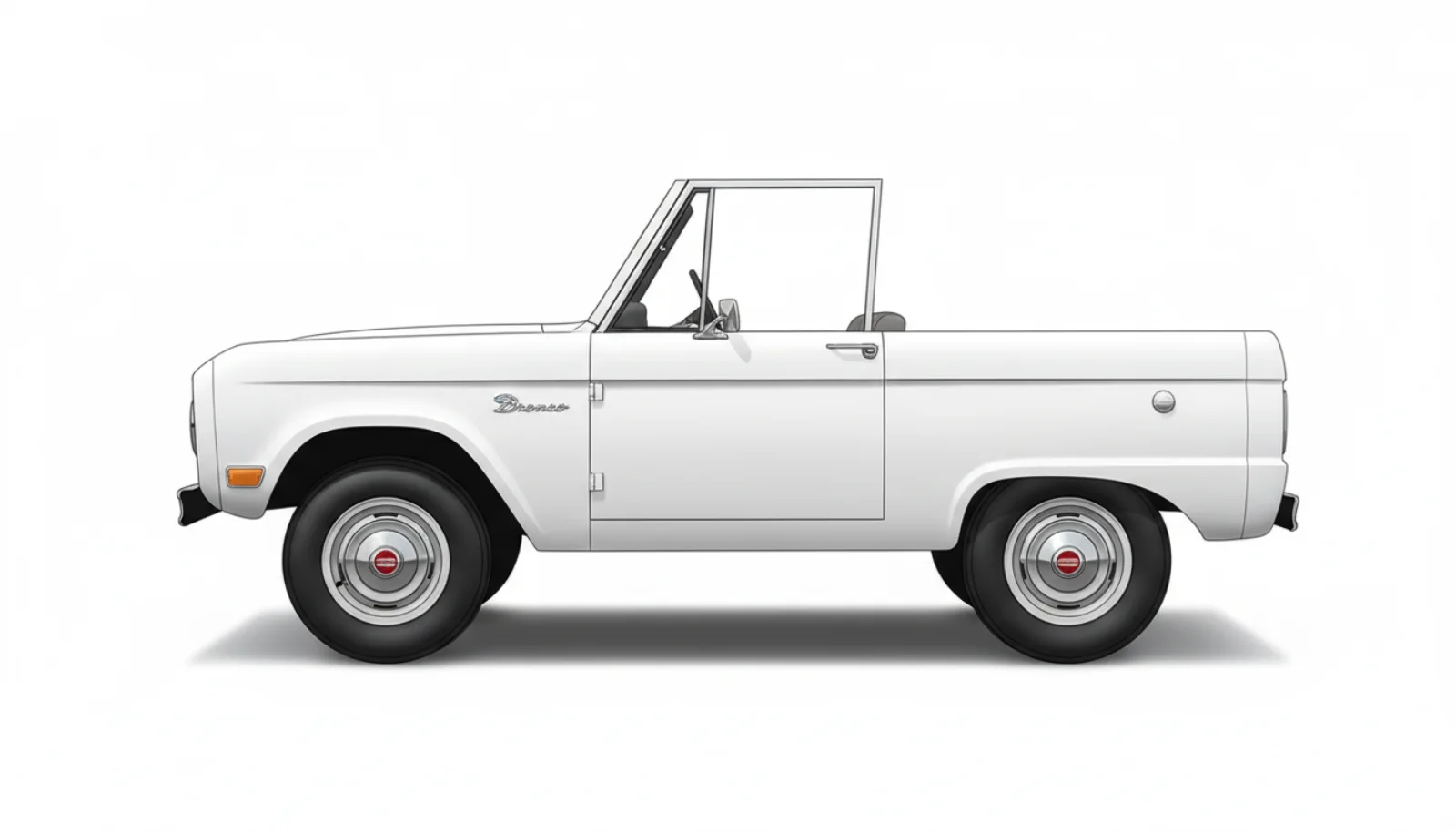
Model year
Generation
First generation (early Bronco)
Built in 1966
Built in all, 1966–now
Serial numbers, 1966
Not documented
Price new, 1966
$2,404
United States · U13 roadster
Origin
United States
Front-engine, four-wheel drive
Ford's four-wheel-drive utility: a compact 92-inch-wheelbase original (1966-77), a full-size F-Series-based two-door (1978-96), and a Ranger-based revival from 2021.
Off-road SUV23 sources
How it launched in 1966
- 01Introduced on 11 August 1965 as a 1966 model; in Ford showrooms from September 1965.
- 02Three bodies: U13 roadster (no doors or top as standard), U14 sports utility with bolt-on half-cab roof, U15 wagon with full-length steel roof.
- 03Standard 170 cu in six (105 hp) with column-shift three-speed manual, the first fully synchronized transmission in a US 4x4 (Hagerty); Dana 20 transfer case with a single lever.
- 04289 V8 (200 hp) added as an option in March 1966.
- 05Coil-sprung, radius-arm front suspension with track bar; 34-foot turning circle; 11-inch front and 10-inch rear drum brakes.
- 06Most 1966s have forward-angled, stud-mounted rear shocks and a tall J-handle transfer-case lever.
- 07Hagerty counts 10 exterior colours.
- 08Base prices: roadster $2,404, wagon $2,625 (Old Cars/Military Trader).
First generation (early Bronco), 1966–1977
Ford's first purpose-built four-wheel-drive utility, on a 92-inch-wheelbase box-section frame of its own rather than a shortened truck chassis. Coil springs and radius arms located a Dana 30 front axle (Dana 44 from 1971) and a Ford 9-inch axle was used at the rear. It launched in August 1965 as the U13 roadster, U14 sports utility (half-cab pickup) and U15 wagon, all with four-wheel drive and a column-shift three-speed manual. The roadster went after 1968 and the half-cab after 1972, leaving the wagon. Built at the Michigan Truck Plant in Wayne, Michigan.
Built, this generation 225,585
Body styles by year
Trim lines and engines, 1966
| Line | Power | Torque | 0–60 mph | Top speed | Weight |
|---|---|---|---|---|---|
170 cu in (2.8 L) inline six, one-barrel, solid lifters, 6-qt oil pan, oil-bath air cleaner | 105 hp | — | — | — | — |
289 cu in (4.7 L) small-block V8 | 200 hp | 282 lb-ft | — | — | — |
170 cu in Six
1966–1972
- Engine
- 170 cu in (2.8 L) inline six, one-barrel, solid lifters, 6-qt oil pan, oil-bath air cleaner
- Displacement
- 2,786 cc
- Layout
- I6 · naturally aspirated · 4WD
- Power
- 105 hp (SAE gross (Ford, 1965))
- Torque
- Not documented
- 0–60 mph
- Not documented
- Top speed
- Not documented
- Weight
- Not documented
- Gearboxes
- 3-speed fully synchronized manual, column shift (Dana 20 two-speed transfer case)
- Length × width × height
- 151.5 × 68.5 × 71.6 in
- Wheelbase
- 92 in
- Body styles
- Roadster (U13), Sports Utility / half-cab pickup (U14), Wagon (U15)
- Price new
- $2,404 (1966, United States)
- Built
- Not documented
What this line added
- Three-speed fully synchronized manual with column shift
- Two-speed 'through-drive' transfer case with single floor lever
- Bench seat for three
- Channel-section front and rear bumpers
- Turn signals and seat belts (Hagerty); padded dash, sun visors, radio and washers were options in Ford's 1965 release
- 14.5-gallon fuel tank
Factory colors, 1966
0 of 112 documented colors were offered this year. Pick one to repaint the page.
Interiors, 1966
Units built by year
Wagon (U15), 1966
Sports Utility / half-cab pickup (U14), 1966
Roadster (U13), 1966
Left- and right-hand drive
The split is not documented.
No left/right-hand-drive split was found. US-built Broncos were left-hand drive; Ford Australia assembled third-generation Broncos at Broadmeadows, but no right-hand-drive count was found.
Sum of Ford's model-year production figures for 1966-1996 (bronco.com for 1966-76, Ford Customer Relationship Center for 1977-96). It includes 1984 and 1988 figures that repeat the previous year exactly and may be errors in Ford's reply. Sixth-generation (2021-) production figures were not found; see markets for sales.
Price when new
Lowest list price each year in United States, in USD of the day. Not adjusted for inflation.
Serial number ranges
Serial number ranges are not documented for this car.
The car
Ford planned the Bronco in the early 1960s, under product manager Donald Frey, as a civilian off-roader to take on the Jeep CJ-5 and International Scout. Introduced in August 1965 as a 1966 model, it had its own short frame, coil-sprung front axle and standard four-wheel drive, and was sold as a doorless roadster, a half-cab pickup Ford called a 'sports utility', and a wagon. Bill Stroppe's racing Broncos won in Baja, and Ford sold a Stroppe-built Baja Bronco from 1971.
Demand moved to bigger trucks such as the Chevrolet Blazer, and for 1978 the Bronco became a full-size two-door on a shortened F-100 chassis with a lift-off rear top. It sold well and was rebuilt on each new F-Series through 1996 (1980, 1987 and 1992 bodies), gaining independent Twin Traction Beam front suspension, fuel injection, ABS and an airbag, and trims from Custom to Eddie Bauer. The 1994 televised pursuit of O. J. Simpson in a white 1993 Bronco made it famous outside the off-road world. The last one was built at Wayne on 12 June 1996, and the four-door Expedition replaced it.
Ford brought the name back for 2021 as a body-on-frame rival to the Jeep Wrangler, built at the same Wayne plant alongside the Ranger. The sixth generation comes as a two-door or four-door with removable doors and roof, turbocharged four- and six-cylinder engines, and trims from Base to the 418-hp Raptor, with heritage-themed Heritage and Stroppe editions.
- Class
- Off-road SUV
- Layout
- Front-engine, four-wheel drive
- Origin
- United States
- Designers
- Donald N. Frey (concept), Paul G. Axelrad (engineering), McKinley Thompson Jr. (1966 design), Dick Nesbitt (1978 design), Don Kopka (1980 design director), Paul Wraith (2021 chief designer)
- Also known as
- Early Bronco (1966-77), Big Bronco / full-size Bronco (1978-96), U725 (2021-), Lie Ma (China)
- In production
- 1966–now
Milestones
- 1965
Bronco introduced on 11 August 1965 as a 1966 model, in roadster, sports utility and wagon bodies.
- 1966
289 V8 option added in March.
- 1969
Stroppe-built Bronco driven by Larry Minor and Rod Hall wins the Baja 1000.
- 1971
Ford announces the Stroppe Baja Bronco on 28 January.
- 1978
Full-size Bronco on the F-100 chassis replaces the original.
- 1981
Ford Australia begins selling Broadmeadows-assembled Broncos (March).
- 1991
Silver Anniversary Edition marks 25 years.
- 1994
17 June: Al Cowlings drives O. J. Simpson in a white 1993 Bronco XLT in a televised police pursuit.
- 1996
Last Bronco leaves the Wayne line on 12 June.
- 2017
Ford confirms the Bronco's return at the North American International Auto Show.
- 2020
Sixth-generation Bronco revealed on 13 July.
- 2021
First production Bronco sold for $1,075,000 at Barrett-Jackson (27 March); production starts at Michigan Assembly on 14 June.
- 2022
Bronco Raptor added.
- 2024
China-market Bronco built by Jiangling Ford goes on sale in January.
Pictures
Illustrations are generated from period references and shown in the selected factory color; they are not photographs.
Where it was built
United States · 1965–1996
Michigan Truck Plant (renamed Michigan Assembly Plant)
Wayne, Michigan
The factory, what else it built →
Australia · 1981–1987
Broadmeadows Assembly Plant (Ford Australia)
Campbellfield, Victoria
Venezuela · 1987–1996
Valencia Assembly
Valencia, Carabobo
United States · 2021–now
Michigan Assembly Plant
Wayne, Michigan
The factory, what else it built →
China · 2024–now
Jiangling Ford Auto (China-market four-door)
Nanchang
Where the cars went
- United States, 2021: Calendar-year sales, sixth generation.
- Canada, 2021: Calendar-year sales, sixth generation.
- United States, 2022: Calendar-year sales, sixth generation.
- Canada, 2022: Calendar-year sales, sixth generation.
- United States, 2023: Calendar-year sales, sixth generation.
- United States, 2024: Calendar-year sales, sixth generation.
- United States, 2025: Calendar-year sales, sixth generation.
- Canada, 2025: Calendar-year sales, sixth generation.
- China, 2024: Calendar-year sales of the Jiangling-built China-market Bronco.
- China, 2025: Calendar-year sales of the Jiangling-built China-market Bronco.
Against its rivals
Same class, same years. Each rival is shown in the specification and year a buyer would have cross-shopped.
Longer is better. Figures are for the variant and year named under each car, from the sources listed below.
In the comparison
International Scout 800 (Comanche 152 four) · 1966 · United States
The established compact 4x4 the Bronco was built to beat; Hagerty notes its far larger turning circle.
Jeep CJ-5 (Dauntless V6) · 1966 · United States
The benchmark open 4x4; Kaiser added the Buick-built V6 for 1966 to answer the Bronco.
Toyota Land Cruiser FJ40 (F six) · 1966 · Japan
Named by Ford as a target for the original Bronco; sold in smaller US numbers.
Chevrolet K5 Blazer (400 V8) · 1978 · United States
The full-size two-door 4x4 the 1978 Bronco was enlarged to fight.
Dodge Ramcharger (318 TBI V8) · 1988 · United States
Chrysler's full-size two-door 4x4 through the 1980s, on the Ram pickup.
Jeep Wrangler JL (3.6 Pentastar V6) · 2021 · United States
The direct target of the 2021 Bronco: two- and four-door, removable doors and roof.
Factory options
| Option | Code | Years | Price | Built with it |
|---|---|---|---|---|
| 289 V8Optional from March 1966 (Hagerty's generations article says April 1966). | — | 1966–1968 | — | — |
| Auxiliary fuel tankbronco.com lists it from 1966, Hagerty as added for 1967. 11.5 gal at first, 10.3 gal from 1970, 7.5 gal from 1972, 8 gal plastic in 1977. | — | 1966–1977 | — | — |
| Bucket seats (front) and two-passenger rear benchOffered from launch (Ford, 1965). Mustang-pattern buckets optional on all three bodies; rear bench deletes the steel bulkhead and moves the spare to the tailgate (Ford release). | — | — | — | — |
| Convertible vinyl top and half doors (roadster)Optional on the U13 roadster, which had no top or doors as standard. | — | 1966–1968 | — | — |
| Sport packageChrome trim group with red FORD letters; became the Bronco Sport model in 1970. | — | 1967–1969 | — | — |
| Swing-away spare tire carrierAdded to the option list for 1968 (Hagerty); standard with the 1972 Ranger package. | — | — | — | — |
| Locking front hubsFrom 1968. Free-wheeling lockout hubs; Hagerty lists them as standard from 1968, bronco.com as a new option. | — | — | — | — |
| Baja Bronco package (Stroppe)Ordered through Ford dealers, completed by Bill Stroppe & Associates in Long Beach. bajabronco.com: often quoted as about 650 built, 'closer to 450 based on Ford records'; Wikipedia's Stroppe Edition text says about 400. | — | 1971–1975 | $5,566 | — |
| Ranger packageTop trim from mid-1972. | — | 1972–1977 | — | — |
| C4 three-speed automaticFactory option from 1973; earlier only through the Baja Bronco. | — | 1973–1977 | — | — |
| Power steering (Saginaw) | — | 1973–1977 | — | — |
| Front limited-slip differentialOn the order guide until 1974, when it was dropped from the order guide for 1974 (Hagerty). | — | — | — | — |
| Engine block heater, 800 W | — | 1975–1977 | — | — |
| Special Decor GroupIntroduced mid-1976. Flat-black grille, tape stripe, bright windshield molding and window frames, wheel covers. | — | — | — | — |
| Power brakesFirst offered for 1977 (Hagerty). | — | 1977 | — | — |
| Full-time 4WD (NP203 transfer case) | — | 1978–1979 | — | — |
| Free Wheelin' package | — | 1978–1979 | — | — |
| Captain's chairs | — | 1979 | — | — |
| Snowplow packageOffered for the first time in 1981 (bronco.com). | — | — | — | — |
| Eddie Bauer package | — | 1985–1996 | — | — |
| Touch Drive push-button 4x4First offered for 1987. | — | — | — | — |
| Silver Anniversary Edition | — | 1991 | — | — |
| Nite package | — | 1991–1992 | — | — |
| Leather front seatsXLT and Eddie Bauer. | — | 1992–1996 | — | — |
| Remote keyless entry with anti-theft alarmOptional from 1992. | — | — | — | — |
| Two-tone light teal and white XLTWikipedia gives 'approximately 600' a year; not used as a count here. | — | — | — | — |
| Sasquatch packageMild lift and 35-inch tires; standard on Wildtrak. | — | 2021–now | — | — |
| HOSS suspension (Bilstein position-sensitive dampers) | — | 2021–now | — | — |
| G.O.A.T. Modes terrain managementUp to seven modes: Normal, Eco, Sport, Slippery, Sand, Baja, Mud/Ruts, Rock Crawl. | — | 2021–now | — | — |
| Trail Turn Assist and Trail One-Pedal Drive | — | 2021–now | — | — |
| Seven-speed manual2.3 L only; initial take rate about 15% (Wikipedia). | — | 2021–now | — | — |
Known issues
Recalls: brakes and steering linkage (1967)
1967safetyNHTSA lists campaign 66V004003 (brake pedal and linkage) and 66V026000 (steering drag-link connection) for 1967 Broncos; no defect summary is published for these early campaigns.
Fix Recall repair by Ford dealers under the NHTSA campaign named.
Recall: tires (1970-71)
1970–1971safetyCampaign 70V113000 covers tire tread/belt; no summary published.
Fix Recall repair by Ford dealers under the NHTSA campaign named.
Recall: power steering (1972)
1972safetyCampaign 72V254000 covers the hydraulic power-assist system; no summary published.
Fix Recall repair by Ford dealers under the NHTSA campaign named.
Recall: exhaust manifold (1975-76)
1975–1976safetyCampaign 76V015000 covers the engine exhaust manifold; no summary published.
Fix Recall repair by Ford dealers under the NHTSA campaign named.
Recalls: automatic transmission fails to hold in Park (1978-80)
1978–1980safetySix campaigns (77V185000, 78V035000, 78V096000, 78V201000, 78V256000 and 79V261000) cover cracked park actuation plates, deformed selector springs, mislocated cam-plate stops, unhardened or poorly welded parking-pawl rods and pawls that may let the transmission fail to lock in Park.
Fix Recall repair by Ford dealers under the NHTSA campaign named.
Recalls: cracking steel wheels (1978-79)
1978–1979safety78V023000 (improperly manufactured rims that may crack) and 79V185000 (substandard disc-to-rim welds causing air loss).
Fix Recall repair by Ford dealers under the NHTSA campaign named.
Recall: folding rear seat latch (1978)
1978safety77V129000: deadener and insulation under the optional folding rear seat could stop the latch engaging fully, failing FMVSS seat-belt anchorage loads.
Fix Recall repair by Ford dealers under the NHTSA campaign named.
Recalls: steering knuckle and brake pedal pin (1979)
1979safety79V035000: steering-arm knuckles could fracture and release the tie rod. 79V117000: brake push-rod retaining pins not heat-treated, so the pedal could disengage.
Fix Recall repair by Ford dealers under the NHTSA campaign named.
Recall: rear axle shafts (1980)
1980safety79V237000: rear axle shaft bearing journals may not have been heat-treated.
Fix Recall repair by Ford dealers under the NHTSA campaign named.
Recalls: seat tracks and shoulder-belt anchors (1983-84)
1983–1984safety83V020000: wrong washer in the seat-track hardware. 83V134000: D-ring shoulder-belt bolts inadequately supported (FMVSS 210).
Fix Recall repair by Ford dealers under the NHTSA campaign named.
Recalls: fuel leaks and sticking throttle (1984-87)
1984–1987safety84V013000 fuel hose clamps out of position; 84V119000 secondary throttle shaft could stick partly open; 84V162000 burrs on 1985 EFI fuel rails could cut O-rings; 87V139000 spring-lock fuel line couplings may not be engaged (1986-87).
Fix Recall repair by Ford dealers under the NHTSA campaign named.
Recall: ignition switch short circuit (1988-91)
1988–1991safety96V071000 (filed 1996): the ignition switch could short internally.
Fix Recall repair by Ford dealers under the NHTSA campaign named.
Firestone Wilderness AT tire replacement (1991-94)
1991–1994safety01X001000: Ford replaced Firestone Wilderness AT tires on its trucks and SUVs for tread separation; NHTSA records it as a safety improvement campaign rather than a recall.
Fix Recall repair by Ford dealers under the NHTSA campaign named.
Recalls: door latch cable, transfer case, bumpers, parking brake (1992-94)
1992–1994safety92V006000 water in the door-latch cable can freeze; 93V089000 wrong electric shift motor lets the transfer case slip out of 4x4 High; 94V018000 front bumper U-clip nuts can fracture; 94V169001 parking-brake self-adjust pawl can slip.
Fix Recall repair by Ford dealers under the NHTSA campaign named.
Recalls: speed-control deactivation switch fire risk (1993-96)
1993–1996safety05V388000 (1994-96), 07V336000 and 08V051000 (1993): the cruise-control deactivation switch can leak, overheat, smoke or burn.
Fix Recall repair by Ford dealers under the NHTSA campaign named.
Recalls: rearview camera image (2021-2026)
2021–2026safetyA series of campaigns: 22V825000, 23V165000, 25V312000 and 25V888000 (image stays on after reversing on 8-inch SYNC screens, with repeated re-repairs), 23V598000 and 25V273000 (no rear image), 25V315000 (software), 26V124000 (APIM overheating, 2021-2026).
Fix Recall repair by Ford dealers under the NHTSA campaign named.
Recalls: rear door opens with child lock on (2021-2025, four-door)
2021–2025safety22V411000, 24V189000, 25V303000 and 25V397000.
Fix Recall repair by Ford dealers under the NHTSA campaign named.
Recall: 2.7/3.0 EcoBoost intake valve failure (2021-22)
2021–2022safety24V635000: intake valves may break, causing engine failure and loss of drive power.
Fix Recall repair by Ford dealers under the NHTSA campaign named.
Recall: rear shock reservoir corrosion (2021-24)
2021–2024safety25V025000: rear shock absorbers may corrode and fail, detaching the external reservoir.
Fix Recall repair by Ford dealers under the NHTSA campaign named.
Recall: molded-in-colour hardtop panels separating (2021-22)
2021–2022safety26V299000: outer roof panels on 3-door and 5-door MIC hardtops may separate and detach.
Fix Recall repair by Ford dealers under the NHTSA campaign named.
Recalls: front suspension fasteners (2024-25)
2024–2025safety24V770000, 25V260000, 25V308000 and 25V310000: upper ball-joint nuts or lower control-arm fasteners may be missing or loose, letting the arm detach.
Fix Recall repair by Ford dealers under the NHTSA campaign named.
Recalls: seat bolts (2021-26)
2021–2026safety25V721000 and 26V268000 (seat-height pivot bolt), 25V311000 (driver seat frame bolts, 2025), 23V358000 (first-row belt latch plates hard to reach, 4-door).
Fix Recall repair by Ford dealers under the NHTSA campaign named.
Recalls: windshield bonding (2022, 2025)
2022–2025safety22V451000 and 25V683000: windshield may not be properly bonded and could detach in a crash (FMVSS 212).
Fix Recall repair by Ford dealers under the NHTSA campaign named.
Recalls: air bags (2021, 2025-26)
2021–2026safety21V770000 and 25V396000 (passenger air-bag vent), 22V928000 (side-impact sensors not secured), 26V580000 (burr on curtain air-bag bracket, 2026).
Fix Recall repair by Ford dealers under the NHTSA campaign named.
Recalls: transmission and Park (2022-25)
2022–2025safety23V070000 loose bolt may stop Park engaging; 23V546000 park system damaged in assembly (2023); 25V164000 valve body machining can cause reverse failure (2024-25); 26V236000 misaligned transmission-to-transfer-case joint after an earlier repair (2021-25).
Fix Recall repair by Ford dealers under the NHTSA campaign named.
Recall: steering gear (2022 Raptor, 2023 Wildtrak)
2022–2023safety23V155000: internal steering-gear damage may raise effort or lock the wheel.
Fix Recall repair by Ford dealers under the NHTSA campaign named.
Recalls: engine and fuel system (2021-26)
2021–2026safety25V455000 low-pressure fuel pump (2021-23), 25V597000 high-pressure pump bolts (2024), 26V468000 engine-bay wiring harness (2021-26), 26V343000 and 26V548000 engine failure / piston domes (2025-26), 26V122000 EGR valve (2025).
Fix Recall repair by Ford dealers under the NHTSA campaign named.
Other recalls (2021-2026)
2021–2026safety21V982000 cruise radar misaligned; 23V283000 lug nuts (2023); 23V379000 and 26V335000 incorrect labels; 24V142000 rear quarter glass on hardtops (2023-24); 25V488000 and 25V823000 electronic brake booster (2025); 25V685000 block heater; 25V788000 instrument cluster; 26V403000 fender flares may detach (2022-26); 26V725000 wiper arm nut (2026).
Fix Recall repair by Ford dealers under the NHTSA campaign named.
Body and frame rust (early Bronco)
1966–1977majorHagerty describes early Broncos rusting almost from new: shelves, pockets and crevices hold dirt and salt, rotting frames, floors and rocker panels. Many were also cut and modified for larger tires.
Fix Replacement and reclaimed body panels are widely available from early-Bronco specialists.
Lightened 1980-81 frame
1980–1981moderateTo save weight Ford punched holes in the 1980-81 frame, making it much weaker; the lightened frame was dropped for 1982.
'Y' steering linkage
1976–1977minorThe 1976 steering revision introduced a Y-type linkage that the bronco.com history calls 'dreaded'.
Hardtop is not legally removable from 1992
1992–1996minorThe hardtop carries the rear three-point belt anchors and the centre brake light, so removing it can leave the truck non-compliant; Ford fitted security Torx bolts and dropped removal instructions from the owner's manual.
How it was advertised
Ford sold the first Bronco, a 1966 model introduced in the autumn of 1965, as "a new kind of sports car" with four-wheel drive rather than as a utility truck. The launch print work came from Ford Division's agency, J. Walter Thompson, whose ad copy for "Blaze a Bronco trail to where the fun is!" and "Bronco: a new kind of sports car!" survives in the J. W. Thompson collection at the Automotive History Preservation Society. The launch ads ran from October 1965 in general-interest and men's magazines (Sports Illustrated, Popular Mechanics, Popular Science, True, Reader's Digest) and outdoor titles (Sports Afield), each built around the three body styles (Roadster, Sports Utility, Wagon) and a list of places a sedan could not go. Ford dealers ran their own newspaper ads alongside, and a long launch television commercial and an 11-minute promotional film, "A Breed Apart", carried the same sports-car pitch.
Spring 1966 brought a second wave announcing the optional 289 V-8 ("the only four-wheel drive in its class with V-8 power"), some insertions carrying a panel on the Bronco's wins at the March 1966 Four Wheel Drive Grand Prix at Riverside. After that the dedicated campaign thinned out quickly. From 1968 to the early 1970s the Bronco usually appeared in shared Ford truck ads that sold it as a second car for hunting, fishing and camping, next to the Ranchero, Club Wagon and camper pickups, in Sports Illustrated, Life, Sports Afield and Field & Stream.
The full-size 1978 Bronco got its own launch ads again ("The first 4-wheeler that puts it all together"), citing Four Wheeler magazine's Four Wheeler of the Year award, plus dealer newspaper ads. The 1980 redesign was launched with "A new advance in family 4-wheelers" in Popular Science, Popular Mechanics, Sports Illustrated, Inside Sports, Smithsonian and Ford's own Ford Times. Through the 1980s the Bronco was sold under Ford truck taglines ("Built Ford Tough", "Best-Built American Trucks", "At Ford, Quality is Job 1") and, from 1985, in joint ads with the smaller Bronco II and with Eddie Bauer co-branding in Sport and Sports Illustrated. Ford Australia ran its own Bronco magazine ads in the early 1980s. Throughout, Ford Division printed a sales brochure for each model year; the Internet Archive holds US editions for nearly every year from 1966 to 1996.
When the name returned in 2020, the cancelled Detroit auto show was replaced by a television "roadblock" on the evening of 13 July 2020. Three three-minute films aired in the first commercial break of the 8 p.m. ET hour on ABC (during CMA Best of Fest, with Kip Moore), ESPN (SportsCenter, with climber Brooke Raboutou) and National Geographic (National Parks: Yosemite, with director Jimmy Chin), and streamed on Hulu the next day. Disney CreativeWorks and Ford's Detroit agency GTB made the films with Chin, Wieden+Kennedy supplied the closing brand anthem, and Ford teased the reveal on its @FordBronco Instagram. Later Bronco-family work came from Wieden+Kennedy, including the 2021 "Built Wild" Bronco Sport spots that premiered during NFL playoff coverage and, in Australia, the 2026 Bronco Basecamp teaser from Wieden+Kennedy Sydney.
Where it ran: 39 documented placements
The advertisements

Two tough trail bosses! Ford Bronco and Bronco II.
1985 · Sports Illustrated · 1985-10-21 · United States
Joint ad for the 1986 full-size Bronco and the smaller Bronco II. The Commons file is the picture page: a red Bronco II and a dark blue and tan full-size Bronco splashing across a shallow stream, seen from above, with the Ford oval. The copy, read from the issue scan, says the big Bronco already leads its class in power and offers buyers a choice of two sizes of Ford 4x4. It ran again in Sports Illustrated's swimsuit issue (10 February 1986) and in Sport (March and August 1986).
More advertisements, viewable at their source (57)
These are still under copyright, so we describe them and link to where they can be seen rather than reproduce them.
- 1965Ford truck dealer ad: "Bronco... the new kind of sports car with 4-wheel drive"newspaper · The Sea Coast Echo (Bay St. Louis, Mississippi) · 1965-10-21 · Internet Archive ↗Newspaper truck ad from the area's Ford dealers listing the 1966 line: heavy two-ton trucks, the twin-I-beam '66 pickup and the new Bronco, introduced in one line as a sports car with four-wheel drive.
- 1965Three new ways to work or play: starring Ford's all-new Bronco!magazine · Sports Afield · 1965-10 · Flickr (SenseiAlan) ↗Two-page Ford truck spread with three panels: the redesigned Ranchero, the Styleside pickup and, given the most space, a red Bronco climbing a dirt bank with small shots of the Sports Utility and Wagon. The Bronco copy sells it for beach, snow and hunting trips as well as town errands.
- 1965Blaze a Bronco trail to where the fun is!magazine · Sports Illustrated · 1965-11-15 · Internet Archive ↗Launch ad for the 1966 Bronco presenting all three bodies and pushing the Roadster for outdoor use. The copy lists where four-wheel drive can go (hills too steep for roads, beach sand, unplowed snow, lakesides for hunting and fishing), mentions the six-cylinder engine and coil-spring ride, and gives a list of extras from snow plow and winch to free-wheeling hubs.
- 1965Blaze a Bronco trail to where the fun is!magazine · Popular Mechanics · 1965-11 · Internet Archive ↗The same launch ad as in Sports Illustrated, with the accessory list (snow plow, winch, limited-slip axle, skid plates, power take-off, rear seat, bucket seats, trailer hitch) that suited this magazine's practical readers.
- 1965Blaze a Bronco trail to where the fun is!magazine · True: The Man's Magazine · 1965-11 · Internet Archive ↗The launch ad placed in a men's adventure monthly; the copy adds that the Bronco is the new kind of sports car with four-wheel drive.
- 1965Blast off in a Bronco!magazine · Sports Afield · 1965-12 · Flickr (SenseiAlan) ↗Full-page colour ad: three people in a red Roadster throwing spray as it drives through the surf along a beach. The copy covers four seasons of outdoor use, the synchronised gearbox, the Mono-Beam coil-spring front end and the 34-foot turning circle, with small pictures of the Sports Utility and Wagon above the line "New fun one from Ford".
- 1965Blast off in a Bronco!magazine · Sports Illustrated · 1965-12-13 · Internet Archive ↗The beach Roadster ad in Sports Illustrated's December issue, with copy on hunting, fishing, snow and beach driving and a sedan-like ride.
- 1966Bronco: new kind of sports car!magazine · Sports Illustrated · 1966-02-14 · Internet Archive ↗Full-page ad: a red Roadster with four people aboard climbs a rocky hillside. The copy promises woods, ski slopes and beaches, a fully synchronised gearbox, no gear whine on the highway and a soft ride from the coil-spring front suspension, and offers a booklet by mail from Ford in Dearborn.
- 1966Bronco: new kind of sports car!magazine · Popular Science · 1966-02 · Internet Archive ↗The same hill-climbing Roadster ad as in Sports Illustrated, run in Popular Science's February 1966 issue.
- 1966Bronco: new kind of sports car!magazine · Reader's Digest · 1966-03 · Flickr (SenseiAlan) ↗The hill-climbing Roadster ad at Reader's Digest's smaller page size, with insets of the Sports Utility and Wagon.
- 1966Now the only four-wheel drive in its class with V-8 power... Bronco!magazine · Sports Illustrated · 1966-04-11 · Internet Archive ↗Announces the 200 hp V-8 option for the Bronco. A red Wagon loaded with camping gear stands in a forest while hunters look on. The copy pairs the new engine with the Bronco's 34-foot turning circle, which it claims is the smallest of any 4-wheeler, and its rugged frame.
- 1966Now the only four-wheel drive in its class with V-8 power... Bronco!magazine · Sports Afield · 1966-04 · Flickr (SenseiAlan) ↗The V-8 announcement ad in Sports Afield: the red Wagon with roof-rack luggage among pines, with Sports Utility and Wagon insets.
- 1966Now the only four-wheel drive in its class with V-8 power... Bronco!magazine · Reader's Digest · 1966-05 · Flickr (SenseiAlan) ↗Digest-size version of the V-8 announcement, also offering literature by mail from Ford.
- 1966Now the only four-wheel drive in its class with V-8 power... Bronco! / Bronco wins at Riverside!magazine · Sports Illustrated · 1966-06-13 · Internet Archive ↗A later run of the V-8 ad with an added panel on the Four Wheel Drive Grand Prix at Riverside, California (4–6 March 1966). There a stock 289 V-8 Bronco won its class and a six-cylinder Bronco took the Top Eliminator prize. This is the first competition result found in the campaign.
- 1966Now the only four-wheel drive in its class with V-8 power... Bronco!magazine · Popular Science · 1966-06 · Internet Archive ↗The V-8 ad with the Riverside race panel, in Popular Science's June 1966 issue. The same issue also has a Ford convertible-top ad that lists the Bronco among the cars it fits.
- 1966Toughest, most powerful, best riding 4-wheeler going. V-8 Bronco!magazine · Popular Science · 1966-12 · Internet Archive ↗Ad for the 1967 Bronco, nicknamed "The Champ", built on toughness claims: an all-box-section welded frame, axles rated at 2,500 and 2,780 lb, Mono-Beam front suspension, big brakes, a 33.6-foot turning circle and the only V-8 in its class.
- 1966Launch television commercial: the four-wheel-drive sports cartelevision · Ford-Trucks.com ↗Long launch spot that opens on rodeo bronc riding before cutting to a doorless Roadster driven hard through Western back country. It shows the Roadster, Sports Utility and Wagon, while an excited announcer calls the Bronco a four-wheel-drive sports car and stresses the removable top and the 200 hp V-8.
- 1966A Breed Apartother · Mac's Motor City Garage ↗An 11-minute colour promotional film from Ford showing the Bronco as roadster, sports utility and wagon on and off the road, implicitly comparing it with the Jeep CJ-5 on space, track, wheelbase and six-cylinder power.
- 19661966 Ford Bronco All-Purpose Vehicle (form FDT-6611, revised January 1966)brochure · Internet Archive ↗Ford's first Bronco sales brochure, presenting it as an all-purpose vehicle. It sets out the three body styles (an open Roadster without roof or doors, a Sports Utility with a short steel roof and roll-up windows, and the Wagon) and notes that in most states the Bronco could be registered as either a passenger car or a truck.
- 1967Tough V-8 Broncomagazine · Popular Science · Flickr (Roberto41144) ↗A pale-blue Wagon on a dirt track under a bright sky. A strip above the picture announces Ford's new 3-point warranty, which the lower copy explains (five years or 50,000 miles on the power train and two years or 24,000 miles on the whole vehicle) alongside the welded box-section frame and V-8 option. The collector who scanned it identifies the source as Popular Science, 1967.
- 1967Only in Ford's Bronco: 200 V-8 horses ahead of you, and a 24/24 plus 5/50 warranty behind you.magazine · Flickr (Darren Marlow) ↗A Bronco Wagon towing a camping trailer across a log bridge in snowy woods, with long copy on the V-8, the new warranty and the frame and suspension. The scanning collector does not record the magazine.
- 19671967 Ford Bronco (form FDT-6711)brochure · Internet Archive ↗Second-year sales brochure, highlighting interior comfort and convenience features and the engine choices.
- 1967Buyer's digest of better ideas for '68catalog · Internet Archive ↗A Ford range insert bound into magazines for the 1968 model year. The Bronco has a short entry (four seats, removable upper body, standard 170 cu in six) and a paragraph pitching it to buyers who want recreation off paved roads.
- 1968Bronco with better ideas from Fordmagazine · Flickr (Darren Marlow) ↗A cream Wagon on a sand dune under three inset photos titled smoothest ride, most powerful and toughest construction, the last showing the chassis from below. It ties the Bronco to Ford's "better ideas" line of the period. The magazine is not recorded.
- 1968Maybe your second car should be more than just another first carmagazine · Sports Illustrated · 1968-11-18 · Internet Archive ↗Shared Ford ad offering trucks and a Bronco as the second car in the garage: a four-wheel-drive Bronco for town errands as well as hunting and fishing trips, with the Mono-Beam front suspension and tight turning circle. A version ran in the 7 October 1968 issue.
- 1968Need a second car? How about a 2½?magazine · Sports Illustrated · 1968-12-16 · Internet Archive ↗Four-panel Ford ad selling better-idea Fords as more than a second car: an orange Bronco Wagon in the woods ("break trails like a mountain goat"), a Club Wagon at a lakeside cabin, a Ranchero and a camper pickup.
- 1968'69 Ford Bronco—best riding 4x4 by farnewspaper · Albany Times (Albany, California) · 1968-12-04 · Internet Archive ↗Newspaper ad for the 1969 Ford truck line claiming Ford trucks ride best. It has a paragraph on the Bronco taking over where roads run out, with four-wheel traction on hills, mud, sand and snow, between the Ranger pickup and the Ranchero.
- 1970Get a second car that can do things your first car can'tmagazine · Sports Afield · 1970-04 · Flickr (SenseiAlan) ↗Four-panel Ford ad: a green Bronco Wagon beside a stream with an angler, a Ranchero, a Club Wagon at a campsite and a camper pickup in redwoods. It sells the Bronco as a go-anywhere second vehicle.
- 1970Ford truck ad with a Bronco panel: "Go where the roads won't dare in Ford's Bronco"magazine · Field & Stream · 1970-07 · Internet Archive ↗Ford recreation-vehicle ad pairing camper-ready pickups with a Bronco paragraph on four-wheel traction in mud, sand and snow, the Mono-Beam ride, the 33.6-foot turning circle and a choice of Six or V-8.
- 1971Nobody beats your Ford Dealer in camper choice, comfort, convenience!magazine · Sports Afield · 1971-04 · Flickr (SenseiAlan) ↗Wide two-page Ford recreation spread by a lake: a blue Bronco, a Ranchero, a Club Wagon, a station wagon, a motorhome on a Ford chassis and an Econoline camper, each with a short caption.
- 1971Get off the beaten track in Ford's Bronco.magazine · Life · 1971-05-28 · Flickr (SenseiAlan) ↗Paired page in a two-page Ford spread, opposite a pickup headed "Works like a truck, rides like a car": a red Bronco Wagon crossing a rocky riverbank with anglers behind it. The copy stresses ground clearance, stability, the Mono-Beam ride and the 33.6-foot turning circle, with a Six or V-8 in wagon or pickup form.
- 1972Make your second car more than just another car.magazine · Life · 1972-10-13 · Flickr (SenseiAlan) ↗Two-panel ad for the 1973 model year: a Ranchero on a beach with surfers, and a two-tone Bronco Wagon in bare winter woods. The Bronco copy announces the new optional power steering and Cruise-O-Matic automatic with the 302 V-8 and aims them at women drivers.
- 1973Make your second car more than just another car.magazine · Sports Illustrated · 1973-04-16 · Internet Archive ↗The Ranchero and Bronco power-steering ad repeated in Sports Illustrated; it ran again in the 7 May 1973 issue.
- 1973Ford Bronco: 4-wheel drive plus power steering and Cruise-O-Matic.magazine · Sports Illustrated · 1973-10-22 · Internet Archive ↗Ford truck ad sharing space with a pickup and box cover. The Bronco section stresses automatic transmission and power steering with the optional 302 V-8, ground clearance and the ability to cross mud, sand and rock. It ran again on 26 November 1973 and 11 February 1974.
- 1977Totally new '78 Ford Bronco . . . totally tough . . . totally comfortablenewspaper · Circleville Herald (Circleville, Ohio) · 1977-10-20 · Internet Archive ↗Ford's 1978 new-model newspaper ad, led by a car, listing the all-new full-size Bronco with a starting price of $6,543 alongside the '78 pickups and the imported Fiesta.
- 1977All-new Bronco: The first 4-wheeler that puts it all togethernewspaper · Amigoe (Curaçao) · 1977-10-26 · Internet Archive ↗Ford ad in a Netherlands Antilles daily for the 1978 range, featuring the new Fiesta and the all-new full-size Bronco with its 351 V-8, family-size room and part-time or full-time four-wheel drive.
- 19771978 Ford Bronco: The Total 4-Wheeler (form FDT-7813)brochure · Internet Archive ↗Sales brochure for the redesigned full-size Bronco, dated August 1977, pitched on total toughness and all-round ability.
- 1978The '78 Ford Bronco. Compare it to any 4-wheeler, anywhere.magazine · Flickr (Darren Marlow) ↗A red-and-white Bronco crossing rough ground under small photos of quad shocks, the transfer lever, a man with his dog and the flip-fold rear seat. A numbered list of eleven features starts with the standard 351 V-8 and ends by citing the Four Wheeler of the Year award from Four Wheeler magazine (October 1977). Carries the "Built Ford Tough" badge. The magazine is not recorded.
- 1978The first 4-wheeler that puts it all together.magazine · Popular Science · 1978-07 · Internet Archive ↗Launch ad for the full-size 1978 Bronco built on a numbered feature list: the standard 5.8-litre (351) V-8, part-time four-wheel drive with optional automatic, a rear footwell, a flip-fold rear seat and a four-speed gearbox.
- 1978Ford Free Wheeling trucks and vans (with the all-new Bronco)other · The Kaleidoscope (Middlebury College yearbook) · Internet Archive ↗Ford Division ad in a college yearbook for factory-customised Free Wheeling vans and pickups, noting a Free Wheeling choice for the all-new Bronco and steering young buyers to the Ford Dealer.
- 1980Introducing 1980 Ford Bronco: A new advance in family 4-wheelers.magazine · Popular Science · 1980-01 · Internet Archive ↗Launch ad for the redesigned 1980 Bronco, led by Twin-Traction Beam independent front suspension, which it says no other truck in its class offers, plus the new interior and a boxed EPA fuel-economy estimate.
- 19801980 Ford Bronco: A new advance in family 4-wheelers.magazine · Flickr (Darren Marlow) ↗Full-page version of the 1980 launch ad: a brown-and-tan Bronco on snow above insets of the roomy interior, a two-tone Bronco and the Twin-Traction Beam front suspension, with a 15 mpg EPA estimate box and the "Built Ford Tough" badge.
- 19801980 Ford Bronco: A new advance in family 4-wheelers.magazine · Sports Illustrated · 1980-04-28 · Internet Archive ↗The 1980 launch ad in Sports Illustrated; it ran again on 2 June 1980 and in Inside Sports (April 1980) and Smithsonian.
- 19801980 Ford Bronco: A new advance in family 4-wheelers.magazine · Ford Times · 1980-09 · Internet Archive ↗The 1980 Bronco ad in Ford's own dealer-distributed magazine. The same issue's editorial calls it built-Ford-tough and repeats the Four Wheeler of the Year award.
- 19811981 Ford Bronco: Miles ahead in MPG and advanced design.magazine · Flickr (Darren Marlow) ↗A red-and-white Bronco on a hillside with a family, set in at an angle across the page. Insets show the new optional overdrive, automatic locking hubs and the interior, and the EPA city and highway figures sit in a box. The magazine is not recorded.
- 1981Bronco roars to the top nonstop ("it's one beautiful beast!")magazine · Sports Illustrated · 1981-12-14 · Internet Archive ↗1982 Bronco ad on the 4.9-litre (300) six's torque and highway economy, family room inside, the optional four-speed overdrive (described as a Ford first) and automatic locking hubs. It closes by calling the Bronco one beautiful beast. It also ran in Science 81 and Inside Sports (December 1981) and again in Sports Illustrated on 29 March 1982.
- 1981Bronco roars to the top nonstop ("it's one beautiful beast!")magazine · Science 81 · 1981-12 · Internet Archive ↗The same 1982 Bronco ad placed in the American Association for the Advancement of Science's general-interest magazine.
- 1982New Ford Broncomagazine · Flickr (Darren Marlow) ↗Ford Australia ad: a silver Bronco XLT under gum trees with a homestead and mountain behind it, presented as a way into country beyond the roads. It offers Custom and XLT versions with the alloy-head six or a V8, and signs off with Ford Australia's "We're moving with you" line.
- 1984Once you had to choose between an English drawingroom and boxy, harsh-riding off-roaders.magazine · Flickr (Darren Marlow) ↗Ford Australia ad with a silver Bronco on a misty hillside. It sets the Bronco's ride and comfort against both luxury off-roaders and crude ones, citing the independent front suspension and the alloy-head six or 5.8-litre V8. Signed with the Bronco 4WD logo and "We're moving with you".
- 1985More Bauer to you!magazine · Sport · 1985-06 · Internet Archive ↗Joint ad for the full-size Bronco (seating five or six) and the Bronco II (seating four), both offered in Eddie Bauer editions. It claims more power than the Chevrolet Blazer's biggest engine from the 5.8-litre High Output V-8, highlights independent front suspension, and carries Ford's "Best-Built American Trucks" line. It also ran in the July 1985 issue and in Popular Mechanics.
- 1986Hot ones for the cold. Tough Ford Bronco and Bronco II.magazine · Popular Mechanics · Internet Archive ↗Winter version of the two-Bronco ad, offering the big Bronco with seating for up to six or the trim four-seat Bronco II and repeating the claim that the full-size Bronco leads its class in power. The exact 1986 issue was not pinned down in the Internet Archive's yearly volume.
- 1986Ford Bronco for 1987 (form FDT-8712)brochure · Internet Archive ↗Sales brochure for the 1987 full-size Bronco, dated August 1986, carrying Ford's "Best-Built American Trucks" quality claim.
- 19911992 Ford Bronco (form FDT-004)brochure · Internet Archive ↗Sales brochure dated July 1991 for four models: Custom, Eddie Bauer, XLT Lariat and the XLT Lariat "Nite". It claims the Bronco had been America's best-selling full-size utility for twelve years running, describes the reworked interior, and closes on Ford Truck's line of the time, "The Best Never Rest".
- 19951996 Ford Broncobrochure · Internet Archive ↗Sales brochure for the 1996 model year, the last of the original Bronco line, dated August 1995.
- 2020Built Wild (Kip Moore)television · ABC (CMA Best of Fest) · 2020-07-13 · Frame.io Insider ↗Three-minute reveal film for the new Bronco set to Kip Moore's song "Red White Blue Jean American Dream", produced by Riverside Entertainment. It aired in the first commercial break after 8 p.m. ET as part of a simultaneous reveal on three Disney networks.
- 2020Built Wild (Brooke Raboutou)television · ESPN (SportsCenter) · 2020-07-13 · Marketing Dive ↗Three-minute reveal film following climber Brooke Raboutou into the outdoors in one of the new Bronco models. Produced by Stept Studios and shown during SportsCenter in the 8 p.m. ET roadblock.
- 2020Built Wild (Jimmy Chin)television · National Geographic (National Parks: Yosemite) · 2020-07-13 · Marketing Dive ↗Three-minute reveal film with director and climber Jimmy Chin, who also helped make the other two films. It aired during National Parks: Yosemite and was tied to an Instagram hashtag challenge on National Geographic's account. All three films streamed on Hulu the following day.
Only one ad has a free-to-host image: the 1985 "Two tough trail bosses!" Bronco and Bronco II ad from Sports Illustrated (21 October 1985), which Wikimedia Commons hosts under PD-US-1978-89. Searches of Commons (category Ford advertisements, the Ford Bronco generation categories and full-text search), the Library of Congress and The Henry Ford's online collection found no other Bronco ad marked public domain or openly licensed. Every other entry is link-only. Many of the 1965–73 scans come from the Flickr account SenseiAlan, which tags each upload CC BY 2.0. That licence is the uploader's and cannot license Ford's copyright in the ad itself, and the pages do not say the ads are public domain (no-notice or non-renewal). So they are treated as copyrighted-link-only. Pre-1978 ads may well be public domain for lack of a notice or renewal, but no hosting page states that for any Bronco ad, so it is not claimed here. Ford Heritage Vault (fordheritagevault.com, Ford's archive of 20,000+ brochures and photographs, 1903–2026): its Multimedia License Agreement says images, video and audio on the site are provided for editorial use only, and approval from archives@ford.com is required for advertising, marketing or other commercial use. The footer reads "© 2026 The Ford Motor Company. All Rights Reserved." Ford's 2022 launch article says items can be downloaded for personal use. Neither permits rehosting on a public site, so no Vault image is used. Classic Industries shows a 1986 Bronco XLT brochure image credited to the Vault, so the Vault holds Bronco literature, but no individual Bronco ad page there was opened. The Automotive History Preservation Society holds J. Walter Thompson ad copy for the 1966 launch ads ("Blaze a Bronco Trail to where the fun is!", "Bronco: a new kind of sports car!", "Ford's all-new Bronco!", "Blast off in a Bronco!"). Its pages credit "J Walter Thompson Ad Agency" but do not name the publications. Its terms allow educational, research or personal use and ask that materials not be republished for financial gain. The agency field is set only on ads whose creative matches those JWT-credited pieces. No source opened names the agency for the 1967–96 ads, so that field is left out there. Duke University's J. Walter Thompson Ford Motor Company advertisements collection (repository.duke.edu/dc/jwtfordmotorads) probably holds more Bronco proofs with publication data, but its pages were behind a bot-verification wall and could not be read. Most magazine placements were confirmed by full-text search of Internet Archive scans; the ad copy was read in the OCR text of the named issue. Headlines from scans were read from the page images on Flickr, Internet Archive and Curbside Classic. For Darren Marlow's Flickr scans (1967, 1968, 1978, 1980, 1981, Australia 1982 and 1984), the collector does not record the magazine, so no publication is given. Could not verify, so not listed as placements: Look, National Geographic (print), Outdoor Life, Boys' Life, Motor Trend, Four Wheeler, Car and Driver and Hot Rod as carriers of Bronco ads. A full-text hit in a November 1987 National Geographic scan could not be opened (403). A hit in Time's 1982 volume could not be traced to a page. The Hot Rod "Bronco" ads of 1969–70 are for a mini-bike of that name, not the Ford. The classicbroncos.com list of 1965–68 Four Wheeler, Motor Trend, Car Life, Road & Track and Popular Mechanics items covers editorial road tests, not ads. Four Wheeler appears here only because Ford's 1978 and 1980 ads cite its Four Wheeler of the Year award. Full-size Bronco advertising from 1987 to 1996 is thinly documented in the sources reached. Apart from the annual brochures, no dated magazine or TV ad for those model years was found, and no 1970s–90s Bronco TV spot was located. Joint Bronco II–only ads (Super Bowl XIX program 1985, Ski March 1989, the 1984 U.S. Volleyball Association sponsorship) are left out because they do not show the full-size Bronco. Agency credits for the July 2020 reveal differ. Marketing Dive credits Disney CreativeWorks with developing the content and does not mention GTB. Frame.io (which interviewed the post house) says GTB conceived the three films with Disney CreativeWorks and Jimmy Chin, and that Wieden+Kennedy made the brand anthem ending each film. An iSpot.tv listing reportedly credits Wieden+Kennedy for the Chin spot, but iSpot pages returned 403 and could not be checked. Ford-reported results in GTB's Cannes Lions entry (for example a 12% share-price rise in reveal week) were not verified. Wieden+Kennedy's 2021 "Built Wild" / "Raised by Goats" work (CNBC, 9 January 2021) and the 2026 Bronco Basecamp teaser (B&T, 5 November 2026) promote the Bronco Sport and the Bronco Basecamp, separate vehicles sold under the Bronco name. They are listed as placements with that caveat and are not counted as Bronco ads. A 2024 W+K "Doors Off December" Bronco campaign for Canada showed up in search, but the LBB article returned 403 and was not listed. The 1966 launch TV commercial is documented by ford-trucks.com (2014), which embedded YouTube video x-hYylpMJ6U. That video no longer resolves (oEmbed returns Not Found), so the article page is given as the source. The network and air dates were not documented.
Sources
- 1Bronco production figures 1977-1996, reply from Ford's Customer Relationship Center (November 2015), posted in the thread 'Bronco production numbers' — Ford Truck Enthusiasts forum (quoting Ford Motor Company) factory
- 2History of the Early Bronco (1966-1977) — bronco.com (archived 2009) reference
- 3History of the Big Bronco (Fullsize 1978-1996), after Trent Riddle, 'Bronco 30th Anniversary', Ford Truckin' Winter 1997 — bronco.com (archived 2009) reference
- 4Ford Bronco — Wikipedia reference
- 5Your handy 1966-77 Ford Bronco buyer's guide — Hagerty Media reference
- 6A brief history of the Ford Bronco generations — Hagerty Media reference
- 7A Ford Bronco's double life (Angelo Van Bogart) — Military Trader / Old Cars reference
- 81966 Ford Bronco announcement publicity releases (Ford Division, August 1965), transcribed — Wild Horses 4x4 (Ford press release archive) factory
- 9Baja Bronco Briefing (Andrew Norton) — Baja Broncos Unlimited (bajabronco.com) club
- 10Ford Bronco paint codes, all years listed under model 'Bronco' (1980-81, 1991-96, 2021-26) — PaintRef.com reference
- 11Recalls by vehicle, Ford Bronco, each model year 1966-1996 and 2021-2026 (API query per year) — US National Highway Traffic Safety Administration government
- 12Michigan Assembly Plant — Wikipedia reference
- 132026 Ford Bronco models and trims — Ford Motor Company (ford.com) factory
- 14Ford begins shipping Bronco SUVs to consumers (15 June 2021) — CNBC reference
- 15Silver Anniversary Broncos (forum thread) — Ford Truck Enthusiasts forum club
- 16International Scout — Wikipedia reference
- 17Jeep CJ — Wikipedia reference
- 18Chevrolet K5 Blazer — Wikipedia reference
- 19Dodge Ramcharger — Wikipedia reference
- 20Jeep Wrangler (JL) — Wikipedia reference
- 21Toyota Land Cruiser (J40) — Wikipedia reference
- 22Early Bronco interior trim reproduction listings (site map) — Wild Horses 4x4 reference
- 23The G.O.A.T.: Ford Bronco 1966-1996 — Classic Industries reference
Research notes: what is not documented, and where sources disagree (20)
- Web-search budget ran out early in this run, so several standard references could not be located: no Standard Catalog of Ford trucks, Marti Auto Works data, Ford window-sticker archive or club registry was opened. Most figures come from Ford's Customer Relationship Center reply (as posted on a forum), the archived bronco.com histories, Hagerty, Wikipedia, PaintRef and NHTSA.
- Production 1977-1996 is Ford's own figure as relayed by its Customer Relationship Center in November 2015 and posted on the Ford Truck Enthusiasts forum; Wikipedia's tables match it. Ford's reply gives 40,376 for both 1983 and 1984 and 43,074 for both 1987 and 1988 (and repeats its Bronco II figures for 1987 and 1988 too), which suggests copy errors in the reply. The figures are used as given.
- Ford's internal codes in the CRC reply: U100 (1977-78), B1L/B150 'Custom' (1979-86), B11/B150 (1987-93), AM 150 4x4 (1994-96). For 1979 Ford splits Custom 48,274 and Ranger XLT 55,764.
- First-generation production 1966-1976 comes from bronco.com (matching Wikipedia and AutaBuy). Hagerty's buyer's guide gives very different round figures per year (18,200 for 1966, 16,100 for 1967, 15,700 for 1968, 19,200 for 1969, 18,500 for 1970, 18,700 for 1971, 18,300 for 1972, 26,300 for 1973, 21,400 for 1974, 13,200 for 1975, 14,500 for 1976, 30,700 for 1977); these look like calendar-year sales, and the 1977 figure in particular conflicts with Ford's 14,546. Hagerty also dates the launch to August 1966 and promises the 289 for March 1967, both a year late against Ford's August 1965 release.
- Production by body style is documented only for 1966 (12,756 wagons, 6,930 pickups, 4,090 roadsters, which sum to the 23,776 total) and for roadsters in 1967 (698) and 1968 (212), from Old Cars/Military Trader. The roadster total of 5,000 is the sum of those three years. AutaBuy calls 4,090 the U13 total and says 1,503 pickups were built in 1971 as the pickup's last year, which conflicts with the 1972 end date in every other source; neither AutaBuy figure is used.
- 1966 base price: Old Cars/Military Trader gives $2,404 for the roadster and $2,625 for the wagon; Wikipedia gives a $2,194 base price without naming the body. The sports-utility price was not found. No other first-generation base prices were found apart from Wikipedia's $3,665 for a 1971 V8 Bronco.
- Base prices for 1978-1996 and for the 2021-2026 trims were not found. Hagerty's valuation tool is behind a login, and Car and Driver, MotorTrend and Edmunds could not be read. CNBC (June 2021) gives an approximate $30,000-$60,000 range including destination, which is too vague to enter. The only sixth-generation prices recorded are the Stroppe Edition's $77,665 (2025 two-door) and $69,995 (2026 four-door), from Wikipedia.
- Engines: the 200 six's end date conflicts. Hagerty and bronco.com imply it was gone after 1974 (Hagerty: 1975 was V8-only), while Wikipedia says it was offered through 1977. 1973-74 is used. Power ratings after 1971 (SAE net) were not found for the first generation, and conceptcarz figures were rejected as internally inconsistent. The 302's 130 hp (carburetted, 1980s) comes from Hagerty's statement that the 1985 EFI version made 60 hp more. bronco.com's 1988 entry gives the injected 351 as 210 hp at 3,800 rpm and 315 lb-ft. The 289's arrival is March 1966 per Wikipedia and bronco.com, April 1966 per Hagerty's generations article.
- The fifth-generation six: Wikipedia's infobox says 1992 only and its text says withdrawn for 1994; bronco.com says 1993 was the end. The variant is shown as 1992 only.
- The 8.8-inch rear axle: bronco.com says it replaced the 9-inch in 1983; Wikipedia says the change was complete by the end of 1986.
- 'Explorer' (named in the research brief as a first-generation trim) is not included: no source opened documents its years, content or production. 'XL' is documented for the third generation only by Wikipedia. Black Diamond and Everglades do not appear on Ford's 2026 Bronco models page, which suggests they ended before 2026, but no source states an end year, so both are left open.
- Baja Bronco production conflicts: about 650 (Hagerty, bronco.com, Wikipedia's racing section), 'closer to 450 based on Ford records' (bajabronco.com), and about 400 between 1971 and 1975 (Wikipedia's Stroppe Edition text). Hagerty dates the Baja to 1971-74, the others to 1971-75. No count is entered. Wikipedia's $5,566 Baja price and $3,665 standard V8 price cite bajabronco.com, but the current version of that page does not show them.
- Silver Anniversary (1991), Nite, Eddie Bauer, Free Wheelin', First Edition and Heritage production counts were not found. A Ford Truck Enthusiasts thread says no Silver Anniversary count has been published. Wikipedia's 7,000 First Edition cap is marked 'citation needed' and is not entered.
- Colours: full factory lists with paint codes are recorded only for the model years PaintRef lists under 'Bronco': 1980, 1981, 1991-1996 and 2021-2026. For 1966-1979 and 1982-1990 no Bronco-specific palette was found. Hagerty gives only the number of colours each year from 1966 to 1977 (10, 13, 13, 15, 17, 18, 17, 17, 18, 18, 16, 18), and these are in the model-year changes. The few first-generation colours entered come from the Baja Bronco scheme and one documented 1975 car. PaintRef's 1991-1994 Bronco lists look broader than the Bronco's own palette and may include the wider light-truck list. For 2021-2026, colours PaintRef marks 'Bronco Sport only', or 'Sport' alone for 2026, are excluded; 2026 Oxford White, listed only with 'Bronco Sport', is excluded for that year. Hex values are screen approximations. Finish is 'solid' wherever PaintRef does not flag metallic or pearl; many 1991-96 colours (e.g. Silver Frost) and the 1980-81 'Glow' Glamour colours are probably metallic but are not marked as such.
- VIN and serial ranges: no source opened documents first-generation serial structure (beyond the U13/U14/U15 model codes) or VIN ranges for any year, so serialRanges are empty.
- Seat counts: first generation from Ford's 1965 release (three-seat bench, optional two-seat rear bench); 1978-79 'six-passenger' from Wikipedia; 1980-96 assumed unchanged at six, and sixth-generation four (two-door) and five (four-door), are not confirmed by a source opened. Door counts exclude the tailgate (Wikipedia calls these '3-door').
- Sixth-generation production by model year was not found. markets records US, Canadian and Chinese calendar-year sales from Wikipedia, which cites Ford sales releases; Canadian figures for 2023-24 are blank there.
- Recalls come from NHTSA's recallsByVehicle API, queried for every model year; units affected are not returned for these campaigns. Aftermarket-equipment recalls that NHTSA links to Bronco years (Federal-Mogul fuel pumps 07E064000, Intercontinental fuel filters 08E019000, Pro-A lamps 06E026000, Dabryan Coach labels 89V220000) are left out of knownIssues. The early 1967-1976 campaigns have no published defect summary.
- Interiors are thinly documented: first-generation parchment and black vinyl dates come from reproduction-trim listings, not a factory list.
- No 0-60 mph or top-speed figures from a period road test were found for any generation.
23 sources. Paint swatches are screen approximations of the factory colors.