FordMustang (first generation)
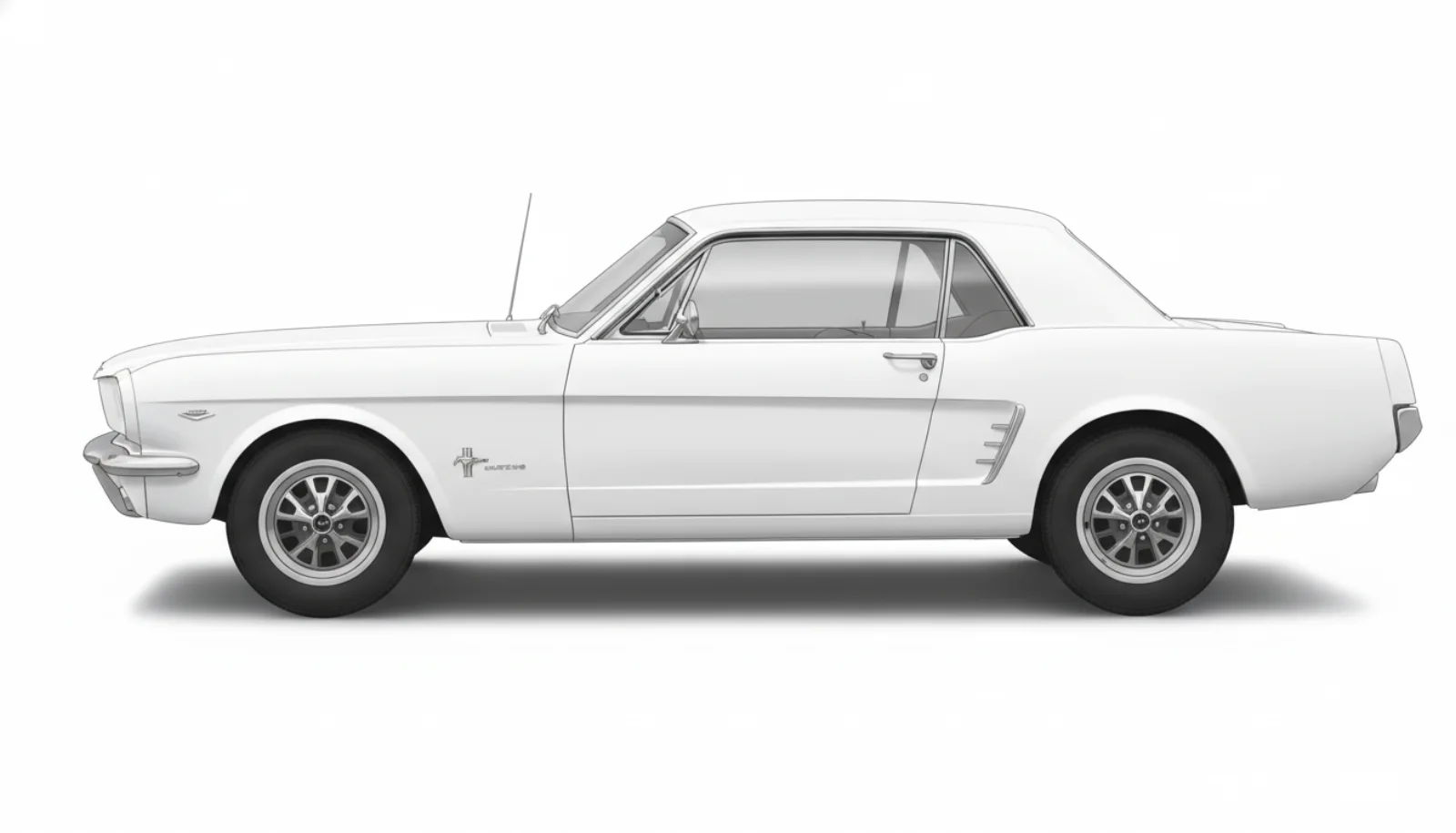
Wimbledon White · M · 1964–1971
Screen approximation of the factory paint
Model year
Generation
1964½–1966
Built in 1964
Built in all, 1964–1973
Serial numbers, 1964
Serial number one5F08F100001 → …
Dearborn, consecutive unit numbers100001 → …
San Jose, consecutive unit numbers100001 → …
and 1 more rangesPrice new, 1964
$2,368
United States · base hardtop
Origin
United States
Front-engine, rear-wheel drive
Ford's compact four-seat sporty car, launched in April 1964 and built as a hardtop, fastback and convertible through four body revisions to 1973.
Pony car17 sources
How it launched in 1964
- 01Early run of the 1965 model year, known to enthusiasts as the 1964½: production began on 9 March 1964 and the car was shown to the public on 17 April 1964 at the New York World's Fair. Every car carries a 1965 VIN (first character 5).
- 02Hardtop and convertible only.
- 03Engines: 170 cu in six (U-code), 260 V8 (F-code), 289 four-barrel V8 (D-code, 210 hp) and the 271-hp 289 High Performance (K-code).
- 04Generator charging system; the front edge of the hood is not folded under as it is on later 1965 cars.
- 05Standard: three-speed floor shift, bucket seats, padded dash, full wheel covers, carpeting, heater and defroster. Base price $2,368.
- 06A convertible paced the 1964 Indianapolis 500.
1964½–1966, 1964–1966
The original body on a 108-inch wheelbase, 181.6 in long. Sold from April 1964 as a hardtop and convertible, with the 2+2 fastback added for the regular 1965 model year. VIN format: model-year digit, plant letter (F Dearborn, R San Jose, T Metuchen), body code (07 hardtop, 08 convertible, 09 fastback), engine letter, then a six-digit consecutive unit number starting at 100001. Cars built before the autumn of 1964 are all 1965 models by VIN.
Built, this generation 1,288,557
Body styles by year
Trim lines and engines, 1964
| Line | Power | Torque | 0–60 mph | Top speed | Weight |
|---|---|---|---|---|---|
170 cu in Thriftpower inline six, one-barrel | 101 hp | 156 lb-ft | — | — | 2,449 lb |
260 cu in small-block V8, two-barrel | 164 hp | 258 lb-ft | — | — | — |
289 cu in small-block V8, four-barrel | 210 hp | 300 lb-ft | — | — | — |
289 cu in small-block V8, four-barrel, solid lifters | 271 hp | 312 lb-ft | 7.6 s | — | — |
170 Six (U-code, early 1965 run)
1964
- Engine
- 170 cu in Thriftpower inline six, one-barrel
- Displacement
- 2,786 cc
- Layout
- I6 · naturally aspirated · RWD
- Power
- 101 hp (SAE gross)
- Torque
- 156 lb-ft
- 0–60 mph
- Not documented
- Top speed
- Not documented
- Weight
- 2,449 lb
- Gearboxes
- 3-speed manual; 4-speed manual; 3-speed Cruise-O-Matic automatic
- Length × width × height
- 181.6 × 68.2 × 51.2 in
- Wheelbase
- 108 in
- Body styles
- Hardtop (body 65A/B/C), Convertible (body 76A/B/C)
- Price new
- $2,368 (1964, United States)
- Built
- Not documented
What this line added
- Three-speed manual with floor shift
- Front bucket seats, full carpeting, padded instrument panel
- Full wheel covers
- Heater and defroster
- 13-inch wheels
- Generator charging system
Factory colors, 1964
19 of 124 documented colors were offered this year. Pick one to repaint the page.
Interiors, 1964
Units built by year
Hardtop (body 65A/B/C), 1964
Convertible (body 76A/B/C), 1964
Left- and right-hand drive
The split is not documented.
No left/right-hand-drive production split was found. Ford built the car as left-hand drive; Wikipedia has a section on 1966 right-hand-drive Mustangs that was not researched for this dossier.
Figure published by Classic & Sports Car for 1964–73. The model-year figures in this dossier add up to 2,978,271; the difference is not explained by the sources consulted (see research notes).
Price when new
Lowest list price each year in United States, in USD of the day. Not adjusted for inflation.
Serial number ranges
| Series | Drive | Years | From | To |
|---|---|---|---|---|
| Serial number onePre-production convertible sold on 14 April 1964 at George Parsons Ford, St. John's, Newfoundland. | — | 1964 | 5F08F100001 | … |
| Dearborn, consecutive unit numbersPlant code F. Consecutive unit numbers restart at 100001 at each plant every model year; example VIN 5F07F100001. The last number used is not documented. | — | 1964–1966 | 100001 | … |
| San Jose, consecutive unit numbersPlant code R. Consecutive unit numbers restart at 100001 at each plant every model year; example VIN 6R07C100001. The last number used is not documented. | — | 1964–1966 | 100001 | … |
| Metuchen, consecutive unit numbersPlant code T. Consecutive unit numbers restart at 100001 at each plant every model year; example VIN 5T07F100001. The last number used is not documented. | — | 1964–1966 | 100001 | … |
| Dearborn, consecutive unit numbersPlant code F. Consecutive unit numbers restart at 100001 at each plant every model year; example VIN 7F01C100001. The last number used is not documented. | — | 1967–1968 | 100001 | … |
| San Jose, consecutive unit numbersPlant code R. Consecutive unit numbers restart at 100001 at each plant every model year; example VIN 8R01J100001. The last number used is not documented. | — | 1967–1968 | 100001 | … |
| Metuchen, consecutive unit numbersPlant code T. Consecutive unit numbers restart at 100001 at each plant every model year; example VIN 8T03R100001. The last number used is not documented. | — | 1967–1968 | 100001 | … |
| Dearborn, consecutive unit numbersPlant code F. Consecutive unit numbers restart at 100001 at each plant every model year; example VIN 9F02Z100001. The last number used is not documented. | — | 1969–1970 | 100001 | … |
| San Jose, consecutive unit numbersPlant code R. Consecutive unit numbers restart at 100001 at each plant every model year; example VIN 9R02M100001. The last number used is not documented. | — | 1969–1970 | 100001 | … |
| Metuchen, consecutive unit numbersPlant code T. Consecutive unit numbers restart at 100001 at each plant every model year; example VIN 0T05M100001. The last number used is not documented. | — | 1969–1970 | 100001 | … |
| Dearborn, consecutive unit numbersPlant code F. Consecutive unit numbers restart at 100001 at each plant every model year; example VIN 2F05Q100001. The last number used is not documented. At each plant the sequence was shared with the other Ford car lines built there, so Mustang numbers are not contiguous. | — | 1971–1973 | 100001 | … |
| Metuchen, consecutive unit numbersPlant code T. Consecutive unit numbers restart at 100001 at each plant every model year; example VIN 1T02M100001. The last number used is not documented. At each plant the sequence was shared with the other Ford car lines built there, so Mustang numbers are not contiguous. | — | 1971 | 100001 | … |
The car
The Mustang went on sale on 17 April 1964 as a hardtop and a convertible built on Falcon running gear, with a base price of $2,368 and an option list long enough to make it an economy car, a small luxury car or a performance car. A 2+2 fastback joined for the regular 1965 model year. Ford built 121,538 in the short first run and 559,451 in the 1965 model year proper, and passed one million during 1966.
The first generation ran through four bodies. The 1964½–66 original was followed by a wider 1967–68 car that could take big-block engines, a longer 1969–70 car that introduced the SportsRoof name and the Mach 1, Grandé and Boss models, and a larger 1971–73 car on a 109-inch wheelbase. Engines ran from a 101-hp six to the 375-hp Boss 429; from 1972 the ratings are SAE net and the largest engine is a 351.
Model-year production fell from 607,568 in 1966 to 125,093 in 1972 before a small recovery in the final year. This dossier treats Shelby-built cars as a separate subject and mentions them only in passing.
- Class
- Pony car
- Layout
- Front-engine, rear-wheel drive
- Origin
- United States
- Designers
- Joe Oros (design chief), L. David Ash, Gale Halderman, Lee Iacocca (programme champion), Donald N. Frey (chief engineer)
- Also known as
- 1964½ Mustang, Ford T5 (Germany), Mustang 2+2, Mustang SportsRoof
- In production
- 1964–1973
Milestones
- 1964
Production begins on 9 March; press preview on 14 April and public launch on 17 April at the New York World's Fair. More than 22,000 orders are taken on the first day.
- 1964
A Mustang convertible paces the Indianapolis 500; the design receives the Tiffany Award for Excellence in American Design.
- 1964
Regular 1965 model year begins on 1 October with the 2+2 fastback added.
- 1965
GT Equipment Group and the Shelby GT350 introduced.
- 1966
Production passes one million; the 1966 model year total of 607,568 is the highest of the generation.
- 1967
First reskin and first big-block engine, the 390.
- 1968
428 Cobra Jet released on 1 April.
- 1969
Mach 1, Grandé, Boss 302 and Boss 429 added on a restyled body.
- 1971
Larger body on a 109-inch wheelbase; Boss 351 built for one year.
- 1972
Power ratings change from SAE gross to SAE net.
- 1973
First-generation production ends in June; the convertible does not return until 1983.
Pictures
Illustrations are generated from period references and shown in the selected factory color; they are not photographs.
Where it was built
United States · 1964–1973
Dearborn Assembly (Rouge complex)
Dearborn, Michigan
The factory, what else it built →
United States · 1964–1970
San Jose Assembly
Milpitas, California
United States · 1964–1971
Metuchen Assembly
Edison, New Jersey
Where the cars went
No country-by-country split of where these cars were delivered is documented in the sources we could find. We do not apportion the total ourselves.
Against its rivals
Same class, same years. Each rival is shown in the specification and year a buyer would have cross-shopped.
Longer is better. Figures are for the variant and year named under each car, from the sources listed below.
In the comparison
Plymouth Barracuda (273 V8) · 1964 · United States
The Valiant-based fastback that reached showrooms about two weeks before the Mustang; units are the short 1964 model year.
Chevrolet Camaro (230 six, base) · 1967 · United States
General Motors' direct answer, new for 1967; units are 1967 model-year production.
Pontiac Firebird (230 OHC six, base) · 1967 · United States
Pontiac's version of the Camaro platform, launched in February 1967; units are 1967 model-year production.
Mercury Cougar (289 two-barrel) · 1967 · United States
The Mustang's more expensive sister car, V8-only, and its closest rival on sales in 1967; units are 1967 model-year production.
AMC Javelin (232 six, base) · 1968 · United States
American Motors' entry in the class from the 1968 model year; units are 1968 model-year production.
Factory options
| Option | Code | Years | Price | Built with it |
|---|---|---|---|---|
| GT Equipment GroupPrice fell to $152.20 for 1966–67 and $146.71 for 1968–69. 5,396 sold for 1969, the only year with a documented count. | — | 1965–1969 | $165.03 | — |
| Interior Decor Group ("pony" interior)Embossed seat backs, woodgrain trim, pistol-grip door handles, five-dial cluster. $94.13 for 1966 (Over-Drive). | — | 1965–1966 | $107.08 | — |
| 289 High Performance V8 (K-code)Price is over the base V8 on a car without the GT group; $276.34 with it. 6,996 cars in the 1965 model year. | — | 1964–1967 | $327.92 | 6,996 |
| Cruise-O-Matic automatic, six-cylinder | — | 1965–1966 | $175.8 | — |
| Cruise-O-Matic automatic, V8 | — | 1965–1966 | $185.39 | — |
| Four-speed manual, six-cylinder | — | 1965–1966 | $113.45 | — |
| Four-speed manual, V8 | — | 1965–1966 | $184.02 | — |
| Front disc brakes (manual)V8 cars only. | — | 1965–1966 | $56.77 | — |
| Power brakes | — | 1965–1966 | $42.29 | — |
| Power steering | — | 1965–1968 | $84.47 | — |
| Power convertible top | — | 1965–1969 | $52.95 | — |
| Limited-slip differential | — | 1965–1969 | $41.6 | — |
| Special Handling PackageStiffer springs, larger shock absorbers, 22:1 steering and a larger front stabiliser bar; with the 200- and 225-hp V8s. | — | 1965–1966 | $30.64 | — |
| Rally-Pac clock and tachometerMounted on the steering column. | — | 1964–1966 | $69.3 | — |
| Styled steel wheels, 14-inch$93.84 for 1966 (Over-Drive). | — | 1965–1966 | $119.71 | — |
| Air conditioner$310.90 for 1966 (Over-Drive). | — | 1965–1966 | $277.2 | — |
| Full-length console | — | 1965–1966 | $50.41 | — |
| Vinyl roof (hardtop) | — | 1965–1968 | $74.19 | — |
| Full-width front seat with centre armrestHardtop and convertible only. 14,905 hardtops and 2,111 convertibles for 1965; 21,397 and 3,190 for 1966. | — | 1965–1966 | $24.42 | — |
| Push-button AM radio with antenna | — | 1965–1967 | $57.51 | — |
| Deluxe (woodgrain) steering wheel | — | 1965–1967 | $31.52 | — |
| Visibility GroupRemote-control mirror, day/night mirror, two-speed wipers and washers. | — | 1965–1966 | $35.83 | — |
| Stereo tape playerAM radio required. | — | 1966–1967 | $128.49 | — |
| 390 cu in 320-hp V8 | — | 1967 | $363.71 | — |
| Select-Aire air conditioning | — | 1967 | $356.09 | — |
| Power front disc brakes | — | 1967–1969 | $64.77 | — |
| Tilt-away steering wheel | — | 1967 | $59.93 | — |
| "Sport Deck" folding rear seat (fastback) | — | 1967–1968 | $64.77 | — |
| Fingertip speed controlV8 and Cruise-O-Matic required. | — | 1967 | $71.3 | — |
| Competition Handling PackageGT group required. | — | 1967 | $388.53 | — |
| Push-button AM/FM radio | — | 1967 | $133.65 | — |
| Convenience Control Panel | — | 1967 | $39.5 | — |
| Wide-oval sports tyres | — | 1967 | $62.35 | — |
| 250 cu in six | — | 1969–1970 | $25.91 | — |
| 351 cu in two-barrel V8 | — | 1969 | $163.97 | — |
| 351 cu in four-barrel V8 | — | 1969 | $189.85 | — |
| 428 Cobra Jet V8 | — | 1969 | $287.53 | — |
| 428 Cobra Jet Ram Air V8 | — | 1969 | $420.96 | — |
| Shaker hood scoop351 and 390 engines. | — | 1969 | $84.25 | — |
| Traction-Lok differential | — | 1969 | $63.51 | — |
| Sport slats for rear window | — | 1969 | $128.28 | — |
| Adjustable rear spoiler | — | 1969 | $19.48 | — |
| Chrome styled steel wheels | — | 1969 | $116.59 | — |
| High-back bucket seats | — | 1969 | $84.25 | — |
| Select-Aire air conditioner | — | 1969 | $379.57 | — |
| TachometerV8 cars only. | — | 1968–1969 | $54.45 | — |
| Sprint decor packageWhite with blue and red trim and USA shield decals. Package A 7,470 cars, Package B 1,913; 6,247 hardtops, 3,086 SportsRoofs and 50 convertibles. | — | 1972 | — | 9,383 |
Known issues
Marginal drum brakes
1964–1973safetyThe standard four-wheel drum brakes are described as barely adequate even for gentle driving. Front discs were optional on V8 cars from 1965 and part of the GT group.
Fix Front disc conversion with a servo.
Structural rust in the unibody
1964–1973majorThe body and frame are one welded structure, so corrosion is the main concern. Documented areas are the floor pans, front and rear frame rails, the cowl below the windshield and its air vents, the base of the rear window, the lower doors, the trunk lid, the inner and outer sills, the front fenders, the area under the battery and the lower shock towers.
Fix Reproduction sheet metal exists for almost every panel; check that earlier repairs are welded steel and not filler or fibreglass patches.
Accident damage around the front suspension towers
1964–1973moderateRipples in the front frame rails where they meet the suspension towers indicate earlier accident damage; the same area also rusts.
Misrepresented performance models
1965–1973moderateBecause GT, Mach 1, Boss and Cobra Jet cars are worth far more than standard ones, many ordinary Mustangs have been rebuilt as replicas. The VIN and door data plate record the original body, engine, colour and trim.
Fix Decode the VIN and data plate before buying, and have a specialist inspect high-value cars.
Heavy, vague steering without power assistance
1964–1973minorUnassisted recirculating-ball steering is heavy and imprecise, more so on wider modern tyres. Squeaks from the front suspension usually point to worn upper ball joints.
Fix Power steering was a factory option; replace worn joints and bushings.
Overheating
1964–1973minorOverheating is a common complaint on surviving cars and can mask a failed head gasket; it is normally cured by a new radiator.
Fix Replace the radiator and check for signs of head-gasket failure.
How it was advertised
The Mustang's launch was one of the most heavily orchestrated in American car advertising. Ford's agency, J. Walter Thompson, had helped pick the name from a search of animal names for its associations with open country and the West. Henry Ford II unveiled the car at the Ford pavilion of the New York World's Fair on 17 April 1964; the night before, Ford bought nine minutes of commercial time in the 9:30–10:00 pm slot on all three networks (CBS's Perry Mason, NBC's Hazel and ABC's The Jimmy Dean Show), reaching close to thirty million homes for about $500,000. On launch day announcement ads ran in some 2,600 newspapers, Time and Newsweek both put Lee Iacocca and the car on their covers, and full-colour magazine ads led with the $2,368 base price, the Tiffany award for design, and the idea that the buyer would design his or her own car from the option list.
Through 1965–1967 the magazine campaign kept a light, comic tone: the "Mustangers always win" stories of hapless people transformed by the car, ads aimed squarely at women ("Six and the single girl", the "Mustang pledge") and at older men, and spreads celebrating a million Mustangs in two years. Ford-built-means-better-built and Total Performance tags ran along the bottom. From 1969 the advertising turned to performance: the Mach 1, Boss 302 and Boss 429 were sold through racing imagery, and Shelby ran its own GT350 and GT500 ads. The car was also promoted heavily on television throughout, but individual later spots were not documented here.
Where it ran: 8 documented placements
More advertisements, viewable at their source (13)
These are still under copyright, so we describe them and link to where they can be seen rather than reproduce them.
- 1964Presenting the unexpected... new Ford Mustang! $2368 f.o.b. Detroitmagazine · Automotive History Preservation Society ↗Two-page launch spread: a blue hardtop with a white vinyl roof in profile, a couple in evening dress behind it, and an inset of a red convertible. The copy leads with the price and the Tiffany design award, then the long option list and a plug for the Ford pavilion at the World's Fair.
- 1964New Ford Mustang $2368 f.o.b. Detroitmagazine · Look · 1964-06-02 · Automotive History Preservation Society ↗Agency proof of a single-page ad: a white hardtop, with a woman at the wheel, set over a blurred red and blue band. The copy repeats the price and Tiffany award and invites readers to design their own Mustang, with an offer of a scale model by mail.
- 1964Mustang—exciting new car from Ford Motor Company... show stopper at the World's Fairmagazine · Automotive History Preservation Society ↗Spread with a white hardtop under the flags at the New York World's Fair, admiring visitors around it, signed off with the corporate line that Ford-built means better built.
- 1965Bernard was a born losermagazine · Automotive History Preservation Society ↗From the "Mustangers always win" series: a blue convertible above the lights of San Francisco and a gambler in a bow tie. A comic story of a hopeless loser whose luck turns once he picks the sporty options (V8, four-speed, front discs).
- 1966Six and the single girlmagazine · Automotive History Preservation Society ↗A young woman sits on the hood of a green hardtop ringed with flowers. The ad pitches the six-cylinder Mustang to single women on economy and practicality, playing on the title of Helen Gurley Brown's bestseller.
- 1966Should a man in his 50's be allowed out in a Mustang?magazine · Automotive History Preservation Society ↗A grey-haired businessman peers over his glasses above a blue 1966 hardtop with him grinning at the wheel; the copy jokes that the car is a fountain of youth while listing standard and optional equipment.
- 1966One million Mustangs in two years!magazine · Automotive History Preservation Society ↗Two-page spread marking the millionth Mustang: a red hardtop leads a row of cars across open country while a stampede of wild horses rises out of the sky behind them.
- 1967Take the Mustang pledge!magazine · Automotive History Preservation Society ↗A young woman raises her hand to swear an oath beneath a blue 1967 hardtop, flanked by two tongue-in-cheek lists of what a Mustang owner will and won't do, each line slipping in a feature such as the tilt-away wheel or stereo tape player.
- 1969If you haven't got a past yet... get a Mach 1. Now.magazine · Automotive History Preservation Society ↗A red Mach 1 SportsRoof in profile on a sunset-lit runway, a young couple leaning on its roof; almost no copy, the car and the line carrying the ad.
- 1969Nearest thing to a Trans-Am Mustang that you can bolt a license plate onto. Boss 302magazine · Automotive History Preservation Society ↗Spread with a Trans-Am racing Mustang at speed above a yellow Boss 302 with rear window slats and spoiler; the copy explains the homologation special's engine and handling parts and points buyers to the Ford dealer's performance corner.
- 1971Three kinds of car, from three different continents.magazine · Internet Archive (Car Brochures & Adverts collection) ↗Australian Ford ad lining up an Australian Fairmont wagon, a European Ford 20M and an American Mustang hardtop in a field, each with a short paragraph; the Mustang is offered as the powerful, luxurious American choice.
- 1971Sporty, personal Mustang '72 ...better ideas from Fordbrochure · 1971-08 · Internet Archive (Car Brochures & Adverts collection) ↗US brochure for the 1972 range with a cover of the grille and running-horse badge of a red Mustang, its lights streaked into bursts of orange and pink.
- 19721973 Ford Mustang brochurebrochure · Internet Archive (Car Brochures & Adverts collection) ↗US sales brochure for the 1973 Mustang, the last year of the first generation.
No first-generation Mustang advertisement with a public-domain or open licence was found on Wikimedia Commons; all entries are link-only. J. Walter Thompson's role is documented for the naming and as Ford's agency at the time; the ads themselves carry no agency credit, so the agency field on each ad is an attribution to Ford's agency of record, not a printed credit. The number of launch-day newspapers is given as about 2,600 by The Henry Ford and EBSCO; one other source says 2,900. The EBSCO summary also wrongly places the unveiling in Detroit; the New York World's Fair location is used. No 1970–1973 US magazine ads for the Mustang were found in the AHPS library or the Internet Archive collections checked; the late years are represented only by brochures and a 1971 Australian ad. This is a gap, not an absence of advertising. The 1973 brochure was not opened beyond its listing. The Look ad's issue date (2 June 1964) and circulation are printed on the agency proof itself. Internet Archive items are collectors' group uploads with no licence statement and are link-only; dates are as given in their titles. The 1973 brochure's print date is not given, so year 1972 (the usual autumn release) is an assumption.
Sources
- 1Mustang Timeline, 1964½–1973 (per-year pages: engines, prices, production, colours, VIN) — The Mustang Source reference
- 2Ford Mustang library pages, 1964–1970 (prices, shipping weights, production, option prices) — OldRide reference
- 3Ford Mustang fact sheets, 1964½–1973 — Over-Drive Magazine reference
- 4Ford Mustang paint code charts, 1964–1973 — PaintRef.com reference
- 51971, 1972 and 1973 Mustang general information (production by body code, data plate decoder, trim codes) — 7173Mustangs.com club
- 6Ford Mustang (first generation) — Wikipedia reference
- 7Boss 302 Mustang — Wikipedia reference
- 8Boss 429 Mustang — Wikipedia reference
- 9Ford Mustang Mach 1 — Wikipedia reference
- 10The 1965 Ford Mustang is still America's most popular classic car — Hagerty reference
- 11Your handy 1965–66 Ford Mustang buyer's guide — Hagerty reference
- 12Buyer's guide: Ford Mustang — Classic & Sports Car reference
- 13Plymouth Barracuda — Wikipedia reference
- 14Chevrolet Camaro (first generation) — Wikipedia reference
- 15Pontiac Firebird (first generation) — Wikipedia reference
- 16Mercury Cougar — Wikipedia reference
- 17AMC Javelin — Wikipedia reference
Research notes: what is not documented, and where sources disagree (22)
- No Ford production report, Marti Auto Works data or marque registry was opened. Figures come from enthusiast and reference sites; three that would have been useful (Mustang Attitude, CJ Pony Parts and the Mustang Specs tables) blocked automated access or sit behind a member wall.
- The dossier is split into four "generations" that are really the four body series of the first-generation car (1964½–66, 1967–68, 1969–70, 1971–73). The 1964 model-year entry is the early ("1964½") run; those cars are 1965 models by VIN.
- Early-run (1964½) production: The Mustang Source gives 121,538 (92,705 hardtops, 28,833 convertibles), and Hagerty's 680,989 for the whole extended 1965 model year equals 121,538 + 559,451. OldRide, the Over-Drive fact sheet and Wikipedia's Barracuda article give 126,538 (97,705 hardtops). 121,538 is used.
- Total production: Classic & Sports Car publishes 2,989,645 for 1964–73. The model-year figures used here sum to 2,978,271. The 11,374 difference was not resolved; it is not explained by the 121,538/126,538 conflict alone.
- 1968: 317,404 is the sum of all body codes on The Mustang Source; OldRide and Over-Drive give 317,148, which omits the 256 deluxe bench-seat fastbacks.
- 1969 hardtop: 128,458 including 504 deluxe bench-seat cars (The Mustang Source); OldRide prints 127,954, which leaves them out. Boss 429 for 1969: 859 (Wikipedia, Over-Drive) against 867 (The Mustang Source).
- 1970: body-style counts sum to 190,727. The Mustang Source lists the Boss 302 (7,013) and Boss 429 (499) as separate lines and prints a total of 191,239, which does not match either reading; whether its SportsRoof figure of 45,934 includes the Boss cars could not be established. Boss 302 for 1970 is 7,013 on The Mustang Source and Wikipedia but 6,318 on OldRide and Over-Drive.
- 1971: 149,678 (7173Mustangs wiki) is used; The Mustang Source adds the 1,806 Boss 351s on top for 151,484.
- 1972: the 7173Mustangs wiki total of 125,093 only adds up with 6,401 convertibles (the figure Over-Drive gives); the wiki table itself and The Mustang Source print 6,121, which is the 1971 convertible figure. The Mustang Source also prints 16,622 SportsRoofs against the wiki's 15,622. 6,401 and 15,622 are used.
- 1973: 134,867 with 51,480 hardtops (7173Mustangs wiki). The Mustang Source prints 51,430 and 134,817; Over-Drive gives 35,490 Mach 1s against 35,440 elsewhere.
- Body-style and series unit totals, and multi-year variant totals (Grandé, Mach 1, Boss 302, Boss 429), are sums of the per-year figures above. In 1969–73 the hardtop total includes the Grandé and the SportsRoof total includes the Mach 1.
- Base prices for 1964–1970 are the factory prices on OldRide. The Mustang Source prints lower figures for some years (1964½ and 1965: $2,320 hardtop, $2,557 convertible, $2,533 fastback; 1967: $2,692 fastback, $2,898 convertible; 1968: $2,578 hardtop, $2,689 fastback). Prices for 1971–1973 come from The Mustang Source alone and should be checked. Boss 429 prices are inconsistent: Over-Drive prints both $4,798 and $4,868 for 1969 and $4,087 for 1970, The Mustang Source $4,928 for 1970.
- Weights: where given, variant weight is the OldRide shipping weight of the hardtop (or the named model) in the first year of the span; for 1971 the Boss 351, Mach 1 and Grandé figures are from Over-Drive, whose basis is not stated. Over-Drive prints much higher weights than OldRide for 1968–70 (for example 3,205 lb against 2,690 lb for the 1969 hardtop), so the two are not on the same basis.
- Engine ratings follow the Wikipedia engine tables and The Mustang Source. Conflicts: 170 six 101 hp (The Mustang Source, Classic & Sports Car) or 105 hp (Wikipedia); 1969–70 302 two-barrel 220 or 210 hp; 1971 351 Cobra Jet 280 or 285 hp; 1972–73 net figures differ by one to three horsepower between sources.
- Performance: only two 0–60 figures were found with any attribution (K-code and 1970 Boss 302). All other variants are null, as are all top speeds.
- Serial numbers: each assembly plant restarted its consecutive unit numbers at 100001 every model year. The 7173Mustangs wiki states that in 1971–73 the sequence was shared with the other Ford lines built at the plant. No source gives the last number used in any year, so every range ends in null. Plant years follow The Mustang Source (San Jose to 1970, Metuchen to 1971, Dearborn throughout); the 7173Mustangs decoder still lists San Jose for 1971.
- Colours: codes and names come from the PaintRef charts for each year and were cross-checked against the colour names listed by The Mustang Source. 1964½–1966 agree closely; differences are noted on the colour concerned (The Mustang Source also lists Midnight Turquoise and Sunlight Yellow for 1965 and several named 1966 colours that PaintRef does not carry). For 1967–1973 the list is the PaintRef chart restricted to colours with a regular one- or two-character code; uncoded special-order, promotional and regional colours are left out, and the PaintRef charts for 1969 and 1970 appear to mix some colours between the two years. Treat 1967–1973 as a starting list, not a complete one.
- No per-colour production counts were found for any year; all colour units are null. Hex values and the solid/metallic label are screen approximations made for this dossier.
- Interiors are documented only for 1971–1973 (7173Mustangs trim-code tables). Trim codes and colours for 1964½–1970 were not researched.
- Options: prices are from the OldRide and Over-Drive lists; year spans show the years for which a price list including the option was read, not the full life of the option. Units with each option are not documented apart from the K-code engine in 1965, the GT in 1969 and the 1972 Sprint package.
- No per-country delivery figures and no left/right-hand-drive split were found; markets is empty. Overseas assembly from kits (listed by Wikipedia for several countries) was not researched.
- Rival figures are from Wikipedia; unit figures are single model-year production as stated on each rival.
17 sources. Paint swatches are screen approximations of the factory colors.