Model year
Generation
LP400
Built in 1974
Built in all, 1974–1990
Serial numbers, 1974
LP400 (prototype 1120001, production cars from 1120002)1120001 → 1120300
Price new, 1974
Not documented
Origin
Italy
Rear mid-engine (longitudinal, gearbox ahead of the engine), rear-wheel drive
Mid-engined V12 two-seater styled by Marcello Gandini and built at Sant'Agata Bolognese in five main versions from 1974 to 1990.
Supercar38 sources
How it launched in 1974
- 01Production-specification car (chassis 1120002, Giallo Fly) shown at the Geneva Motor Show in March 1974; Lamborghini dates the start of series production to the same month.
- 02First car dispatched in April 1974 to the Milan dealer Achilli Motors.
- 03Launch specification: 3,929 cc V12 with a claimed 375 bhp, five-speed gearbox, Marchesi spaceframe, aluminium body, 14-inch magnesium wheels, Stewart-Warner instruments.
- 04First right-hand-drive car, chassis 1120026, dispatched on 14 October 1974 to the UK agent for the London Motor Show.
LP400, 1974–1977
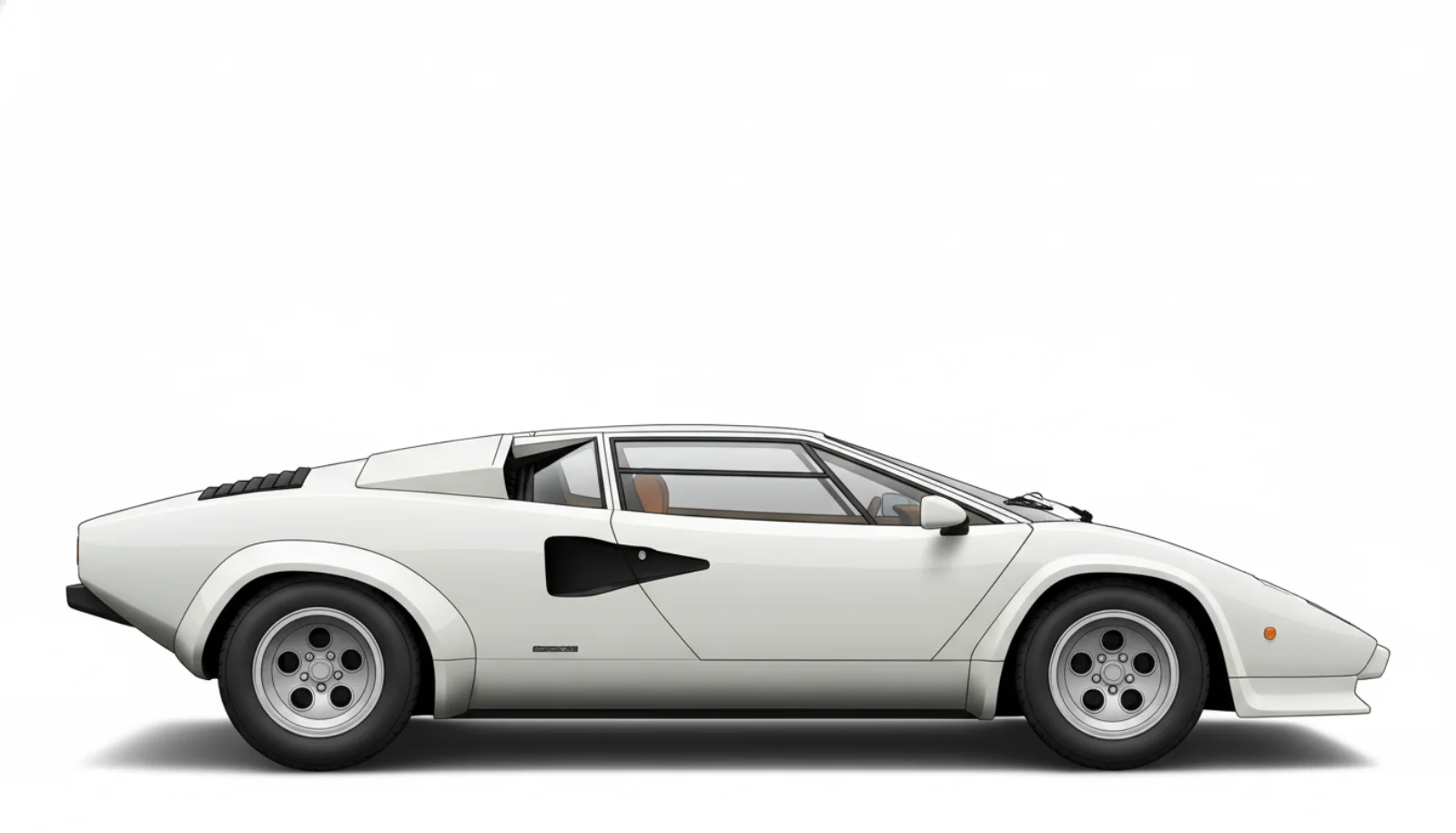
The original narrow-bodied car, without wheel-arch extensions or spoilers, on 14-inch Campagnolo magnesium wheels and Michelin XWX tyres. The roof has a central recess left over from the prototype's periscope mirror, which gives the car its 'Periscopio' nickname. Four-litre V12 with six sidedraught Weber 45 DCOE carburettors.
Built, this generation 150
Body styles by year
Trim lines and engines, 1974
| Line | Power | Torque | 0–60 mph | Top speed | Weight |
|---|---|---|---|---|---|
3.9 L Tipo L406 60° V12, twin overhead camshafts per bank, six Weber 45 DCOE twin-choke carburettors, 10.5:1 compression | 375 hp | 266 lb-ft | 5.6 s | 180 mph | 2,860 lb |
LP400
1974–1977
- Engine
- 3.9 L Tipo L406 60° V12, twin overhead camshafts per bank, six Weber 45 DCOE twin-choke carburettors, 10.5:1 compression
- Displacement
- 3,929 cc
- Layout
- V12 · naturally aspirated · RWD
- Power
- 375 hp (Factory claim, 375 bhp at 8,000 rpm, as listed by the International Lamborghini Registry)
- Torque
- 266 lb-ft
- 0–60 mph
- 5.6 s — Motor, 1975, as tabulated by AutoZine; Road & Track recorded 6.8 s in 1976
- Top speed
- 180 mph
- Weight
- 2,860 lb
- Gearboxes
- 5-speed manual
- Length × width × height
- 163 × 74.4 × 42.1 in
- Wheelbase
- 96.5 in
- Body styles
- Coupé
- Price new
- L. 19,500,000 (1976, Italy)
- Built
- 150
What this line added
- Aluminium body on a tubular steel spaceframe
- Campagnolo cast magnesium wheels, 7.5 x 14 front and 9.5 x 14 rear, Michelin XWX tyres
- Girling ventilated disc brakes
- Eight Stewart-Warner gauges in a suede-trimmed binnacle
- Leather upholstery; side windows that open only partly
Factory colors, 1974
2 of 7 documented colors were offered this year. Pick one to repaint the page.
Interiors, 1974
Units built by year
Left- and right-hand drive
The split is not documented.
No overall split is documented. Right-hand-drive counts found by version: LP400 around 17; LP400 S Series 3 15 of 82; 5000 S a believed 37; Quattrovalvole 17 with the late side skirts (earlier cars not counted); 25th Anniversary 67.
International Lamborghini Registry: 1,997 cars in all versions (LP400 150, LP400 S 237, LP500 S 321, 5000 QV 631, 25th Anniversary 658). Lamborghini's press material gives 1,999 (152, 235, 323, 631, 658).
Price when new
Lowest list price each year in Italy, in ITL of the day. Not adjusted for inflation.
Serial number ranges
| Series | Drive | Years | From | To |
|---|---|---|---|---|
| LP400 (prototype 1120001, production cars from 1120002)150 cars within a 300-number block. Chassis 1120001 is the 1973 Geneva prototype and 1120002 the first production-specification car. | — | 1974–1977 | 1120001 | 1120300 |
| LP400 S Series 150 cars. First chassis per Supercar Nostalgia, last per the International Lamborghini Registry. | — | 1978–1979 | 1121001 | 1121100 |
| LP400 S Series 2105 cars. | — | 1979–1981 | 1121102 | 1121310 |
| LP400 S Series 382 cars, of which 15 right-hand drive. | — | 1981–1982 | 1121312 | 1121468 |
| LP500 S / 5000 SFirst and last chassis as listed by Lambocars. | — | 1982–1985 | ZA9C00500CLA12472 | ZA9C00500ELA12795 |
| 5000 QuattrovalvoleFirst chassis as listed by Lambocars; the last Quattrovalvole chassis is not documented. FLA12803 was the first right-hand-drive car. | — | 1985–1988 | ZA9C00500FLA12798 | … |
| 25th Anniversary, last car built (retained by the factory)Single chassis, not a range: the first and last numbers of the Anniversary run are not documented. Other documented Anniversary chassis include KLA12670, KLA12717 and KLA12960. | — | 1990 | KLA12085 | KLA12085 |
The car
The Countach began as the LP500 show car on the Bertone stand at Geneva on 11 March 1971. Three years of development turned it into the LP400: a welded round-tube spaceframe made by Marchesi in Modena, a hand-formed aluminium body built in Lamborghini's own works, and the 3,929 cc four-cam V12 mounted lengthways with the gearbox pointing forward between the seats. Series production started at Sant'Agata Bolognese in March 1974.
The car was then developed in steps. The LP400 S of 1978 added wheel-arch extensions, a chin spoiler and very wide Pirelli P7 tyres, and is divided by collectors into three series. The LP500 S (also badged 5000 S) of 1982 took the engine to 4,754 cc; the 5000 Quattrovalvole of 1985 went to 5,167 cc with four valves per cylinder and downdraught Weber carburettors, with a Bosch fuel-injected version for the United States. The 25th Anniversary of 1988, restyled by Horacio Pagani, was the final and most numerous version.
Factory record-keeping was poor and the totals differ by source. The International Lamborghini Registry counts 1,997 cars; Lamborghini's own press material gives 1,999. More than half of all Countachs were Quattrovalvole or Anniversary cars built in the last five years.
Published performance varies widely with the source. The figures in this dossier name who measured them; the factory's claimed top speeds were not matched in independent period tests.
- Class
- Supercar
- Layout
- Rear mid-engine (longitudinal, gearbox ahead of the engine), rear-wheel drive
- Origin
- Italy
- Designers
- Marcello Gandini (Bertone), Paolo Stanzani (chief engineer), Horacio Pagani (25th Anniversary restyle)
- Also known as
- Countach LP400, Countach LP400 S, Countach LP500 S, Countach 5000 S, Countach 5000 Quattrovalvole, Countach 25th Anniversary, Countach 25° Anniversario
- In production
- 1974–1990
Milestones
- 1971
LP500 prototype shown at the Geneva Motor Show on 11 March.
- 1973
LP400 prototype, chassis 1120001, shown in red at Geneva and repainted green for the Paris show.
- 1974
Production LP400 shown at Geneva in March; series production starts and the first car is dispatched in April.
- 1978
LP400 S introduced at Geneva.
- 1980
The Mimran group takes control of Automobili Lamborghini in July.
- 1982
LP500 S with the 4,754 cc engine introduced at Geneva.
- 1985
5000 Quattrovalvole with the 5,167 cc four-valve engine introduced at Geneva.
- 1987
Chrysler buys Automobili Lamborghini on 24 April; the one-off composite Countach Evoluzione is built.
- 1988
25th Anniversary introduced in September.
- 1990
Last Countach completed on 4 July and retained by the factory; the Diablo replaces it.
Pictures
Illustrations are generated from period references and shown in the selected factory color; they are not photographs.
Where it was built
Where the cars went
No country-by-country split of where these cars were delivered is documented in the sources we could find. We do not apportion the total ourselves.
Against its rivals
Same class, same years. Each rival is shown in the specification and year a buyer would have cross-shopped.
Longer is better. Figures are for the variant and year named under each car, from the sources listed below.
In the comparison
Ferrari 365 GT4 BB · 1974 · Italy
Maranello's mid-engined twelve-cylinder flagship, launched within months of the LP400.
Maserati Bora 4.9 · 1976 · Italy
The third Italian mid-engined supercar of the 1970s, with a V8 and a more comfortable cabin.
Ferrari 512 BB · 1978 · Italy
The five-litre Boxer was the direct alternative to the LP400 S.
Porsche 911 Turbo 3.3 (930) · 1978 · Germany
Comparable straight-line pace for far less money, and usable every day.
Ferrari Testarossa · 1985 · Italy
The Quattrovalvole's contemporary and main showroom rival through the second half of the 1980s.
Factory options
| Option | Code | Years | Price | Built with it |
|---|---|---|---|---|
| Rear wingOffered from the LP400 S onwards, first on two vertical supports and later with endplates. Lambocars puts it at about US$5,000 in the Quattrovalvole years. Period tests show it cost top speed: Motor recorded 155 mph with the wing on a 1984 LP500 S. | — | 1978–1990 | — | — |
| Wheel colour: gold or silverWheels could be ordered in gold instead of silver. | — | 1978–1988 | — | — |
| Sports exhaustListed as an option on the 5000 S, Quattrovalvole and 25th Anniversary. | — | 1982–1990 | — | — |
| Audio systemA choice of audio systems on the 5000 S and Quattrovalvole; Alpine on the 25th Anniversary. | — | 1982–1990 | — | — |
| Sport seats25th Anniversary: fixed-back, manually adjusted seats giving more headroom than the standard electric seats. | — | 1988–1990 | — | — |
| Contrast seat piping25th Anniversary, available only with the electric seats. | — | 1988–1990 | — | — |
| Out-of-range paint and interior coloursAlmost any paint and trim combination could be ordered. | — | 1978–1990 | — | — |
Known issues
Spaceframe corrosion
1974–1990majorThe tubular steel chassis corrodes in places that are hard to see and hard to repair: around the rear suspension and driveshafts, the spare wheel well and the headlamp pods.
Fix Inspect on a lift with panels and undertrays off; repairs need a specialist who can let in new tube.
Accident repairs are difficult
1974–1990majorBody panels were hand-formed and differ from car to car, so crash damage is hard to put right properly. Poor panel fit and alignment point to past repairs.
Fix Check alignment and panel gaps carefully and ask for a documented history.
Reaction between steel frame and aluminium panels
1974–1990moderateElectrolytic corrosion can develop where the aluminium body panels meet the steel structure.
Suspension bush wear
1974–1990moderateThe many suspension bushes and joints wear and leave the handling vague.
Fix Renew bushes and joints and have the geometry reset.
Labour-heavy engine maintenance
1974–1990moderateThe V12 and gearbox are regarded as strong when maintained, but access is poor: even a valve clearance check means removing the six Weber carburettors. Misfires, usually traced to electrics or ignition, and fluid leaks are warning signs. Routine upkeep can reach five figures.
Fix Specialist servicing with records; cars that are used regularly tend to be more reliable.
Weak air conditioning and cabin heat
1974–1990minorThe air conditioning struggles in hot climates and the large windscreen lets in a lot of heat. The 25th Anniversary received a more powerful system.
Heavy controls and poor rear visibility
1974–1990minorThe clutch is heavy, there is no power steering and the wide rear tyres of the S and later cars make parking effort high. Rearward visibility is poor and worse on the Quattrovalvole with its raised engine cover.
How it was advertised
The Countach was hardly advertised in the conventional sense. It was launched as the LP500 prototype at the Geneva Motor Show in 1971, where it drew huge press coverage, and production LP400s were first offered at Geneva in 1974; later versions (the LP400 S in 1978 and the twin-turbo show car in 1984) were also introduced at Geneva. Lamborghini, a small and often financially troubled maker, relied on motor shows, the motoring press and its factory brochures, which presented the car in studio photographs against flat colour or, for the 1988 25th Anniversary model, in black and gold.
Much of the Countach's fame came from other people's media. In the United States, where it was sold first through the grey market and only from 1985 in factory federal form, it appeared in The Cannonball Run and served as the Monaco Grand Prix safety car from 1980 to 1983. Suppliers used it in their own advertising: in 1986 Pirelli ran a full-page ad showing a yellow Countach from directly overhead, calling it the world's fastest production car and and offering readers a three-by-two-foot poster of the photograph by mail. No Lamborghini agency, magazine campaign or television advertising for the Countach was found.
Where it ran: 3 documented placements
The advertisements

When it comes to original equipment tires on the world's fastest production car, there are simply no options.
1986 · Car and Driver · 1986-04 · United States
Pirelli tyre ad: a yellow Countach with rear wing photographed from directly above on a textured gold ground, the Pirelli logo across the wing. The small print lists the makes Pirelli supplied and offers a 3 by 2 foot poster of the photograph by mail.
More advertisements, viewable at their source (3)
These are still under copyright, so we describe them and link to where they can be seen rather than reproduce them.
- 1971LP500 prototype unveiled at Genevaother · Geneva Motor Show · Wikipedia ↗The car's public debut as the yellow LP500 prototype, which drew intense public and press interest three years before production began; the launch functioned in place of an advertising campaign.
- 1982Lamborghini Countach LP 500 S brochurebrochure · Internet Archive (Car Brochures & Adverts collection) ↗Factory brochure for the LP 500 S with a dead-on front view of a white Countach, red interior visible through the windscreen, against a flat blue backdrop under the gold Lamborghini script and bull.
- 1988Lamborghini Countach 25th Anniversary brochurebrochure · Internet Archive (Car Brochures & Adverts collection) ↗Brochure for the 25th Anniversary Countach marking the company's quarter-century, with a black cover, a gold laurel wreath around "25" and gold bands top and bottom carrying the Lamborghini name.
The Countach was barely advertised by Lamborghini; no factory magazine or newspaper advertisement was found in the AHPS library, Wikimedia Commons or the Internet Archive collections checked. This reflects the car, not only a gap in research, though Italian-press advertising was not searched because the web-search budget for this run was exhausted. The Pirelli ad is hosted on Commons as PD-US-1978-89 (published in the US without a copyright notice); the licence and credit are taken from the file page. It is a supplier's ad, not Lamborghini's. Brochure markets are given as IT (the factory) because the Internet Archive titles do not state a market; a second item for the 1988 brochure and an alternate 1982 catalogue exist but were not opened. No early LP400 (1974–1978) brochure or ad was found.
Sources
- 1Countach (all versions, production totals and dates) — International Lamborghini Registry registry
- 2Countach LP400 — International Lamborghini Registry registry
- 3Countach LP400 S (Series 1, 2 and 3) — International Lamborghini Registry registry
- 4Countach LP500S/LP5000S — International Lamborghini Registry registry
- 5Countach LP5000 QV — International Lamborghini Registry registry
- 6Countach 25th Anniversario — International Lamborghini Registry registry
- 71974–2024: 50 years since production of the first Lamborghini Countach (press release, read as reprinted by 2nd Opinion) — Automobili Lamborghini factory
- 8Celebrating the 50-year legacy of the Lamborghini Countach (Lamborghini text, as republished by the ClassicCars.com Journal) — Automobili Lamborghini factory
- 9Guide: Lamborghini Countach LP400 — Supercar Nostalgia reference
- 10Guide: Lamborghini Countach LP400 S — Supercar Nostalgia reference
- 11Guide: Lamborghini Countach 5000 S — Supercar Nostalgia reference
- 12Guide: Lamborghini Countach Quattrovalvole — Supercar Nostalgia reference
- 13Guide: Lamborghini Countach 25th Anniversary — Supercar Nostalgia reference
- 14VIN: Lamborghini Countach LP400 chassis 1120002 — Supercar Nostalgia reference
- 15VIN: Lamborghini Countach LP400 chassis 1120026 — Supercar Nostalgia reference
- 16VIN: Lamborghini Countach LP400 chassis 1120120 — Supercar Nostalgia reference
- 17VIN: Lamborghini Countach LP400 chassis 1120182 — Supercar Nostalgia reference
- 18VIN: Lamborghini Countach LP400 S chassis 1121372 — Supercar Nostalgia reference
- 19VIN: Lamborghini Countach 5000 S chassis DLA12654 — Supercar Nostalgia reference
- 20VIN: Lamborghini Countach Quattrovalvole chassis JLA12283 — Supercar Nostalgia reference
- 21Lamborghini Countach LP400 specs and performance — Lambocars reference
- 22Countach LP400 S — Lambocars reference
- 23Lamborghini Countach LP400 S specs and performance — Lambocars reference
- 24Countach LP500 S — Lambocars reference
- 25Lamborghini Countach LP500 S specs and performance — Lambocars reference
- 26Countach LP500 Quattrovalvole — Lambocars reference
- 27Lamborghini Countach LP5000 QV specs and performance — Lambocars reference
- 28Countach 25th Anniversary — Lambocars reference
- 29Lamborghini Countach: period road test figures — AutoZine reference
- 30Countach (recalling Road & Track's March 1986 road test) — Simanaitis Says reference
- 311987 Lamborghini Countach 5000 QV (fuel-injected North American car) — Supercars.net auction
- 32Buyer's guide: Lamborghini Countach — Goodwood reference
- 33Lamborghini Countach (model reference) — Sports Car Market reference
- 34Lamborghini Countach — Wikipedia (English) reference
- 35Ferrari Berlinetta Boxer — Wikipedia (English) reference
- 36Maserati Bora — Wikipedia (English) reference
- 37Porsche 930 — Wikipedia (English) reference
- 38Ferrari Testarossa — Wikipedia (English) reference
Research notes: what is not documented, and where sources disagree (17)
- Unit totals conflict and no source is definitive; the registry itself says factory record-keeping was lacking. Figures used are the International Lamborghini Registry's: LP400 150, LP400 S 237, LP500 S 321, 5000 QV 631, 25th Anniversary 658, total 1,997. Lamborghini's press material gives 152, 235, 323, 631 and 658, total 1,999. Other counts seen: LP400 157 (Wikipedia, and the heading of the registry's own LP400 page) or 158; 5000 QV 610 (RM Sotheby's, Supercar Nostalgia, Lambocars, Wikipedia); 25th Anniversary 657 (Supercar Nostalgia, Lambocars spec page, and the text of the registry page) or 667 (Lambocars article). The Quattrovalvole figure, 631 against 610, is the largest gap and deserves a human look.
- LP400 S Series 3: the registry's text says 82 cars but its model index lists 83 produced. 82 is used because it matches the 237 total.
- Production by year is documented only for the LP400 (registry: 1974 23, 1975 60, 1976 27, 1977 40). No year-by-year figures were found for the LP400 S, LP500 S, Quattrovalvole or Anniversary, so those are null. The 25 cars for 1990 is the registry's 'possibly only 25' and is flagged as an estimate.
- LP400 dates: the registry's year count ends in 1977 and it dates the first LP400 S build to December 1977, which is what the generation years follow. Lamborghini and Supercar Nostalgia say LP400 production ran into 1978.
- First LP400 delivery: Supercar Nostalgia dates the dispatch of chassis 1120002 to 13 April 1974; Lambocars says the first production car left the factory on 11 April 1974.
- Chassis ranges: the LP400 range and the LP500 S first and last numbers come from Lambocars; the LP400 S series boundaries come from the registry and Supercar Nostalgia. Lambocars instead lists the LP400 S as 1121004 to 1121470, and Wikipedia describes chassis 1121210 as the first LP400 S; neither was used. The last Quattrovalvole chassis and the first Anniversary chassis were not found. The five-digit serial appears to restart during the Quattrovalvole run (late cars such as JLA12283 carry lower numbers than the first car, FLA12798), which is why no end number is given.
- LP400 S engine output: the registry lists 375 bhp at 8,000 rpm and 285 lb-ft at 5,000 rpm. Lambocars quotes 353 bhp at 7,500 rpm and 363 Nm (268 lb-ft); Supercar Nostalgia quotes 375 bhp and 269 lb-ft, with 353 bhp only for export Series 3 cars on Weber 40 carburettors; Wikipedia lists 350 PS. The registry figures are used as the most authoritative source, but the 285 lb-ft torque figure is an outlier and should be checked against a period brochure.
- LP400 torque: 266 lb-ft at 5,500 rpm in the registry's table (268 in its text); Supercar Nostalgia gives 269 lb-ft at 5,000 rpm.
- Quattrovalvole torque: the registry's table prints 340 lb-ft for both European and US engines, but its Anniversary page, Lambocars (501 Nm), Goodwood and Supercar Nostalgia all give 369 lb-ft for the carburetted engine, so 369 is used for the European car and 340 for the US car. For the fuel-injected Anniversary the registry prints a single 369 lb-ft figure and 425 bhp; Supercar Nostalgia gives 420 bhp. Compression ratio is given as 9.5:1 by Supercar Nostalgia and 9.2:1 or 8:1 by the registry.
- Fuel-injected cars: 66 Quattrovalvoles are 'said to be' fuel-injected North American cars (auction catalogues, Wikipedia); the carburetted count is left null rather than subtracted. For the Anniversary, Supercar Nostalgia gives 205 fuel-injected North American cars and 67 right-hand drive. Because these are North American specification counts, not US deliveries, markets is left empty. No delivered-by-country breakdown was found for any version; the registry's car-by-car lists require a login.
- Performance: 0–60 mph times are period magazine results as compiled by AutoZine, whose page gives the magazine and year but not the issue; the original magazines were not opened. Top speeds are the registry's listed figures except for the Quattrovalvole, where measured results are used (Autocar 1985, 178 mph, European car; Road & Track March 1986, 173 mph, US car). auto motor und sport measured 288 km/h for the LP400 (9/1978), 293 km/h for the LP500 S (22/1984) and 298 km/h for the Quattrovalvole (12/1987) according to Wikipedia. The factory claimed 315 km/h for the LP400. No attributed period 0–60 mph time was found for the 25th Anniversary, or for LP400 S Series 2 and 3 cars.
- Dimensions are converted from the millimetre figures in the registry (and Lambocars for the European Quattrovalvole); the registry's own inch conversions do not match its millimetre figures. Wheelbase is given as 2,450 mm for early cars, 2,473 mm by the registry for the Quattrovalvole and Anniversary, and 2,500 mm by Lambocars, so the European Quattrovalvole wheelbase is left null. Weights are the registry's except the European Quattrovalvole (1,490 kg, Lambocars and Supercar Nostalgia); Supercar Nostalgia quotes 1,275 kg for the LP400 and LP400 S and 1,590 kg for the Anniversary, and Wikipedia lists a 1,065 kg dry weight for the LP400.
- Prices: only the Italian list prices on Lambocars carry a year (LP400 19.5 million lire in 1976, LP400 S 45.5 million in 1979, LP500 S 104.5 million in 1984, Quattrovalvole 188.5 million in 1986). Lambocars also lists undated US prices of $52,000 (LP400), $85,000 (LP400 S), $102,000 (LP500 S), $100,000 (Quattrovalvole) and $145,000 (Anniversary), and the registry gives $85,000 with US emissions equipment for the LP500 S without a year. These are not in the data because the year could not be documented. No UK list prices and no Italian price for the Anniversary were found.
- Colours: no factory colour chart or paint codes were found. The colours listed are those documented as original on individual cars, and the years show those cars only, not the full period a colour was offered. Units by colour are documented only for the three Anniversario Argento cars. Whether Rosso Speciale and Blu Speciale were solid or metallic is not stated by the source.
- 25th Anniversary launch and end: the registry says it was launched at the Monza Grand Prix in 1988, Lamborghini says the Paris Motor Show in September 1988, and Supercar Nostalgia says it was unveiled at Sant'Agata in September 1988. The last car is dated 4 July 1990 by Lamborghini; the registry gives production to March or April 1990 and Lambocars to January 1990.
- Right-hand-drive totals are documented only in part (see driveSide), so both totals are null.
- Known issues are drawn from the Goodwood and Sports Car Market guides; the Classic & Sports Car and Magneto buying guides could not be opened.
38 sources. Paint swatches are screen approximations of the factory colors.