Porsche911 (1964–1973)
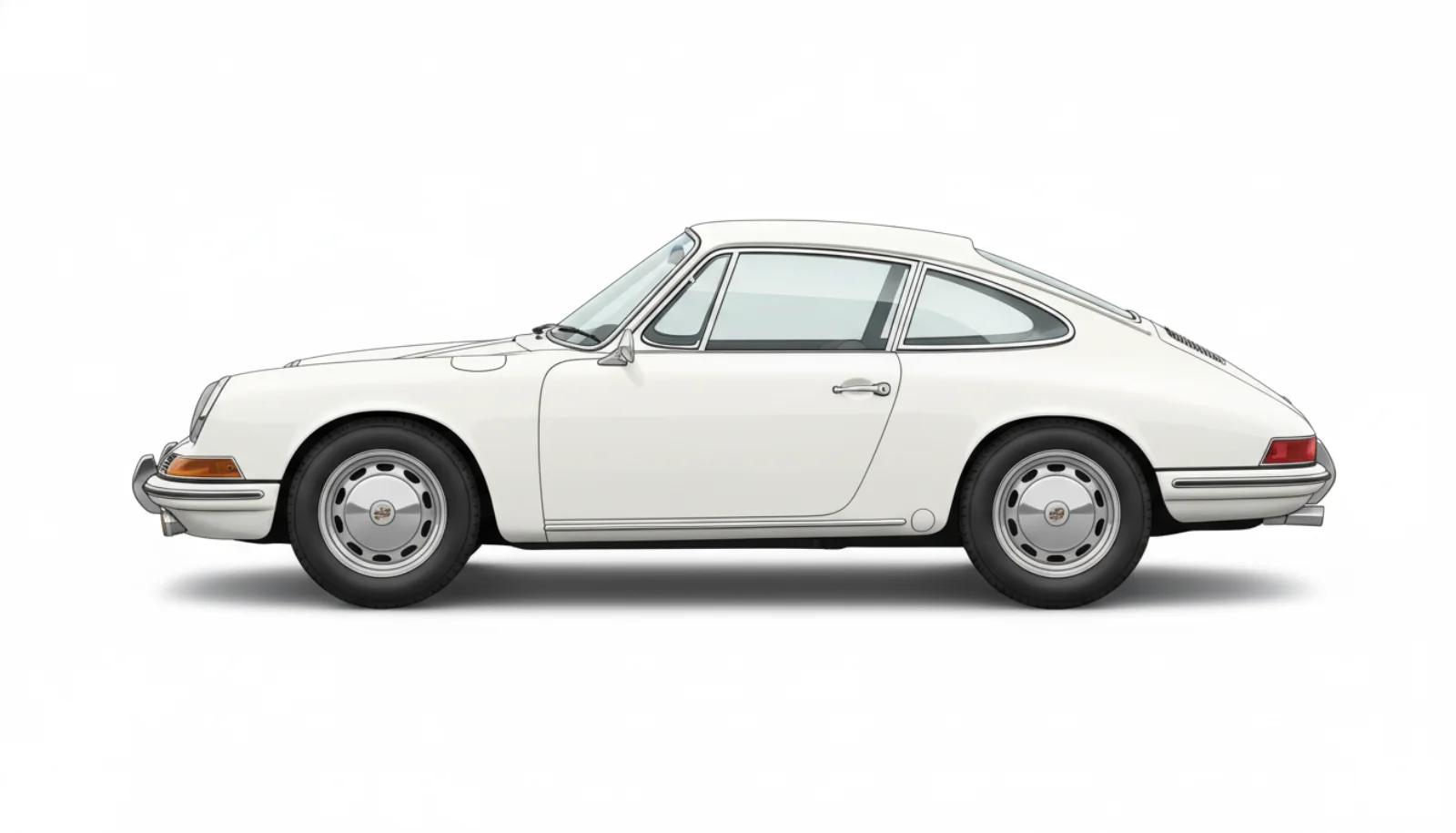
Irish Green · 6406 / 6606 / 6706 / 6806 · 1965–1969
Screen approximation of the factory paint
Model year
Generation
2.0 litre, short wheelbase (0-series and A-series)
Built in 1965
Not documented
Built in all, 1964–1973
Serial numbers, 1965
911 Coupé, built in calendar year 1964300001 → 300232
911 Coupé, model year 1965300233 → 303390
Price new, 1965
$6,490
United States
Origin
Germany
Rear-engine, rear-wheel drive
The first 911: an air-cooled flat-six 2+2 that grew from 2.0 to 2.7 litres in nine model years.
Sports car23 sources
How it launched in 1965
- 01Series production began in the late summer of 1964 (sources give August or September) after the car had been shown as the 901 at Frankfurt in September 1963; it was renamed 911 after Peugeot objected to the 901 number.
- 02Launched as a coupé only, with the 1,991 cc flat-six giving 130 PS, two triple-choke Solex carburettors, a five-speed gearbox and disc brakes all round.
- 03Chassis numbers ran from 300001; the first 232 numbers are attributed to cars built in calendar year 1964.
- 04US deliveries began in February 1965 and the first right-hand-drive cars were built in May 1965.
- 05The four-cylinder 912 joined the range in April 1965.
- 06A Targa prototype was shown at Frankfurt in September 1965.
2.0 litre, short wheelbase (0-series and A-series), 1965–1968
The first 911s, sold for model years 1965 to 1968 on a 2,211 mm wheelbase with the 1,991 cc flat-six. The car launched as a single 130 PS coupé. The 160 PS 911 S and the Targa body arrived for 1967, and the 1968 A-series split the range into T, L and S with a Sportomatic option and dual-circuit brakes.
Body styles by year
Trim lines and engines, 1965
| Line | Power | Torque | 0–60 mph | Top speed | Weight |
|---|---|---|---|---|---|
1,991 cc air-cooled flat-six, two triple-choke Solex 40 PI carburettors; Weber 40 IDA from March 1966 | 130 hp | 174 lb-ft | 8.7 s | 130 mph | 2,271 lb |
911 (2.0)
1965–1968
- Engine
- 1,991 cc air-cooled flat-six, two triple-choke Solex 40 PI carburettors; Weber 40 IDA from March 1966
- Displacement
- 1,991 cc
- Layout
- F6 · naturally aspirated · RWD
- Power
- 130 hp (DIN, as quoted by Porsche in PS (British sources quote the same number as bhp))
- Torque
- 174 lb-ft
- 0–60 mph
- 8.7 s — CAR magazine, March 1965, pre-series car. Top speed is the factory rating quoted in the same test.
- Top speed
- 130 mph
- Weight
- 2,271 lb
- Gearboxes
- 5-speed manual (Type 901); 4-speed Sportomatic semi-automatic (optional from model year 1968)
- Length × width × height
- 163.9 × 63.4 × 52 in
- Wheelbase
- 87 in
- Body styles
- Coupé, Targa (zip-out soft rear window; a fixed glass window was optional in model year 1968)
- Price new
- $6,490 (1965, United States)
- Built
- Not documented
What this line added
- 130 PS at 6,100 rpm, dry-sump lubrication
- Five-speed gearbox
- Disc brakes on all four wheels
- 4.5 x 15 in steel wheels
- Five-dial instrument panel with wood dash trim (1965-1967)
- For model year 1968 the plain 911 continued mainly as the US-market car (emissions engine Type 901/14); 1,215 coupés and 402 Targas were built that year
Factory colors, 1965
5 of 39 documented colors were offered this year. Pick one to repaint the page.
Interiors, 1965
Units built by year
Left- and right-hand drive
The split is not documented.
No overall left- and right-hand-drive split was found. Right-hand-drive production began in May 1965, and right-hand-drive Targas only in model year 1973. Of the Carrera RS 2.7, 117 are reported as right-hand drive (17 Sport and 100 Touring).
Porsche AG's figure for the original 911 generation, 1963 to 1973. The per-variant figures found for the six-cylinder cars are far lower: about 70,000 for model years 1968 to 1973 including the Carrera RS, plus roughly 8,500 coupé chassis numbers and 718 Targas recorded for 1964 to 1967. A secondary source reports a Porsche milestone page giving 81,100, so the larger figure may include the four-cylinder 912. Porsche does not say.
Price when new
Lowest list price each year in Germany, in DEM of the day. Not adjusted for inflation.
Serial number ranges
| Series | Drive | Years | From | To |
|---|---|---|---|---|
| 911 Coupé, built in calendar year 1964Sold as model year 1965 cars. | — | 1965 | 300001 | 300232 |
| 911 Coupé, model year 1965 | — | 1965 | 300233 | 303390 |
| 911 Coupé, model year 1966The factory parts catalogue shows 300236 as its 1966 start point for parts purposes. | — | 1966 | 303391 | 305100 |
| 911 and 911 S Coupé, model year 1967911 S cars carry an S suffix (305101 S onward in the factory catalogue). A parts supplier's table gives 307351 to 308522 for the 911 and 307361S to 308523S for the S. | — | 1967 | 305101 | 308522 |
| 911 and 911 S Targa, model year 1967Last number not documented. One table prints an end of 550544, which belongs to the 912 Targa series that starts at 550001. | — | 1967 | 500001 | … |
| 911 S Coupé, model year 1968 (first number) | — | 1968 | 11800001 | … |
| 911 L Coupé, USA/Canada, model year 1968 (first number) | — | 1968 | 11805001 | … |
| 911 L Coupé, model year 1968 (first number) | — | 1968 | 11810001 | … |
| 911 T Coupé, model year 1968 (first number) | — | 1968 | 11820001 | … |
| 911 Coupé, USA/Canada, model year 1968 (series listed in the factory catalogue) | — | 1968 | 11835001 | … |
| 911 L Targa, USA/Canada, model year 1968 (first number) | — | 1968 | 11855001 | … |
| 911 Targa, USA/Canada, model year 1968 (first number) | — | 1968 | 11880001 | … |
| 911 T Coupé, model year 1969 (first number) | — | 1969 | 119100001 | … |
| 911 T Targa, model year 1969 (first number) | — | 1969 | 119110001 | … |
| 911 T Coupé, Karmann-built body, model year 1969 (first number)The factory catalogue lists this series against the USA/Canada 911 T; the body digit 2 is decoded elsewhere as a Karmann-built coupé. | — | 1969 | 119120001 | … |
| 911 E Coupé, model year 1969 (first number) | — | 1969 | 119200001 | … |
| 911 E Targa, model year 1969 (first number) | — | 1969 | 119210001 | … |
| 911 E Coupé, Karmann-built body, model year 1969 (first number) | — | 1969 | 119220001 | … |
| 911 S Coupé, model year 1969 (first number)A parts supplier's table gives 119301492 as its first 911 S number. | — | 1969 | 119300001 | … |
| 911 S Targa, model year 1969 (first number) | — | 1969 | 119310001 | … |
| 911 T, model year 1970 (first number listed)As listed by a parts supplier. The body digit 2 denotes a Karmann-built coupé in the 1969 scheme. | — | 1970 | 9110120001 | … |
| 911 E, model year 1970 (first number listed) | — | 1970 | 9110220001 | … |
| 911 S Coupé, model year 1970 (first number) | — | 1970 | 9110300001 | … |
| 911 T Coupé with fuel injection (US specification), model year 1972 (first number) | — | 1972 | 9112500001 | … |
| 911 S Coupé, model year 1972 (first number) | — | 1972 | 9112300001 | … |
| 911 T Coupé with mechanical injection (US specification), model year 1973, built to January 1973 (first number) | — | 1973 | 9113500001 | … |
| 911 T Coupé with K-Jetronic (US specification), from January 1973 (first number) | — | 1973 | 9113101501 | … |
| 911 E Coupé, model year 1973 (first number) | — | 1973 | 9113200001 | … |
| 911 S Coupé, model year 1973 (first number) | — | 1973 | 9113300001 | … |
The car
Porsche showed the successor to the 356 as the 901 at Frankfurt on 12 September 1963 and put it into production in 1964 as the 911, the name changed after Peugeot claimed three-digit numbers with a central zero. It kept the 356's rear-engine layout but used a new 1,991 cc air-cooled flat-six with overhead camshafts and dry-sump lubrication, a five-speed gearbox, MacPherson strut front suspension and semi-trailing arms at the rear.
The range widened quickly. The 160 PS 911 S and the Targa, an open car with a fixed roll hoop, arrived for model year 1967. For 1968 the line was split into T, L and S, and for 1969 the wheelbase was lengthened by 57 mm, the E replaced the L, and the E and S gained mechanical fuel injection. Each model year from 1968 carries a series letter, A to F.
The engine grew to 2.2 litres for 1970 and 2.4 litres for 1972, when the stronger Type 915 gearbox arrived. The final step was the 1973 Carrera RS 2.7, a 210 PS lightweight built to homologate the 911 for racing; Porsche planned 500 and built about three times that.
The original body ended with the F-series in July 1973. Porsche counts 111,995 first-generation cars from 1963 to 1973. The impact-bumper G-series replaced it for model year 1974.
- Class
- Sports car
- Layout
- Rear-engine, rear-wheel drive
- Origin
- Germany
- Designers
- Ferdinand Alexander 'Butzi' Porsche
- Also known as
- 901, Original 911, F-model, 0-series to F-series, Urelfer
- In production
- 1964–1973
Milestones
- 1963
Shown as the 901 at the Frankfurt motor show, 12 September.
- 1964
Series production begins at Zuffenhausen; the car is renamed 911.
- 1965
Fifth overall on the Monte Carlo Rally. US deliveries start in February, right-hand-drive production in May. Targa prototype shown at Frankfurt in September.
- 1966
911 S launched with 160 PS and the first Fuchs forged alloy wheels; Targa production starts in December.
- 1967
A-series (model year 1968): 911 T and 911 L join the range and Sportomatic is offered.
- 1968
B-series (model year 1969): wheelbase lengthened by 57 mm; 911 E and S gain fuel injection.
- 1969
C-series (model year 1970): engine enlarged to 2.2 litres.
- 1971
E-series (model year 1972): 2.4-litre engines and the Type 915 gearbox.
- 1972
Carrera RS 2.7 unveiled at the Paris Motor Show on 5 October; the planned 500 are sold by the end of November.
- 1973
Carrera RSR wins the Daytona 24 Hours in February and the Targa Florio in May. F-series production ends in July.
Pictures
Illustrations are generated from period references and shown in the selected factory color; they are not photographs.
Where it was built
Germany · 1964–1973
Porsche Werk Zuffenhausen
Stuttgart
The factory, what else it built →
Germany
Karmann (some coupé bodies)
Osnabrück
Where the cars went
No country-by-country split of where these cars were delivered is documented in the sources we could find. We do not apportion the total ourselves.
Against its rivals
Same class, same years. Each rival is shown in the specification and year a buyer would have cross-shopped.
Longer is better. Figures are for the variant and year named under each car, from the sources listed below.
In the comparison
Jaguar E-Type Series 1 4.2 fixed-head coupé · 1965 · United Kingdom
More power and a higher top speed for similar money, in a larger front-engined car.
Ferrari Dino 246 GT · 1970 · Italy
A mid-engined 2.4-litre six aimed squarely at 911 S buyers.
Mercedes-Benz 280 SL (W 113) · 1968 · Germany
The other German six-cylinder two-seater, softer and more of a tourer.
Alfa Romeo 1750 GT Veloce · 1968 · Italy
A cheaper four-cylinder 2+2 coupé with a similar sporting brief.
Factory options
| Option | Code | Years | Price | Built with it |
|---|---|---|---|---|
| Sportomatic four-speed semi-automatic transmissionFichtel & Sachs torque converter with a vacuum clutch operated by touching the gear lever. Not offered on the 911 S for 1969 to 1971. | — | 1968–1973 | DM 1,000 | — |
| Electric sunroof | — | 1965–1973 | $395 | — |
| Carrera RS Sport packageLightweight trim: no rear seats, carpets, clock or armrests, thinner glass, glass-fibre engine lid. | M471 | 1973 | DM 700 | 200 |
| Carrera RS Touring packageComfort trim based on the 911 S interior, steel engine lid. | M472 | 1973 | DM 2,500 | 1,308 |
| Rally Kit for the 911 SType 901/30 engine with about 170 PS, thicker anti-roll bars, uprated brake pads, underbody protection, limited-slip differential and roll cage. | — | 1967–1968 | — | — |
| Fuchs forged alloy wheelsStandard on the 911 S, optional on other variants. | — | 1967–1973 | — | — |
| Fixed glass rear window for the TargaOptional for 1968, standard from 1969. | — | 1968 | — | — |
| Comfort package for the 911 TBrought the T's cabin up to 911 E level. | — | 1969–1973 | — | — |
| Boge hydro-pneumatic self-levelling front strutsStandard on the 911 E for 1969 to 1971, optional on T and S; optional across the range from 1972. | — | 1969–1973 | — | — |
| Air conditioning | — | 1969–1973 | — | — |
| Limited-slip differentialListed among the options from the B-series; a ZF unit is named for 1970. | — | 1969–1973 | — | — |
| Electric windows | — | 1970–1973 | — | — |
| Heated windscreen | — | 1971–1973 | — | — |
| 110-litre long-range fuel tank (911 S) | — | 1970–1973 | — | — |
| 85-litre fuel tank with space-saver spare | — | 1972–1973 | — | — |
| S kit for the 911 T and EFront spoiler, wheels and sill plates from the 911 S. | — | 1972–1973 | — | — |
| Koni dampers | — | 1965–1973 | — | — |
| Leather upholstery | — | 1965–1973 | — | — |
| Blaupunkt radio | — | 1965–1973 | — | — |
| Fitted luggage, three pieces, leather or canvas | — | 1965–1969 | — | — |
Known issues
Lift-off oversteer on short-wheelbase cars
1965–1968safetyWith about 59 per cent of the weight on the rear wheels, narrow tyres and semi-trailing arms, the car turns tail-first if the driver lifts off mid-corner, most of all in the wet.
Fix The 57 mm longer wheelbase and lighter magnesium engine castings of 1969 calmed the handling. Drive through corners on a steady or opening throttle.
Body corrosion
1965–1973majorThe early cars had very little rust protection and many were badly corroded within a decade. Tectyl treatment came for 1970 and zinc-coated underbody panels for 1971, but the whole shell was not galvanised. Poor past repairs hidden under fresh underseal or filler are the main buying risk.
Fix Inspect the shell and restoration invoices with a specialist; repair with genuine panels. A full structural rebuild is a five-figure job.
Fragile magnesium crankcases
1969–1973majorThe die-cast magnesium crankcases introduced on late-1968 production are known to be fragile. Cases were swapped freely in the 1970s and 1980s, so some engines are not the original despite carrying plausible numbers.
Fix Check engine numbers against the factory record and have the case inspected at rebuild.
Carrera RS 2.7 authenticity
1973majorValues are high enough that standard cars have been rebuilt as RS replicas; the club register warns there may be more RSs now than were built.
Fix Buy only with expert verification of chassis, engine and body numbers.
Solex carburettor flat spot
1965–1966moderateThe original triple-choke Solex carburettors were hard to keep in tune and gave a flat spot in the mid-range.
Fix Porsche changed to Weber 40 IDA carburettors from March 1966; many earlier cars were converted.
Type 915 gearbox synchromesh wear
1972–1973moderateSecond- and third-gear synchros are a weak point of the 915 gearbox.
Fix Gearbox rebuild with new synchro rings.
Valve guide wear
1965–1973moderateValves and guides typically last about 125,000 miles; a car of this age should have evidence of at least a top-end rebuild.
Fix Top-end overhaul.
External oil filler mistaken for the fuel filler
1972minorThe 1972 cars have an oil filler flap behind the right-hand door. Owners and pump attendants filled the oil tank with petrol.
Fix Porsche deleted the external flap for 1973.
How it was advertised
The 911 was first shown as the 901 at the Frankfurt motor show on 12 September 1963 and renamed 911 before sales began in 1964, after Peugeot objected to the three-digit name with a central zero. In the United States, the 911's largest market, the car was advertised in enthusiast magazines in the name of Porsche of America Corporation of Teaneck, New Jersey; German-market advertising was not documented in this research.
The American ads of the late 1960s argued from engineering and competition rather than glamour. The January 1968 announcement of the Targa, named after the Sicilian road race Porsche had won repeatedly, presented its fixed stainless roll bar as the answer to open-car safety, drawn in a busy street scene. A 1969 ad, "Racing—the ultimate proof", cited the Sportomatic 911 that had won the 84-hour Marathon de la Route at the Nürburgring and the prototypes' wins at Daytona, Sebring, the Targa Florio and the Nürburgring 1000 km, and told readers the car they could buy was built to the same standard. No television advertising and no agency of record for the 911 in this period were documented.
Where it ran: 3 documented placements
More advertisements, viewable at their source (7)
These are still under copyright, so we describe them and link to where they can be seen rather than reproduce them.
- 1965Porsche 911brochure · 1965-03 · Internet Archive (Car Brochures & Adverts collection) ↗German-market launch brochure with a graphic cover: a red band, then a huge outlined "911" on pale green, and below it an orange coupe photographed against streaked, blurred light to suggest speed.
- 1966Porsche targabrochure · Internet Archive (Car Brochures & Adverts collection) ↗Brochure introducing the 911 and 912 Targa: a dark green Targa in profile with the roof panel removed and rear screen in place, under the word "targa" in large white script.
- 1967Porsche 911 · 911 S · 912 (US brochure)brochure · Internet Archive (Car Brochures & Adverts collection) ↗US-market brochure for the 1967 range, its landscape cover left white apart from the Porsche crest.
- 1968Some day, all convertibles will have a roll bar. The new Targa by Porsche.magazine · Car and Driver · 1968-01 · Car and Driver (via AOL) ↗Pen-and-wash illustration of a 911L Targa in a city street, with smaller vignettes of the Targa top-up, top-down and with the rear window open. The copy presents the brushed-steel roll bar as a safety advance borrowed from racing, explains the four ways the roof can be configured, and lists the 912, 911 and 911L Targa versions and East Coast prices.
- 1969The new Porsche 911. With the 2.2 litre engine.brochure · 1969-09 · Internet Archive (Car Brochures & Adverts collection) ↗English-language brochure announcing the enlarged 2.2-litre engine for the 1970 model year, with a plain cream cover carrying only the title in small capitals.
- 1969Racing—the ultimate proofmagazine · Car and Driver · 1969-02 · Car and Driver (via AOL) ↗A red-and-white numbered 911 racer blurred at speed along a pit wall, under copy arguing that racing, not publicity, drives Porsche's engineering: the Sportomatic 911's win in the 84-hour Marathon de la Route, prototype wins at Daytona, Sebring, the Targa Florio and the Nürburgring, and Trans-American championship success. Prices from about $5,100 East Coast.
- 1973The Porsche 911 with the 2.4 liter engine. The classic sports car whose timeless design combines technology and function.brochure · Internet Archive (Car Brochures & Adverts collection) ↗US brochure for the final long-hood model year: a purple 911 coupe photographed beside water, with a strapline already calling the design classic and timeless.
Only two 911 magazine advertisements from 1964–1973 could be documented; the rest of the list is factory brochures. No early 911 material with a public-domain or open licence was found on Wikimedia Commons, and the AHPS library holds 911 road tests but no 911 ads. German-market press advertising and the factory posters of the period were not documented; the web-search budget for this research run ran out before Porsche-heritage sources could be looked for. This is the main gap. Brochure dates and markets are as given in the Internet Archive item titles (uploaded by a collectors' group, no licence stated). The 1966 Targa brochure's market is assumed German from its German-titled companions; the 2.2-litre brochure is English-language and its market (GB or export) is not stated. Both ads appear in Car and Driver's own retrospective gallery, which gives the magazine and month; the Targa ad also carries "January 1968" in its folio. Porsche of America Corporation's address changed between the two ads (Tryon Avenue to Galway Place, Teaneck); both are printed on the ads.
Sources
- 1The original 911: the masterpiece from Zuffenhausen (The seven generations of the Porsche 911, part 1) — Porsche Newsroom, Porsche AG factory
- 250 years of the Porsche 911 Carrera RS 2.7 — Porsche Newsroom, Porsche AG factory
- 3Porsche Classic model overview: 911 (F model), identifying features by variant and model year — Porsche Classic text, read as published by Porsche Classic Center Gelderland factory
- 4Porsche original parts catalogue Kat 073, 911/912 model years 1965-1969: summary of types, vehicle identification numbers and engine types — Porsche AG (Porsche Classic) factory
- 5Porsche Early 911 Buyers' Guide (1965-73) — Porsche Club Great Britain, Early 911 Register club
- 6Guide: Porsche 911 2.0 O-series — Supercar Nostalgia reference
- 7Guide: Porsche 911 A- and B-series (1968-1969) — Supercar Nostalgia reference
- 8Guide: Porsche 911 2.2 C- and D-series (1970-1971) — Supercar Nostalgia reference
- 9Guide: Porsche 911 2.4 E- and F-series (1972-1973) — Supercar Nostalgia reference
- 10Guide: Porsche 911 2.7 Carrera RS — Supercar Nostalgia reference
- 11Structure of the Porsche chassis numbers — Turbosition reference
- 12Porsche 911 engine variants 1965-1989, with first chassis number per model year — Mecatechnic reference
- 13Early 911 and 912 Porsche factory sales literature 1963-1973 (brochures, price lists, colour charts) — DerWhite's 356 Literature reference
- 14Porsche paint codes by model year, 1965-1973 — PaintRef.com reference
- 15When we first drove the Porsche 911 (CAR archive, March 1965) — CAR magazine period-test
- 16Porsche 911 T/L/S, model year 1968 — kfz-tech.de reference
- 17Porsche 911 T/E/S, model year 1969 — kfz-tech.de reference
- 18Porsche production numbers by model and year — CarWhere Research reference
- 19Porsche 911 (classic) — Wikipedia reference
- 20Jaguar E-Type — Wikipedia reference
- 21Dino 206 GT and 246 GT — Wikipedia reference
- 22Mercedes-Benz W113 — Wikipedia reference
- 23Alfa Romeo 105/115 Series Coupés — Wikipedia reference
Research notes: what is not documented, and where sources disagree (12)
- Total production: Porsche gives 111,995 for the original generation, 1963-1973. The six-cylinder variant figures used here (Supercar Nostalgia, model years 1968-1973, plus the Carrera RS) come to about 70,000, and a secondary source (CarWhere) reports a Porsche milestone page giving 81,100. The 111,995 figure may include the 912; this needs a human check against Porsche's own breakdown.
- Model years 1965-1967: no per-year or per-variant production was found in a usable form. Supercar Nostalgia gives 8,520 standard coupés, 3,422 911 S coupés and 718 Targas for August 1964 to July 1967, but 3,422 equals the count of 1967 coupé chassis numbers (305101-308522) and 8,520 roughly equals the whole coupé number range (300001-308522), so those figures appear to be mislabelled. Units for the 2.0 and 2.0 S variants and for 1965, 1966 and 1967 are therefore null.
- Per-model-year units for 1968-1973 are sums of the per-variant coupé and Targa figures given by Supercar Nostalgia; the source does not say where its figures come from. The 1973 total (15,021) adds Porsche's 1,580 Carrera RS to the 13,441 T, E and S cars. Coupé units for 1973 and for the 2.4 generation are left null because the RS split would have to be assumed.
- Carrera RS 2.7: Porsche's 2022 history gives 1,580 built (200 Sport, 1,308 Touring, 55 racing, 17 base cars); Porsche's 2018 generation history and Supercar Nostalgia give 1,525. 1,580 is used. No chassis number range for the RS was found in a source opened.
- Chassis numbers: full ranges are documented only for 1964-1967. For 1968 and 1969 only the first number of each series is given, from Porsche's parts catalogue Kat 073; for 1970-1973 only first numbers from a parts supplier's table (Mecatechnic), which repeats its 1970 numbers for 1971 and gives the same number for the 1972 E and S, so 1971 and the 1972 E are omitted. Last numbers by variant, the Karmann/Porsche body split and all Targa series from 1970 remain undocumented. Stuttcars has a full table behind a paywall.
- Colours: names and codes come from two factory colour charts described by DerWhite (model years 1966 and 1968) and from PaintRef, a paint-code database that lists all Porsche codes by year without separating the 911 from the 914 or special-order paints. Colours that looked specific to the 914 were left out, but the 1969-1973 list should be checked against Porsche's own colour charts, which could not be read. The full 1965 chart was not found. No source gives units built per colour. Hex values are screen approximations.
- Interior colours were not documented; only materials are listed.
- Prices: the US launch price (USD 6,490), the July 1966 German price of the 911 S, the 1968 and 1969 German prices and the January 1968 US price of the 911 L Targa are documented. German prices for 1965 and for the 2.2 and 2.4 cars, and US prices after 1968, were not found. The Carrera RS price of DM 34,000 is quoted by Porsche in a passage about the Sport version; whether it is the base price or the price with the M471 package is not clear.
- Performance: the only period 0-60 mph figure found is CAR magazine's 8.7 s for a pre-series 911 in March 1965. Other figures in circulation are factory 0-100 km/h or 0-62 mph times and are recorded in the notes, not in the 0-60 field. Top speeds are factory figures. Weights and top speeds for the 2.2-litre cars were not found.
- Power figures are Porsche's DIN PS ratings entered unchanged; 130 PS is 128 bhp, though British sources quote the PS number as bhp.
- Markets: no per-country delivery figures were found, so the markets list is empty. Sources agree only that the United States was the largest market.
- Start of production is given as August 1964 by Supercar Nostalgia and September 1964 by Porsche Club GB.
23 sources. Paint swatches are screen approximations of the factory colors.