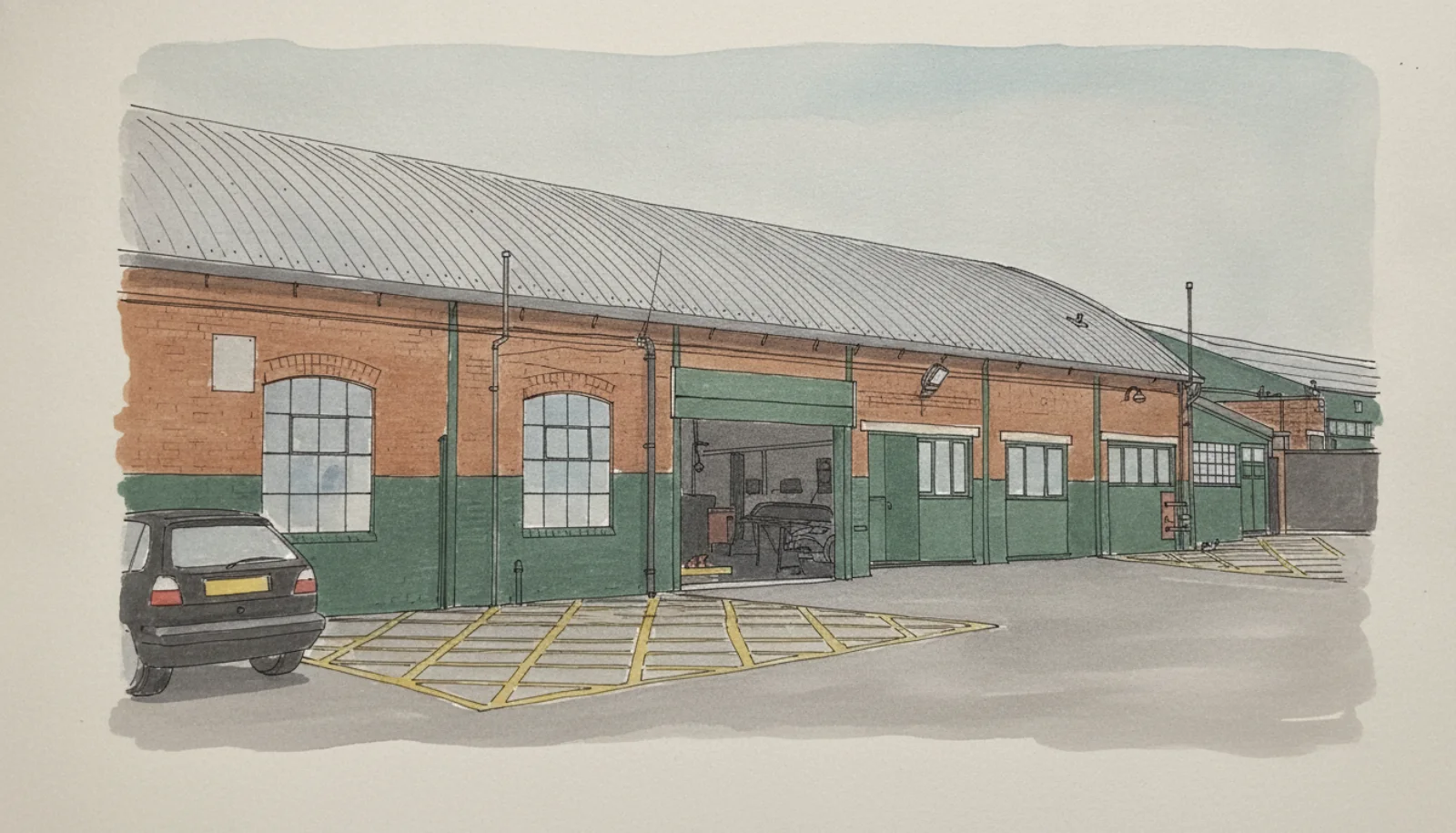
The site on Tickford Street, at the east end of Newport Pagnell, was the works of the coachbuilders Salmons, founded by Joseph Salmons in the 1820s or 1830 (sources differ). The firm moved from carriages to motor bodies at the end of the 1890s, launched its Tickford 'All Weather' folding-roof body in 1925, and through the 1930s built catalogued Tickford dropheads for a long list of British makes, employing about 450 people and turning out some 30 bodies a week by the end of the decade. Ian Boswell bought the business in 1943 and renamed it Tickford Ltd after its trademark.
David Brown, who already owned Aston Martin and Lagonda, bought Tickford in 1954–55, and the DB2/4 Mk II of 1955 was the first Aston Martin built at Tickford Street. Over the next decade the rest of the company followed from Feltham: the DB4, DB5 and DB6 were built here, the main factory hall went up in 1964, and the office villa 'Sunnyside' became the company's headquarters. By 1969 the works employed about 800 people, beat aluminium panels in its own press shop and assembled every engine by hand, building more than 80 cars a month.
After a spell in receivership that ended with its sale in June 1975, the plant built the V8, Vantage, Volante and the wedge-shaped Lagonda in small numbers, celebrated its 10,000th car in April 1984, and moved on to the Virage family in 1989 and the V12 Vanquish in 2001. Aston Martin, by then owned by Ford, moved its newer models to a purpose-built factory at Gaydon, and the last Vanquish S left Tickford Street on 19 July 2007, after just over 13,300 cars by one local count. The site carries on as Aston Martin Works, a heritage sales, service and restoration business, which has also built the DB4 GT and DB5 Goldfinger continuation series there.
Opened
Closed
- Status
- repurposed
- Models built
- 17
- Components
- 6
- Peak workforce
- Not documented
- Location
- 52.0843, -0.7167
- Also called
- Salmons & Sons coachworks, Tickford Ltd works, Tickford Works, Aston Martin Works (heritage, service and restoration, current)
Cars built here
- 1955–1957Aston Martin DB2/4 Mk IINamed by Aston Martin Works historians and the town history site as the first Aston Martin built at Tickford Street; full production there began in 1955 (Retro Rides, 2025). The end year is the DB2/4 run's end per Wikipedia.
- 1957–1959Aston Martin DB Mark III · 551Wikipedia gives Newport Pagnell as the assembly plant.
- 1958–1963Aston Martin DB4 (including DB4 GT and DB4 Convertible) · 1,1101,110 DB4s plus 75 DB4 GTs (Wikipedia). Wikipedia says the DB4 was built at the Newport Pagnell works; see researchNotes for the Feltham/Newport Pagnell split in these years.
- 1961–1964Lagonda Rapide · 55
- 1963–1965Aston Martin DB5 (saloon, convertible and Vantage) · 1,059Original production 1963–1965. The 25 DB5 Goldfinger continuation cars of 2020 are listed separately.
- 1965–1971Aston Martin DB6 (including Volante) · 1,788September 1965 to January 1971.
- 1967–1972Aston Martin DBS (six-cylinder) · 787Wikipedia: 787 produced at Newport Pagnell, 1967–1972.
- 1969–1989Aston Martin DBS V8 / V8 (saloon and Volante) · 4,0214,021 including Vantage and Volante versions (Wikipedia citing Edwards, 'Aston Martin', Haynes 2004). The DBS V8 was renamed Aston Martin V8 in May 1972.
- 1974–1990Aston Martin Lagonda (four-door saloon, including the 1974–1976 V8-based Series 1) · 645645 in all per Wikipedia; seven Series 1 cars were built 1974–1976 (Wikipedia DBS article; Motor Sport, 1976, says eight).
- 1977–1989Aston Martin V8 Vantage (saloon and Volante) · 534342 saloons and 192 Volantes; these are included in the V8 total above.
- 1989–1996Aston Martin Virage (coupé) · 411
- 1992–1996Aston Martin Virage VolanteWikipedia gives 224 or 233 built (its sources disagree).
- 1993–2000Aston Martin Vantage (Virage-based, later V600) · 280
- 1996–2000Aston Martin V8 Coupé · 101Wikipedia's Virage article covers it under a Newport Pagnell infobox but does not state its plant separately.
- 2001–2007Aston Martin V12 Vanquish / Vanquish SSeptember 2001 to 19 July 2007, the last model built at Newport Pagnell.
- 2017Aston Martin DB4 GT Continuation · 25Track-only cars built by Aston Martin Works at Newport Pagnell; announced 2016, deliveries expected late 2017 (Wikipedia). The exact build span is not documented in the sources read.
- 2020Aston Martin DB5 Goldfinger Continuation · 25Built at Newport Pagnell from 2020 (Wikipedia); the end of the build is not documented in the sources read.
Parts made here
- Carriages and horse-drawn vehicles (Salmons)From the founding in the 1820s/1830 until the move to motor bodies; no end date documented.
- Coachbuilt car bodies, including Tickford drophead bodies for BSA, Daimler, Hillman, Lanchester, MG, Rover, Standard, Triumph, Vauxhall and Wolseley · 1898–1955Motor bodies from 1898; the Tickford All Weather body from 1925; the catalogued 1930s dropheads per Wikipedia. Wikipedia says Aston Martin and Lagonda cars of the David Brown era before 1955 were fitted with Tickford bodies; how many and which models is not documented in the sources read.
- Hand-formed aluminium body panels (own press shop and panel beaters) · 1955–2007Documented by Motor Sport in 1969 (DB6 and Volante panels; DBS panels came pre-pressed from Boulton Paul) and 1976. Year span is the car-building period; when in-house panel work started and stopped is not dated in the sources read.
- Engines, hand-assembled and tested (six-cylinder and the four-cam V8)Motor Sport 1969: one man builds each engine, about 11 hours for a DB6 unit and 13 for a DBS; no foundry, castings mostly from British Aluminium. Motor Sport 1976: the all-aluminium V8 is built and tested on site, with blocks, con-rods and hubs machined in-house.
- Chassis and steel superstructure, suspension parts including hubs and the De Dion rear axleMade in-house per Motor Sport (1976). Motor Sport (1969) says DB6/DBS chassis were then fabricated at David Brown's Huddersfield plant, not at Newport Pagnell.
- Seat frames, leather trim and upholstery, Volante hoodsMotor Sport 1969 and 1976.
Pictures
Milestones
- 1898
Salmons begins building bodies for motor cars.
- 1925
Salmons announces its Tickford 'All Weather' drophead body.
- 1943
Ian Boswell buys Salmons & Sons and renames it Tickford Ltd.
- 1955
David Brown's group takes over Tickford; full Aston Martin production starts at Tickford Street with the DB2/4 Mk II.
- 1958
The DB4 is launched, built at Newport Pagnell.
- 1959
David Brown, Carroll Shelby, Stirling Moss and Roy Salvadori celebrate the World Sportscar Championship at the works.
- 1963
The DB5 is launched; Motor Sport dates the move of production from Feltham to Newport Pagnell to this year.
- 1964
The main factory building is completed.
- 1966
Queen Elizabeth II visits the factory.
- 1975
June: Peter Sprague and George Minden buy the business from the receiver for £1,050,000.
- 1984
April: the 10,000th Aston Martin is built.
- 2001
September: V12 Vanquish production begins.
- 2007
19 July: the last V12 Vanquish S ends car production at Newport Pagnell.
- 2017
Aston Martin Works builds 25 DB4 GT Continuation cars at Newport Pagnell.
- 2020
Aston Martin Works builds 25 DB5 Goldfinger Continuation cars at Newport Pagnell.
- 2025
Aston Martin marks 70 years at Newport Pagnell.
Sources
- Aston Martin (Newport Pagnell history) — newport-pagnell.uk
- How Aston Martins Are Made (March 1969) — Motor Sport
- Aston Martin of Newport Pagnell (September 1976) — Motor Sport
- Aston Martin celebrates 70 years at Newport Pagnell — Retro Rides
- Newport Pagnell is home of Aston Martin (22 May 2025) — Patrick Comerford (blog)
- Tickford — Wikipedia
- Newport Pagnell — Wikipedia
- Aston Martin DB2 — Wikipedia
- Aston Martin DB2/4 — Wikipedia
- Aston Martin DB Mark III — Wikipedia
- Aston Martin DB4 — Wikipedia
- Aston Martin DB4 GT Zagato — Wikipedia
- Lagonda Rapide — Wikipedia
- Aston Martin DB5 — Wikipedia
- Aston Martin DB6 — Wikipedia
- Aston Martin DBS — Wikipedia
- Aston Martin V8 — Wikipedia
- Aston Martin V8 Vantage (1977) — Wikipedia
- Aston Martin Lagonda — Wikipedia
- Aston Martin V8 Zagato — Wikipedia
- Aston Martin Bulldog — Wikipedia
- Aston Martin Virage — Wikipedia
- Aston Martin Vanquish — Wikipedia
- Aston Martin DB7 — Wikipedia
- Commons file pages for the three photographs (licence, author and Geograph object-location fields) — Wikimedia Commons
- Coordinates: no source gives a coordinate for the factory itself. 52.0843, -0.7167 is the Geograph 'object location' recorded on the Commons page of the Aston Martin Works service building photograph on Tickford Street (nearby Geograph photos of the site record 52.0842–52.0845, -0.7157 to -0.7167). Wikipedia's town coordinate is 52.087, -0.722.
- When did Aston Martin production move here? Sources conflict. The town history and Retro Rides (citing Aston Martin Works historian Steve Waddingham) say the DB2/4 Mk II of 1955 was the first car built at Tickford Street and that full production began in 1955, with racing and service staying at Feltham into the 1960s. Wikipedia places the DB Mark III and DB4 at Newport Pagnell. Motor Sport (1976) says production has been based here 'since 1963, when David Brown moved it from Feltham'; Motor Sport (1969) says the main factory was built in 1964 and only 'a few earlier cars' were assembled in the old Tickford body works. Wikipedia's Newport Pagnell article says 1954–2007; the Tickford article dates the David Brown purchase to late 1955; another fan site (astonmartins.com, not readable, blocked) is quoted in search results as December 1954. 'opened' is set to 1955, the year a car-production start is documented.
- Salmons founding: Wikipedia says the 1820s; the town history site says 1830. Wikipedia credits 1898 for the first motor bodies. The partnership name 'Salmons and Sons' dates from 1867 or 1869 per search snippets not confirmed in an opened source.
- Total output: the town history says just over 13,300 cars in 52 years; a 2025 blog post quoting the same tradition says 'nearly 13,000 since 1955'. Neither is a registry figure, so no total is used.
- Workforce peak not documented. Figures found: about 450 at Salmons/Tickford in the late 1930s (Wikipedia); 800 in 1969, about 450 of them on car production (Motor Sport); about 490 before the company collapsed into receivership (date not given) and a target of 230 in 1976 (Motor Sport); about 100 at Aston Martin Works in 2025 (Retro Rides).
- Excluded from built: DB4 GT Zagato (1960–1963; bodies by Zagato in Italy, final build location not documented in the sources read); V8 Zagato (1986–1990, Zagato bodies, no assembly location stated); the one-off Bulldog concept (1979, Wikipedia says Newport Pagnell); Virage Shooting Brake, Vantage Volante special edition and V600 conversions (Works Service projects, town not stated); V8 Volante long-wheelbase (1997–2000, 63 built, plant not stated); V8 Vantage Le Mans (plant and dates not stated); DB7 (built at Bloxham); DB4 GT Zagato Continuation (not researched). The DB2 (1950–1953) predates the move and is not listed.
- Chassis: Motor Sport 1969 says the DB6/DBS chassis came from David Brown's Huddersfield plant; Motor Sport 1976 says the V8's steel chassis and superstructure were made in-house. Both are reported as stated.
- Lagonda Series 1 count: Wikipedia says seven production four-door Lagondas (1974–1976); Motor Sport (September 1976) says eight.
- The continuation-car build spans (2017 for the DB4 GT, 2020 for the DB5 Goldfinger) are the years Wikipedia gives; later Works continuation series were not researched.