Model year
Generation
DB5
Built in 1963
Not documented
Built in all, 1963–1965
Serial numbers, 1963
All DB5s: saloon, convertible and shooting brake in one sequence, both drive sidesDB5C/1251/R → DB5/2275/L
Price new, 1963
£4,175
United Kingdom · launch price as quoted by Supercars.net
Origin
United Kingdom
Front-engine, rear-wheel drive
Aston Martin's 4.0-litre grand tourer of 1963 to 1965, built as a saloon and convertible, with a dozen Radford shooting brakes.
Grand tourer26 sources
How it launched in 1963
- 01Production begins in July 1963 at chassis 1251, taking over from the DB4 Series 5 Vantage; Aston Martin dates the public debut to the Frankfurt Motor Show in September.
- 02Engine bored to 96 mm for 3,995 cc, with three SU carburettors and a claimed 282 bhp.
- 03New over the DB4: alternator, Girling disc brakes in place of Dunlops, Sundym tinted glass, electric windows, an oil pressure gauge and a fuel filler on each rear wing.
- 04Early cars have the David Brown four-speed gearbox with optional overdrive; the ZF five-speed and a Borg-Warner three-speed automatic are options.
- 05Convertible offered from the start (chassis prefix DB5C), with an optional steel hardtop; DB5C/1253/L was built for the 1963 New York and Los Angeles shows.
DB5, 1963–1965
A development of the DB4 Series 5 Vantage, sharing its steel platform chassis and Touring-designed aluminium body built at Newport Pagnell under the Superleggera licence. The engine was bored out to 3,995 cc and fed by three SU carburettors, and the specification gained an alternator, Girling disc brakes, tinted glass and electric windows. A ZF five-speed gearbox, optional at first, soon became standard, and a triple-Weber Vantage engine was offered from September 1964. Saloon and convertible were factory bodies; a dozen saloons were rebuilt as shooting brakes by Harold Radford in 1965.
Built, this generation 1,022
Body styles by year
Trim lines and engines, 1963
| Line | Power | Torque | 0–60 mph | Top speed | Weight |
|---|---|---|---|---|---|
4.0 L Tadek Marek twin-cam aluminium inline-six (96 x 92 mm), three SU HD8 carburettors | 282 hp | 280 lb-ft | 8.1 s | 141 mph | 3,236 lb |
DB5
1963–1965
- Engine
- 4.0 L Tadek Marek twin-cam aluminium inline-six (96 x 92 mm), three SU HD8 carburettors
- Displacement
- 3,995 cc
- Layout
- I6 · naturally aspirated · RWD
- Power
- 282 hp (bhp at 5,500 rpm, Aston Martin's claimed figure)
- Torque
- 280 lb-ft
- 0–60 mph
- 8.1 s — Autocar road test, as quoted by Carscoops (2023); the test date is not given
- Top speed
- 141 mph
- Weight
- 3,236 lb
- Gearboxes
- 4-speed manual (David Brown), overdrive optional: earliest cars; 5-speed manual (ZF): optional at first, standard from chassis 1340; 3-speed automatic (Borg-Warner): optional
- Length × width × height
- 179.9 × 66 × 52 in
- Wheelbase
- 98 in
- Body styles
- Sports Saloon (coupé), Convertible, Shooting Brake by Harold Radford
- Price new
- £4,175 (1963, United Kingdom)
- Built
- Not documented
What this line added
- Alternator in place of a dynamo
- Girling disc brakes with twin servos
- Sundym tinted glass
- Electric windows
- Oil pressure gauge and oil cooler
- Twin fuel tanks with a filler on each side
- Reclining seats trimmed in leather, wool pile carpets
- Chrome wire wheels
- Fire extinguisher
Factory colors, 1963
9 of 9 documented colors were offered this year. Pick one to repaint the page.
Interiors, 1963
Units built by year
Year-by-year production is not documented for this car.
Left- and right-hand drive
The split is not documented.
No documented left/right split for the whole run was found. By body: convertibles 39 left-hand drive of 123 (RM Sotheby's, Supercars.net) or 19 (Wikipedia, Ultimatecarpage); shooting brakes 4 left-hand and 8 right-hand drive. Conceptcarz says 220 saloons were left-hand drive, 193 of them for the United States, without naming its source.
Sum of Aston Martin's own figures: 887 saloons, 123 convertibles and 12 shooting brakes. Bonhams, Aston Service Dorset and most references give 1,021, which is also the count of chassis numbers used. Totals of about 1,059 include the 37 Short Chassis Volantes.
Serial number ranges
| Series | Drive | Years | From | To |
|---|---|---|---|---|
| All DB5s: saloon, convertible and shooting brake in one sequence, both drive sidesJuly 1963 to September 1965. Numbers 2021, 2094, 2124 and 2125 were not used, which leaves 1,021 numbers. Format is prefix/number/drive side: DB5 for saloons (and the shooting brakes converted from them), DB5C for convertibles, suffix R for right-hand and L for left-hand drive. Auction houses also write the convertible prefix as DB5/C. | — | 1963–1965 | DB5C/1251/R | DB5/2275/L |
| ZF five-speed gearbox standard from this chassisChange point as given by Supercar Nostalgia. Sports Car Market instead says the David Brown four-speed was fitted to only the first 30 to 35 cars. | — | 1964–1965 | 1340 | 2275 |
The car
The DB5 replaced the DB4 in July 1963 and was built at Newport Pagnell until September 1965. It kept the DB4's steel platform chassis and Touring-styled aluminium body, but the Tadek Marek twin-cam six grew to 3,995 cc and a claimed 282 bhp, and the car was better equipped: alternator, Girling disc brakes, tinted glass and electric windows were standard, and the ZF five-speed gearbox became so during 1964.
Aston Martin offered a saloon (its word for the coupé) and a convertible, and from September 1964 a Vantage engine with three Weber carburettors. In 1965 Harold Radford rebuilt twelve saloons as shooting brakes, the first for company owner David Brown. Aston Martin gives production as 887 saloons, 123 convertibles and 12 shooting brakes; the usual published total is 1,021.
The model is best known for its part in the 1964 James Bond film Goldfinger, which used a development car and a production saloon finished in Silver Birch. The DB6 replaced the DB5 in October 1965, and the remaining convertible chassis were finished as the Short Chassis Volante.
- Class
- Grand tourer
- Layout
- Front-engine, rear-wheel drive
- Origin
- United Kingdom
- Designers
- Federico Formenti, Carrozzeria Touring (body), Tadek Marek (engine)
- In production
- 1963–1965
Milestones
- 1963
Production begins in July; shown at the Frankfurt Motor Show in September.
- 1964
Vantage engine option introduced in September.
- 1964
Goldfinger released, featuring a Silver Birch DB5.
- 1965
Harold Radford begins shooting brake conversions in April.
- 1965
Thunderball uses two further film cars, DB5/2008/R and DB5/2017/R.
- 1965
Production ends in September; the DB6 follows in October.
- 2010
Goldfinger road car DB5/1486/R sold by RM Auctions for $4.6 million.
- 2020
Aston Martin builds 25 Goldfinger continuation cars at Newport Pagnell.
Pictures
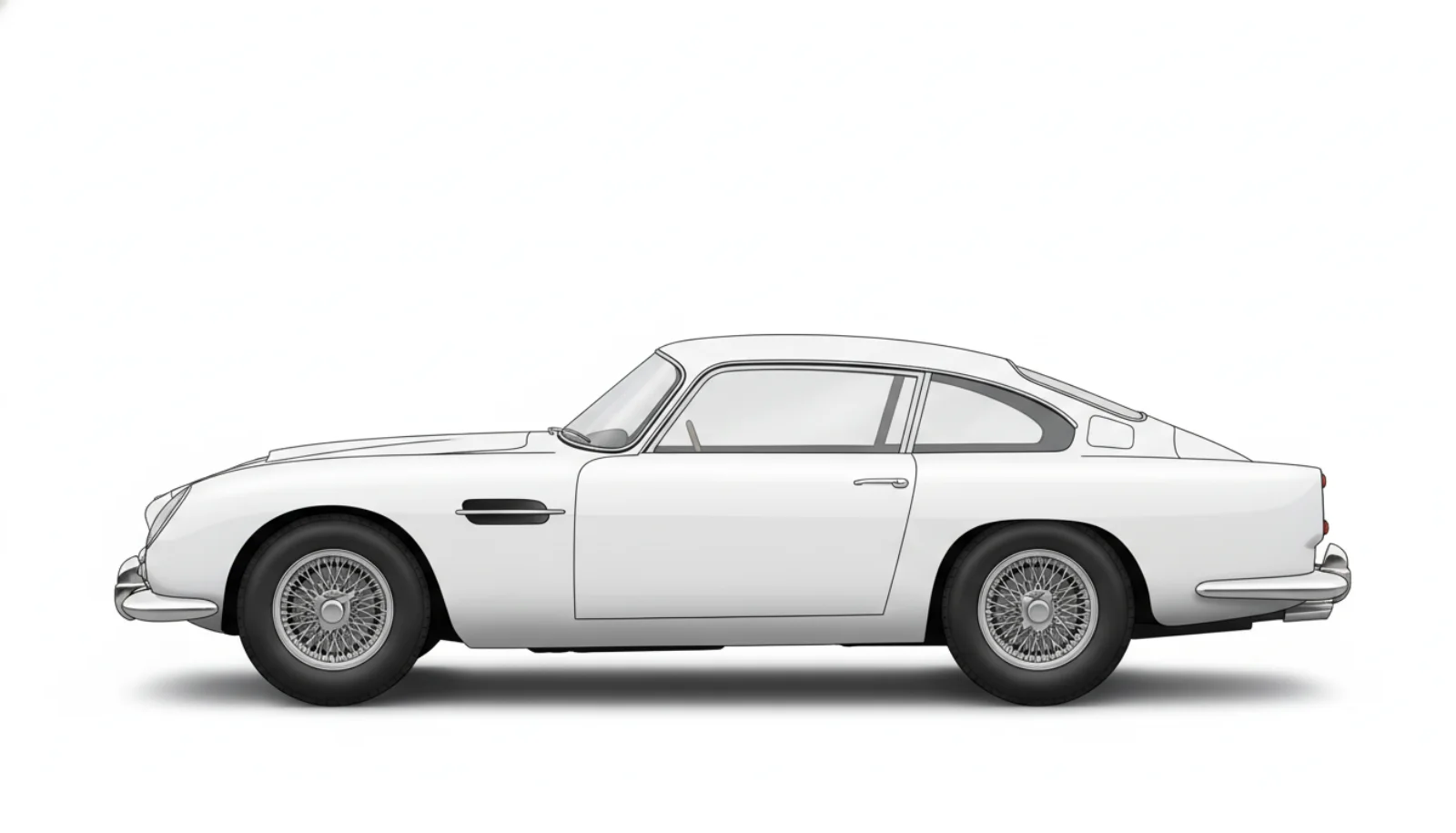
Illustrations are generated from period references and shown in the selected factory color; they are not photographs.
Where it was built
United Kingdom · 1963–1965
Aston Martin Lagonda, Tickford Street
Newport Pagnell
The factory, what else it built →
United Kingdom · 1965
Harold Radford (Coachbuilders): shooting brake conversions
London
Where the cars went
No country-by-country split of where these cars were delivered is documented in the sources we could find. We do not apportion the total ourselves.
Against its rivals
Same class, same years. Each rival is shown in the specification and year a buyer would have cross-shopped.
Longer is better. Figures are for the variant and year named under each car, from the sources listed below.
In the comparison
Jaguar E-Type 4.2 Fixed-Head Coupé · 1964 · United Kingdom
Faster on paper and roughly half the price, though a two-seater.
Ferrari 330 GT 2+2 · 1964 · Italy
The Italian four-seat V12 alternative, launched in January 1964.
Maserati Sebring (Series I, 3.5) · 1963 · Italy
A 3.5-litre straight-six 2+2 coupé of the same size and purpose.
Jensen C-V8 Mk II · 1965 · United Kingdom
A British four-seat GT with a 6.3-litre Chrysler V8 and quicker acceleration.
Factory options
| Option | Code | Years | Price | Built with it |
|---|---|---|---|---|
| Vantage engineThree Weber 45 DCOE carburettors and revised camshafts, offered from September 1964. | — | 1964–1965 | — | 65 |
| ZF five-speed manual gearboxOptional on the earliest cars, then standard. | — | 1963–1964 | — | — |
| Borg-Warner three-speed automaticLater changed to the Borg-Warner Model 8. | — | 1963–1965 | — | — |
| Overdrive on the four-speed gearbox (Laycock de Normanville) | — | 1963–1964 | — | — |
| Normalair air conditioning | — | 1963–1965 | — | — |
| Steel hardtop (convertible) | — | 1963–1965 | — | — |
| Powr-Lok limited-slip rear axleRecorded as 'Power Lock rear axle' on DB5C/1273/R. | — | 1963–1965 | — | — |
| Chrome wire wheels with three-ear hub capsRecorded as a non-standard item on several build records, though other sources list chrome wires as standard. | — | 1963–1965 | — | — |
| Radio (Motorola, Bosch Köln or Blaupunkt Köln) | — | 1963–1965 | — | — |
| Power-operated radio aerial | — | 1963–1965 | — | — |
| Two Marchal fog lamps | — | 1963–1965 | — | — |
| Front safety belts (Britax) | — | 1963–1965 | — | — |
| Detachable headrests | — | 1963–1965 | — | — |
| Fiamm horns with changeover switch | — | 1963–1965 | — | — |
| Heated rear window | — | 1963–1965 | — | — |
| Radford shooting brake conversionCarried out by Harold Radford (Coachbuilders) on a finished saloon; Supercar Nostalgia puts the price at about 50 per cent above a standard saloon. | — | 1965 | — | 12 |
Known issues
Corroded suspension mountings
1963–1965safetyVague steering can be worn bushes, but it can also be corroded chassis mounts; in severe cases a suspension arm can pull loose from its mounting.
Fix Check the pick-up points for corrosion and renew bushes; repair the mountings before the car is driven.
Electrolytic corrosion between aluminium skin and steel structure
1963–1965majorWhere the aluminium panels meet the steel frame the two metals react, and the cloth separators fitted when new hold moisture. Bubbling paint usually means the steel beneath is corroding.
Fix Specialist inspection before purchase; proper repair means removing panels and renewing the steel, which is why most survivors have had at least one full restoration.
Chassis and sill corrosion
1963–1965majorRot starts inside the steel platform and works outward: inner sills, jacking points, the lower bulkhead where it meets the floor, the spare wheel well and the front and rear suspension mounting points.
Fix Inspect on a lift and with a borescope in the sills; structural repair by a marque specialist, documented with photographs.
Overheating from silted cooling passages
1963–1965majorCoolant passages towards the rear of the block clog with sediment. Poor circulation leads to overheating, which can blow the head gasket or warp the cylinder head; an engine that warms up suspiciously fast is a warning.
Fix Flush and clear the block and keep the cooling system maintained; an engine rebuild is the cure once damage is done.
Oil changes and timing chain
1963–1965moderateThe twin-cam six needs frequent oil changes, and the timing chain is due for replacement about every 60,000 miles.
Fix Check the service record for both.
Early four-speed gearbox
1963–1964minorThe David Brown four-speed fitted to the first cars is regarded as troublesome next to the ZF five-speed that replaced it. On any car, clonks, baulking or jumping out of gear need investigating.
Fix The ZF gearbox is robust if its oil is changed regularly.
Hand-formed panels do not interchange
1963–1965minorEach body was shaped by hand, so replacement panels need fitting to the individual car and are expensive.
Vantage claims need proof
1964–1965minorStandard cars have been uprated to Vantage specification since new, so a triple-Weber engine alone does not make a factory Vantage.
Fix Confirm against the factory build record or heritage certificate.
How it was advertised
Aston Martin Lagonda was a small company building a few hundred cars a year, and the DB5, launched in September 1963, was sold mainly through motor shows, road tests, dealers and factory sales literature rather than through large advertising campaigns. Its brochures were photographic and understated: a red saloon on open moorland, or a silver car outside a Cotswold stone house, with the car's name set in italic down the margin, accompanied by a separate specification sheet and price list.
The DB5's real publicity came from film. Eon Productions cast a DB5 as James Bond's car in Goldfinger (released September 1964 in Britain and December 1964 in the US), and two further DB5s fitted with the film gadgets were built purely for promotion; both publicity cars were shown at the New York World's Fair, where the car was billed as "the most famous car in the world", and Aston Martin's sales rose in the aftermath. Corgi's die-cast model of the Bond DB5 became the best-selling toy of 1964, and the same car returned in Thunderball in 1965. None of this was paid advertising by Aston Martin, and no Aston Martin agency, magazine campaign or television advertising for the DB5 was found.
Where it ran: 5 documented placements
More advertisements, viewable at their source (7)
These are still under copyright, so we describe them and link to where they can be seen rather than reproduce them.
- 1964DB5 sales brochure (red saloon on moorland)brochure · Aston Martin brochure archive (aston.co.uk, via Internet Archive) ↗Factory brochure opening on a full-bleed photograph of a red DB5 saloon, registered DB5 1964, on a moorland road under a hazy hillside.
- 1964The DB5 Aston Martinbrochure · Aston Martin brochure archive (aston.co.uk, via Internet Archive) ↗Brochure cover with a silver DB5 on the gravel forecourt of a Cotswold stone house, a woman at the door, and the title running vertically in italic script down the right edge.
- 1964DB5 brochure (silver saloon with couple, Cotswold house)brochure · Internet Archive (Car Brochures & Adverts collection) ↗Another DB5 brochure using the same silver saloon (GMY 5B) at the stone house, here with a man and a girl in a pink dress standing beside it.
- 1964More space than ever. Aston Martin Shooting Brake by Radfordbrochure · Internet Archive (Car Brochures & Adverts collection) ↗Leaflet for the DB5 shooting brake converted by coachbuilder Harold Radford: a black-and-white side view of the estate under bold white type on black, presenting it as the first shooting-brake version of a luxury grand tourer.
- 1964DB5 specification sheetbrochure · Aston Martin brochure archive (aston.co.uk, via Internet Archive) ↗The factory's technical specification sheet issued alongside the DB5 brochures.
- 1964DB5 prices and termsbrochure · Aston Martin brochure archive (aston.co.uk, via Internet Archive) ↗Price list and terms of sale issued with the DB5 literature.
- 1964"The most famous car in the world": Goldfinger DB5s at the New York World's Fairother · Wikipedia ↗Not an Aston Martin advertisement but the car's most important promotion: the two gadget-laden DB5 publicity cars built for the film were displayed at the World's Fair under the "most famous car in the world" billing.
The DB5 was barely advertised in the conventional sense. No magazine or newspaper advertisement for the DB5 was found in the AHPS library (which has Aston Martin ads for the DB2/4, DB4 and DB4 Vantage, but none for the DB5), on Wikimedia Commons, or elsewhere. UK motoring-magazine advertising in The Autocar and The Motor may exist but was not located. The brochure dates are inferred from the registration plates shown (DB5 1964; GMY 5B, a 1964–65 suffix); the archived files carry no printed date that was checked. The specification sheet and price list were not opened, only identified from the links Wikipedia cites. Wikipedia places the publicity cars at the 1964 New York World's Fair; the Fair ran in 1964 and 1965 and the film opened in the US in December 1964, so the display may belong to the 1965 season. Not resolved. The sales rise after Goldfinger is stated by Wikipedia without a figure; one secondary article claims about 47 per cent, which was not verified and is not used. The Internet Archive has several DB5 brochures from a collectors' group (no licence stated). One is titled 1963, but its cover car carries the registration GMY 5B, a 1964 suffix, so it is dated 1964 here. A copy titled 1965 Saloon and Convertible brochure has the same "The DB5 Aston Martin" cover as the aston.co.uk file.
Sources
- 1Past models: DB5 and DB5 Convertible — Aston Martin Lagonda factory
- 2The Aston Martin DB5 celebrates her 60th birthday (Aston Martin 60th-anniversary release, September 2023, as republished) — Supercars.net / Aston Martin Lagonda factory
- 3DB5 & DB6: production dates, chassis numbers and totals — Aston Service Dorset reference
- 4Lot 107: left-hand drive 1965 Aston Martin DB5 Vantage Saloon, chassis DB5/2214/L (catalogue description) — Bonhams auction
- 5Monterey 2024: 1965 Aston Martin DB5 Convertible, chassis DB5/C/1921/L (catalogue description) — RM Sotheby's auction
- 6Monterey 2019: 1965 Aston Martin DB5 Shooting Brake by Radford, chassis DB5/2273/L (catalogue description) — RM Sotheby's auction
- 7Vehicle archive: 1965 Aston Martin DB5 Vantage Convertible, chassis DB5C/1906/R — DK Engineering reference
- 8Vehicle archive: Aston Martin DB5 delivered April 1965 in Sierra Blue — DK Engineering reference
- 9Guide: Aston Martin DB5, a Historical & Technical Appraisal — Supercar Nostalgia reference
- 10VIN: the David Brown Aston Martin DB5 Convertible chassis DB5C/1273/R — Supercar Nostalgia reference
- 111963-1965 Aston Martin DB5 — Supercars.net reference
- 121963-1965 Aston Martin DB5 Convertible — Supercars.net reference
- 13Aston Martin DB5 Convertible: chassis listing — Ultimatecarpage.com reference
- 14Aston Martin DB5: history and chassis profiles — Conceptcarz reference
- 15Buyer's Guide: Aston Martin DB5 — Goodwood Classic Car Insurance reference
- 16Aston Martin DB5 Review & Buying Guide (1963-1966) — Carwow reference
- 17Aston Martin DB5 model profile — Sports Car Market reference
- 18007's favorite Aston turns 60 (September 2023) — Carscoops reference
- 19Aston Martin DB5 and DB5 Vantage specifications — GB Classic Cars reference
- 20Aston Martin DB5 paint colours — Paintnuts reference
- 21Listing CC-1608720: 1965 Aston Martin DB5 Vantage Convertible, Deep Carriage Green — ClassicCars.com reference
- 22Aston Martin DB5 — Wikipedia reference
- 23Jaguar E-Type — Wikipedia reference
- 24Ferrari 330 — Wikipedia reference
- 25Maserati Sebring — Wikipedia reference
- 26Jensen C-V8 — Wikipedia reference
Research notes: what is not documented, and where sources disagree (13)
- astonmartins.com, the most detailed online register of the model, could not be opened (it sits behind a bot check), and the Aston Martin Heritage Trust and Aston Martin Owners Club registers are not online. The chassis range therefore rests on Aston Service Dorset, a parts specialist, and on auction catalogues.
- Production total: Aston Martin's 60th-anniversary release gives 887 saloons, 123 convertibles and 12 shooting brakes (1,022). Bonhams and Aston Service Dorset give 1,021 including the convertibles and shooting brakes, which matches the chassis range less its four unused numbers. Other figures seen: 898 saloons plus 123 convertibles (Supercar Nostalgia, DK Engineering, counting the shooting brakes as saloons), 899 saloons (Carwow, Conceptcarz), 886 saloons (Supercars.net), 1,059 (Wikipedia, Goodwood; includes the Short Chassis Volantes). Shooting brakes: 12 by Radford in most sources; Wikipedia says 13 with a factory prototype, and Sports Car Market says 12 by Radford plus one by FLM Panelcraft.
- Chassis numbers: only the overall range and its four gaps are documented. Saloons, convertibles and shooting brakes share one sequence, and no source opened gives sub-ranges by body style or by drive side, nor a list of which numbers are convertibles. Individual numbers cited here come from auction and dealer descriptions.
- Left/right-hand drive: no total split was found, so both are null. The left-hand-drive convertible count is 39 in RM Sotheby's catalogue and 19 on Wikipedia and Ultimatecarpage; Conceptcarz quotes both 19 and 32. Conceptcarz's 220 left-hand-drive saloons (193 for US delivery) is unsourced and was not used for the markets table, which is empty because no per-country delivery figures were found.
- Vantage: 65 Vantage-engined cars per Bonhams and Wikipedia (Wikipedia: 65 coupés). Supercar Nostalgia adds 12 Vantage convertibles, a sale listing claims 7, Goodwood says about 60 in all and Conceptcarz says 95. Power is 314 bhp in Bonhams and Sports Car Market and 325 bhp in Wikipedia, Supercar Nostalgia and GB Classic Cars. No road-test figures for the Vantage were found; GB Classic Cars lists 150 mph and 0-60 in 6.5 s without attribution, so both are null.
- Standard-car figures: torque is 280 lb ft at 4,500 rpm on Aston Martin's own page but 288 lb ft at 3,850 rpm on Wikipedia and Supercar Nostalgia. Weight is Aston Martin's 1,468 kg converted to pounds; Wikipedia gives 1,502 kg and Supercars.net 1,466 kg. Dimensions are Aston Martin's millimetre figures converted to inches; the wheelbase is Wikipedia's.
- Performance: the only figure tied to a named test is Autocar's 0-60 mph in 8.1 s, quoted by Carscoops alongside a 141 mph top speed. Other unattributed figures run from 7.1 s (Goodwood, 0-62) to 8.0 s and 142 to 148 mph; Aston Martin's anniversary release claims more than 150 mph. The original road test was not found online.
- Prices: UK figures only. Supercars.net also lists a US price of $12,995 and Conceptcarz a range of $12,780 to $13,655, neither dated or sourced, so no US price is recorded. No price for the Vantage option was found.
- Launch: Aston Martin dates the debut to Frankfurt in September 1963; Carwow says October 1963 and Conceptcarz mentions the Earls Court show. The gearbox change point (chassis 1340) is Supercar Nostalgia's; Sports Car Market says only the first 30 to 35 cars had the four-speed, and Carwow dates the change to 1964. The clutch changed from Borg & Beck to Laycock during the run and the automatic to the Borg-Warner Model 8; neither change is dated in the sources.
- Units by model year were not found, so the model years carry no counts.
- Colours: no factory colour chart for the DB5 could be opened. The colours listed are those individually documented on build records quoted in sale catalogues, plus three named for the model by a paint supplier; the real range was wider (dealers also mention Black Pearl, Aegean Blue, California Sage, Autumn Gold, Peony and Pacific Blue, none of which was verified). No factory paint codes or per-colour counts were found, the year span shown is the whole production run, and hex values are screen approximations. Interior colours are likewise only those seen on documented cars.
- Options are those recorded on individual build records or named in the references; no factory option list or option prices were found, and option take-up is undocumented except for the Vantage engine and the Radford conversion.
- Rivals: figures are from the Wikipedia article for each car. The Ferrari's 300 PS and the Maserati's 235 PS are shown in bhp (296 and 232). Wikipedia gives conflicting Sebring production totals (593 in the infobox, about 446 in the text), so its units are null; the Ferrari's 1,099 is the infobox figure against 1,080 in the text.
26 sources. Paint swatches are screen approximations of the factory colors.