Model year
Generation
Series 1 (3.8 and 4.2)
Built in 1961
Built in all, 1961–1974
Serial numbers, 1961
3.8 Open Two-Seater, right-hand drive: full run850001 → 850943
3.8 Open Two-Seater, left-hand drive: full run875001 → 881886
3.8 Fixed-Head Coupé, right-hand drive: full run860001 → 861799
and 5 more rangesPrice new, 1961
£2,098
United Kingdom · £1,480 basic plus £618 purchase tax
Origin
United Kingdom
Front-engine, rear-wheel drive
Jaguar's two-seat sports car of 1961 to 1974, built as an open two-seater, fixed-head coupé and 2+2 with six-cylinder and V12 engines.
Sports carLHD 58,384RHD 14,13223 sources
How it launched in 1961
- 01Shown at the Geneva Motor Show on 15 March 1961 with fixed-head coupé 9600 HP and open two-seater 77 RW; early production went for export and home-market sales opened in July.
- 02Launch specification: 3.8-litre XK six with three SU carburettors (265 bhp), Moss four-speed gearbox without synchromesh on first, all-independent suspension and four-wheel disc brakes.
- 03Open two-seater and fixed-head coupé only. Left-hand-drive cars and the right-hand-drive OTS start in March (875001, 885001, 850001); the right-hand-drive FHC follows in July at 860001.
- 04Earliest cars have a flat floor, external bonnet latches (Wikipedia: the first 500 cars; the latches were then moved inside the car) and bonnet louvres made as separate welded-in panels.
- 05Six opalescent (metallic) paints introduced in production in February 1961: Blue, Dark Green, Gunmetal, Silver Grey, Silver Blue and Bronze.
Series 1 (3.8 and 4.2), 1961–1967
The original E-type: a steel monocoque centre section with a tubular front subframe, all-independent suspension, disc brakes on every wheel (inboard at the rear) and the XK twin-cam six fed by three SU carburettors. It was sold first as an open two-seater and a fixed-head coupé with the 3.8-litre engine and a Moss gearbox; from late 1964 the 4.2-litre engine and Jaguar's own all-synchromesh gearbox took over, and a longer-wheelbase 2+2 with an optional automatic followed in 1966. Glass-covered headlamps and toggle switches identify the series; cars from 1967 lost the headlamp covers ahead of the Series 1½.
Built, this generation 31,699
Body styles by year
Trim lines and engines, 1961
| Line | Power | Torque | 0–60 mph | Top speed | Weight |
|---|---|---|---|---|---|
3.8 L XK twin-cam inline-six (87 x 106 mm), three SU carburettors, 9:1 compression (8:1 optional) | 265 hp | 260 lb-ft | 7.1 s | 149.1 mph | 2,770 lb |
3.8 Series 1
1961–1964
- Engine
- 3.8 L XK twin-cam inline-six (87 x 106 mm), three SU carburettors, 9:1 compression (8:1 optional)
- Displacement
- 3,781 cc
- Layout
- I6 · naturally aspirated · RWD
- Power
- 265 hp (bhp at 5,500 rpm, Jaguar's published figure as listed by the Jaguar Enthusiasts' Club)
- Torque
- 260 lb-ft
- 0–60 mph
- 7.1 s — The Motor, 1961, open two-seater press car on Dunlop racing tyres
- Top speed
- 149.1 mph
- Weight
- 2,770 lb
- Gearboxes
- 4-speed manual (Moss, no synchromesh on first)
- Length × width × height
- 175.3 × 65.25 × 46.5 in
- Wheelbase
- 96 in
- Body styles
- Open Two-Seater (OTS), Fixed-Head Coupé (FHC)
- Price new
- £2,098 (1961, United Kingdom)
- Built
- 15,498
What this line added
- Four-wheel disc brakes, inboard at the rear
- Independent rear suspension
- 15-inch wire wheels
- Aluminium-trimmed dashboard centre and console (to September 1963)
Factory colors, 1961
17 of 38 documented colors were offered this year. Pick one to repaint the page.
Interiors, 1961
Units built by year
Open Two-Seater (OTS), 1961
Fixed-Head Coupé (FHC), 1961
Left- and right-hand drive
Sums of XKEdata's counts for each left- and right-hand-drive chassis run (26 runs; together 72,516, nine more than the published 72,507 total). The Jaguar Enthusiasts' Club figures differ by one car on several runs.
Published total for all series (Motor Sport, Classic Register). The row-by-row counts in XKEdata's car-number guide add up to 72,516 and the table Wikipedia attributes to XKEdata to 72,515; the differences come from how the first and last number of each run are counted.
Serial number ranges
| Series | Drive | Years | From | To |
|---|---|---|---|---|
| 3.8 Open Two-Seater, right-hand drive: full runBuilt: 942 (XKEdata); 942 (Jaguar Enthusiasts' Club). First built March 1961, last August 1964. | RHD | 1961–1964 | 850001 | 850943 |
| 3.8 Open Two-Seater, left-hand drive: full runBuilt: 6,886 (XKEdata); 6,885 (Jaguar Enthusiasts' Club). First built March 1961, last August 1964. JDHT gives the last number as 881886; XKEdata and the JCNA table give 881887. | LHD | 1961–1964 | 875001 | 881886 |
| 3.8 Fixed-Head Coupé, right-hand drive: full runBuilt: 1,798 (XKEdata); 1,798 (Jaguar Enthusiasts' Club). First built July 1961, last August 1964. | RHD | 1961–1964 | 860001 | 861799 |
| 3.8 Fixed-Head Coupé, left-hand drive: full runBuilt: 5,872 (XKEdata); 5,871 (Jaguar Enthusiasts' Club). First built March 1961, last August 1964. JDHT and JCNA give the last number as 890872; XKEdata gives 890873. | LHD | 1961–1964 | 885001 | 890872 |
| 4.2 Series 1 Open Two-Seater, right-hand drive: full runBuilt: 863 (XKEdata); 863 (Jaguar Enthusiasts' Club). First built September 1964. Series 1½ numbering starts at 1E1864. | RHD | 1964–1967 | 1E1001 | 1E1863 |
| 4.2 Series 1 Open Two-Seater, left-hand drive: full runBuilt: 5,888 (XKEdata); 5,888 (Jaguar Enthusiasts' Club). First built August 1964. XKEdata and the JEC start the Series 1½ at 1E15889 (the open-headlamp bonnet change point in Service Bulletin P.198); JDHT's September 1967 row and the JCNA table start it at 1E15980 (Zenith-Stromberg carburettors). | LHD | 1964–1967 | 1E10001 | 1E15888 |
| 4.2 Series 1 Fixed-Head Coupé, right-hand drive: full runBuilt: 1,583 (XKEdata); 1,583 (Jaguar Enthusiasts' Club). First built August 1964. Series 1½ numbering starts at 1E21584. | RHD | 1964–1967 | 1E20001 | 1E21583 |
| 4.2 Series 1 Fixed-Head Coupé, left-hand drive: full runBuilt: 4,249 (XKEdata); 4,249 (Jaguar Enthusiasts' Club). First built August 1964. XKEdata and the JEC start the Series 1½ at 1E34250; Service Bulletin P.198 as quoted by JCNA gives 1E34550 for the open-headlamp bonnet; JDHT and JCNA start the Zenith-Stromberg cars at 1E34583. | LHD | 1964–1967 | 1E30001 | 1E34249 |
| 4.2 Series 1 2+2, right-hand drive: full runBuilt: 974 (XKEdata); 974 (Jaguar Enthusiasts' Club). First chassis September 1965. Series 1½ numbering starts at 1E50975. | RHD | 1965–1967 | 1E50001 | 1E50974 |
| 4.2 Series 1 2+2, left-hand drive: full runBuilt: 2,644 (XKEdata); 2,644 (Jaguar Enthusiasts' Club). First chassis October 1965. XKEdata, the JEC and Service Bulletin P.198 start the Series 1½ at 1E77645; JDHT and JCNA start the Zenith-Stromberg cars at 1E77709. | LHD | 1965–1967 | 1E75001 | 1E77644 |
| 3.8 Open Two-Seater, right-hand drive: 1961 production yearFirst built March 1961. First chassis number of the 1961 production year per the Jaguar Daimler Heritage Trust; the 1962 production year begins at 850328. | RHD | 1961 | 850001 | … |
| 3.8 Open Two-Seater, right-hand drive: 1962 production yearFirst chassis number of the 1962 production year per the Jaguar Daimler Heritage Trust; the 1963 production year begins at 850646. | RHD | 1962 | 850328 | … |
| 3.8 Open Two-Seater, right-hand drive: 1963 production yearFirst chassis number of the 1963 production year per the Jaguar Daimler Heritage Trust; the 1964 production year begins at 850808. | RHD | 1963 | 850646 | … |
| 3.8 Open Two-Seater, right-hand drive: 1964 production yearLast chassis number 850943 (August 1964), per the Jaguar Daimler Heritage Trust. | RHD | 1964 | 850808 | 850943 |
| 3.8 Open Two-Seater, left-hand drive: 1961 production yearFirst built March 1961. First chassis number of the 1961 production year per the Jaguar Daimler Heritage Trust; the 1962 production year begins at 876471. | LHD | 1961 | 875001 | … |
| 3.8 Open Two-Seater, left-hand drive: 1962 production yearFirst chassis number of the 1962 production year per the Jaguar Daimler Heritage Trust; the 1963 production year begins at 878863. | LHD | 1962 | 876471 | … |
| 3.8 Open Two-Seater, left-hand drive: 1963 production yearFirst chassis number of the 1963 production year per the Jaguar Daimler Heritage Trust; the 1964 production year begins at 880808. | LHD | 1963 | 878863 | … |
| 3.8 Open Two-Seater, left-hand drive: 1964 production yearLast chassis number 881886 (August 1964), per the Jaguar Daimler Heritage Trust. | LHD | 1964 | 880808 | 881886 |
| 3.8 Fixed-Head Coupé, right-hand drive: 1961 production yearFirst built July 1961. First chassis number of the 1961 production year per the Jaguar Daimler Heritage Trust; the 1962 production year begins at 860134. | RHD | 1961 | 860001 | … |
| 3.8 Fixed-Head Coupé, right-hand drive: 1962 production yearFirst chassis number of the 1962 production year per the Jaguar Daimler Heritage Trust; the 1963 production year begins at 861052. | RHD | 1962 | 860134 | … |
| 3.8 Fixed-Head Coupé, right-hand drive: 1963 production yearFirst chassis number of the 1963 production year per the Jaguar Daimler Heritage Trust; the 1964 production year begins at 861434. | RHD | 1963 | 861052 | … |
| 3.8 Fixed-Head Coupé, right-hand drive: 1964 production yearLast chassis number 861799 (August 1964), per the Jaguar Daimler Heritage Trust. | RHD | 1964 | 861434 | 861799 |
| 3.8 Fixed-Head Coupé, left-hand drive: 1961 production yearFirst built March 1961. First chassis number of the 1961 production year per the Jaguar Daimler Heritage Trust; the 1962 production year begins at 885399. | LHD | 1961 | 885001 | … |
| 3.8 Fixed-Head Coupé, left-hand drive: 1962 production yearFirst chassis number of the 1962 production year per the Jaguar Daimler Heritage Trust; the 1963 production year begins at 888035. | LHD | 1962 | 885399 | … |
| 3.8 Fixed-Head Coupé, left-hand drive: 1963 production yearFirst chassis number of the 1963 production year per the Jaguar Daimler Heritage Trust; the 1964 production year begins at 889752. | LHD | 1963 | 888035 | … |
| 3.8 Fixed-Head Coupé, left-hand drive: 1964 production yearLast chassis number 890872 (August 1964), per the Jaguar Daimler Heritage Trust. | LHD | 1964 | 889752 | 890872 |
| 4.2 Series 1 Open Two-Seater, right-hand drive: 1964 production yearFirst built September 1964. First chassis number of the 1964 production year per the Jaguar Daimler Heritage Trust; the next documented year (1965) begins at 1E1078. | RHD | 1964 | 1E1001 | … |
| 4.2 Series 1 Open Two-Seater, right-hand drive: 1965 production yearFirst chassis number of the 1965 production year per the Jaguar Daimler Heritage Trust; the next documented year (1966) begins at 1E1435. | RHD | 1965 | 1E1078 | … |
| 4.2 Series 1 Open Two-Seater, right-hand drive: 1966 production yearFirst chassis number of the 1966 production year per the Jaguar Daimler Heritage Trust; the next documented year (1967) begins at 1E1705. | RHD | 1966 | 1E1435 | … |
| 4.2 Series 1 Open Two-Seater, right-hand drive: 1967 production yearFirst chassis number of the 1967 production year per the Jaguar Daimler Heritage Trust; its September 1967 row (the Series 1½ specification) begins at 1E1864. | RHD | 1967 | 1E1705 | … |
| 4.2 Series 1 Open Two-Seater, left-hand drive: 1964 production yearFirst built August 1964. First chassis number of the 1964 production year per the Jaguar Daimler Heritage Trust; the next documented year (1965) begins at 1E10441. | LHD | 1964 | 1E10001 | … |
| 4.2 Series 1 Open Two-Seater, left-hand drive: 1965 production yearFirst chassis number of the 1965 production year per the Jaguar Daimler Heritage Trust; the next documented year (1966) begins at 1E12348. | LHD | 1965 | 1E10441 | … |
| 4.2 Series 1 Open Two-Seater, left-hand drive: 1966 production yearFirst chassis number of the 1966 production year per the Jaguar Daimler Heritage Trust; the next documented year (1967) begins at 1E14472. | LHD | 1966 | 1E12348 | … |
| 4.2 Series 1 Open Two-Seater, left-hand drive: 1967 production yearFirst chassis number of the 1967 production year per the Jaguar Daimler Heritage Trust; its September 1967 row (the Series 1½ specification) begins at 1E15980. | LHD | 1967 | 1E14472 | … |
| 4.2 Series 1 Fixed-Head Coupé, right-hand drive: 1964 production yearFirst built August 1964. First chassis number of the 1964 production year per the Jaguar Daimler Heritage Trust; the next documented year (1965) begins at 1E20139. | RHD | 1964 | 1E20001 | … |
| 4.2 Series 1 Fixed-Head Coupé, right-hand drive: 1965 production yearFirst chassis number of the 1965 production year per the Jaguar Daimler Heritage Trust; the next documented year (1966) begins at 1E21155. | RHD | 1965 | 1E20139 | … |
| 4.2 Series 1 Fixed-Head Coupé, right-hand drive: 1966 production yearFirst chassis number of the 1966 production year per the Jaguar Daimler Heritage Trust; the next documented year (1967) begins at 1E21473. | RHD | 1966 | 1E21155 | … |
| 4.2 Series 1 Fixed-Head Coupé, right-hand drive: 1967 production yearFirst chassis number of the 1967 production year per the Jaguar Daimler Heritage Trust; its September 1967 row (the Series 1½ specification) begins at 1E21584. | RHD | 1967 | 1E21473 | … |
| 4.2 Series 1 Fixed-Head Coupé, left-hand drive: 1964 production yearFirst built August 1964. First chassis number of the 1964 production year per the Jaguar Daimler Heritage Trust; the next documented year (1965) begins at 1E30454. | LHD | 1964 | 1E30001 | … |
| 4.2 Series 1 Fixed-Head Coupé, left-hand drive: 1965 production yearFirst chassis number of the 1965 production year per the Jaguar Daimler Heritage Trust; the next documented year (1966) begins at 1E32474. | LHD | 1965 | 1E30454 | … |
| 4.2 Series 1 Fixed-Head Coupé, left-hand drive: 1966 production yearFirst chassis number of the 1966 production year per the Jaguar Daimler Heritage Trust; the next documented year (1967) begins at 1E34072. | LHD | 1966 | 1E32474 | … |
| 4.2 Series 1 Fixed-Head Coupé, left-hand drive: 1967 production yearFirst chassis number of the 1967 production year per the Jaguar Daimler Heritage Trust; its September 1967 row (the Series 1½ specification) begins at 1E34583. | LHD | 1967 | 1E34072 | … |
| 4.2 Series 1 2+2, right-hand drive: 1965 production yearFirst chassis September 1965. First chassis number of the 1965 production year per the Jaguar Daimler Heritage Trust; the next documented year (1967) begins at 1E50676. | RHD | 1965 | 1E50001 | … |
| 4.2 Series 1 2+2, right-hand drive: 1967 production yearJDHT has no record of the first 1966 number, noting only that it is lower than 1E50021. First chassis number of the 1967 production year per the Jaguar Daimler Heritage Trust; its September 1967 row (the Series 1½ specification) begins at 1E50975. | RHD | 1967 | 1E50676 | … |
| 4.2 Series 1 2+2, left-hand drive: 1965 production yearFirst chassis October 1965. First chassis number of the 1965 production year per the Jaguar Daimler Heritage Trust; the next documented year (1966) begins at 1E75010. | LHD | 1965 | 1E75001 | … |
| 4.2 Series 1 2+2, left-hand drive: 1966 production yearFirst chassis number of the 1966 production year per the Jaguar Daimler Heritage Trust; the next documented year (1967) begins at 1E76986. | LHD | 1966 | 1E75010 | … |
| 4.2 Series 1 2+2, left-hand drive: 1967 production yearFirst chassis number of the 1967 production year per the Jaguar Daimler Heritage Trust; its September 1967 row (the Series 1½ specification) begins at 1E77709. | LHD | 1967 | 1E76986 | … |
| 4.2 Series 1½ Open Two-Seater, right-hand drive: full runBuilt: 320 (XKEdata); 319 (Jaguar Enthusiasts' Club). Start number as used by XKEdata and the JEC; last number (July 1968) per JDHT, where XKEdata gives 1E2184. | RHD | 1967–1968 | 1E1864 | 1E2183 |
| 4.2 Series 1½ Open Two-Seater, left-hand drive: full runBuilt: 2,479 (XKEdata); 2,478 (Jaguar Enthusiasts' Club). Start number as used by XKEdata and the JEC; last number (July 1968) per JDHT, where XKEdata gives 1E18368. JDHT's September 1967 row and the JCNA table start the Zenith-Stromberg cars at 1E15980. | LHD | 1967–1968 | 1E15889 | 1E18367 |
| 4.2 Series 1½ Fixed-Head Coupé, right-hand drive: full runBuilt: 375 (XKEdata); the Jaguar Enthusiasts' Club table prints 4,230 for this row, an evident misprint. Start number as used by XKEdata and the JEC; last number (July 1968) per JDHT, where XKEdata gives 1E21959. | RHD | 1967–1968 | 1E21584 | 1E21958 |
| 4.2 Series 1½ Fixed-Head Coupé, left-hand drive: full runBuilt: 1,565 (XKEdata); 1,564 (Jaguar Enthusiasts' Club). Start number as used by XKEdata and the JEC; last number (July 1968) per JDHT, where XKEdata gives 1E35815. JDHT's September 1967 row and the JCNA table start the Zenith-Stromberg cars at 1E34583. | LHD | 1967–1968 | 1E34250 | 1E35814 |
| 4.2 Series 1½ 2+2, right-hand drive: full runBuilt: 404 (XKEdata); 404 (Jaguar Enthusiasts' Club). Start number as used by XKEdata and the JEC; last number (July 1968) per JDHT. | RHD | 1967–1968 | 1E50975 | 1E51379 |
| 4.2 Series 1½ 2+2, left-hand drive: full runBuilt: 1,577 (XKEdata); 1,576 (Jaguar Enthusiasts' Club). Start number as used by XKEdata and the JEC; last number (July 1968) per JDHT, where XKEdata gives 1E79222. JDHT's September 1967 row and the JCNA table start the Zenith-Stromberg cars at 1E77709. | LHD | 1967–1968 | 1E77645 | 1E79221 |
| 4.2 Series 1½ Open Two-Seater, right-hand drive: from September 1967First chassis number in the Jaguar Daimler Heritage Trust's 'September 1967' row; the 1968 production year begins at 1E1995. | RHD | 1967 | 1E1864 | … |
| 4.2 Series 1½ Open Two-Seater, right-hand drive: 1968 production yearLast chassis number 1E2183 (July 1968), per the Jaguar Daimler Heritage Trust. | RHD | 1968 | 1E1995 | 1E2183 |
| 4.2 Series 1½ Open Two-Seater, left-hand drive: from September 1967First chassis number in the Jaguar Daimler Heritage Trust's 'September 1967' row; the 1968 production year begins at 1E16653. | LHD | 1967 | 1E15980 | … |
| 4.2 Series 1½ Open Two-Seater, left-hand drive: 1968 production yearLast chassis number 1E18367 (July 1968), per the Jaguar Daimler Heritage Trust. | LHD | 1968 | 1E16653 | 1E18367 |
| 4.2 Series 1½ Fixed-Head Coupé, right-hand drive: from September 1967First chassis number in the Jaguar Daimler Heritage Trust's 'September 1967' row; the 1968 production year begins at 1E21744. | RHD | 1967 | 1E21584 | … |
| 4.2 Series 1½ Fixed-Head Coupé, right-hand drive: 1968 production yearLast chassis number 1E21958 (July 1968), per the Jaguar Daimler Heritage Trust. | RHD | 1968 | 1E21744 | 1E21958 |
| 4.2 Series 1½ Fixed-Head Coupé, left-hand drive: from September 1967First chassis number in the Jaguar Daimler Heritage Trust's 'September 1967' row; the 1968 production year begins at 1E34984. | LHD | 1967 | 1E34583 | … |
| 4.2 Series 1½ Fixed-Head Coupé, left-hand drive: 1968 production yearLast chassis number 1E35814 (July 1968), per the Jaguar Daimler Heritage Trust. | LHD | 1968 | 1E34984 | 1E35814 |
| 4.2 Series 1½ 2+2, right-hand drive: from September 1967First chassis number in the Jaguar Daimler Heritage Trust's 'September 1967' row; the 1968 production year begins at 1E51117. | RHD | 1967 | 1E50975 | … |
| 4.2 Series 1½ 2+2, right-hand drive: 1968 production yearLast chassis number 1E51379 (July 1968), per the Jaguar Daimler Heritage Trust. | RHD | 1968 | 1E51117 | 1E51379 |
| 4.2 Series 1½ 2+2, left-hand drive: from September 1967First chassis number in the Jaguar Daimler Heritage Trust's 'September 1967' row; the 1968 production year begins at 1E77860. | LHD | 1967 | 1E77709 | … |
| 4.2 Series 1½ 2+2, left-hand drive: 1968 production yearLast chassis number 1E79221 (July 1968), per the Jaguar Daimler Heritage Trust. | LHD | 1968 | 1E77860 | 1E79221 |
| Series 2 Open Two-Seater, right-hand drive: full runBuilt: 775 (XKEdata); 775 (Jaguar Enthusiasts' Club). Last built August 1970. | RHD | 1968–1970 | 1R1001 | 1R1776 |
| Series 2 Open Two-Seater, left-hand drive: full runBuilt: 7,852 (XKEdata); 7,852 (Jaguar Enthusiasts' Club). Last built October 1970. Late US-specification cars designated 1971 models carry a 2R prefix from about 2R13621 (May 1970); XKEdata lists the run as 1R7001 to 2R14854. | LHD | 1968–1970 | 1R7001 | 1R14853 |
| Series 2 Fixed-Head Coupé, right-hand drive: full runBuilt: 1,071 (XKEdata); 1,070 (Jaguar Enthusiasts' Club). Last built September 1970. | RHD | 1968–1970 | 1R20001 | 1R21071 |
| Series 2 Fixed-Head Coupé, left-hand drive: full runBuilt: 3,785 (XKEdata); 3,785 (Jaguar Enthusiasts' Club). Last built October 1970. Late US-specification cars designated 1971 models carry a 2R prefix from about 2R27981 (April 1970). | LHD | 1968–1970 | 1R25001 | 1R28786 |
| Series 2 2+2, right-hand drive: full runBuilt: 1,041 (XKEdata); 1,040 (Jaguar Enthusiasts' Club). Last built July 1970. | RHD | 1968–1970 | 1R35001 | 1R36041 |
| Series 2 2+2, left-hand drive: full runBuilt: 4,286 (XKEdata); 4,286 (Jaguar Enthusiasts' Club). Last built July 1970. | LHD | 1968–1970 | 1R40001 | 1R44287 |
| Series 2 Open Two-Seater, right-hand drive: 1968 production yearFirst built August 1968. First chassis number of the 1968 production year per the Jaguar Daimler Heritage Trust; the 1969 production year begins at 1R1075. | RHD | 1968 | 1R1001 | … |
| Series 2 Open Two-Seater, right-hand drive: 1969 production yearFirst chassis number of the 1969 production year per the Jaguar Daimler Heritage Trust; the 1970 production year begins at 1R1499. | RHD | 1969 | 1R1075 | … |
| Series 2 Open Two-Seater, right-hand drive: 1970 production yearLast chassis number 1R1776 (August 1970), per the Jaguar Daimler Heritage Trust. | RHD | 1970 | 1R1499 | 1R1776 |
| Series 2 Open Two-Seater, left-hand drive: 1968 production yearFirst built August 1968. First chassis number of the 1968 production year per the Jaguar Daimler Heritage Trust; the 1969 production year begins at 1R8126. | LHD | 1968 | 1R7001 | … |
| Series 2 Open Two-Seater, left-hand drive: 1969 production yearFirst chassis number of the 1969 production year per the Jaguar Daimler Heritage Trust; the 1970 production year begins at 1R12201. | LHD | 1969 | 1R8126 | … |
| Series 2 Open Two-Seater, left-hand drive: 1970 production yearLast chassis number 1R14853 (October 1970), per the Jaguar Daimler Heritage Trust. | LHD | 1970 | 1R12201 | 1R14853 |
| Series 2 Fixed-Head Coupé, right-hand drive: 1968 production yearFirst built August 1968. First chassis number of the 1968 production year per the Jaguar Daimler Heritage Trust; the 1969 production year begins at 1R20127. | RHD | 1968 | 1R20001 | … |
| Series 2 Fixed-Head Coupé, right-hand drive: 1969 production yearFirst chassis number of the 1969 production year per the Jaguar Daimler Heritage Trust; the 1970 production year begins at 1R20605. | RHD | 1969 | 1R20127 | … |
| Series 2 Fixed-Head Coupé, right-hand drive: 1970 production yearLast chassis number 1R21071 (September 1970), per the Jaguar Daimler Heritage Trust. | RHD | 1970 | 1R20605 | 1R21071 |
| Series 2 Fixed-Head Coupé, left-hand drive: 1968 production yearFirst built August 1968. First chassis number of the 1968 production year per the Jaguar Daimler Heritage Trust; the 1969 production year begins at 1R25601. | LHD | 1968 | 1R25001 | … |
| Series 2 Fixed-Head Coupé, left-hand drive: 1969 production yearFirst chassis number of the 1969 production year per the Jaguar Daimler Heritage Trust; the 1970 production year begins at 1R27572. | LHD | 1969 | 1R25601 | … |
| Series 2 Fixed-Head Coupé, left-hand drive: 1970 production yearLast chassis number 1R28786 (October 1970), per the Jaguar Daimler Heritage Trust. | LHD | 1970 | 1R27572 | 1R28786 |
| Series 2 2+2, right-hand drive: 1968 production yearFirst built August 1968. First chassis number of the 1968 production year per the Jaguar Daimler Heritage Trust; the 1969 production year begins at 1R35119. | RHD | 1968 | 1R35001 | … |
| Series 2 2+2, right-hand drive: 1969 production yearFirst chassis number of the 1969 production year per the Jaguar Daimler Heritage Trust; the 1970 production year begins at 1R35697. | RHD | 1969 | 1R35119 | … |
| Series 2 2+2, right-hand drive: 1970 production yearLast chassis number 1R36041 (July 1970), per the Jaguar Daimler Heritage Trust. | RHD | 1970 | 1R35697 | 1R36041 |
| Series 2 2+2, left-hand drive: 1968 production yearFirst built August 1968. First chassis number of the 1968 production year per the Jaguar Daimler Heritage Trust; the 1969 production year begins at 1R40799. | LHD | 1968 | 1R40001 | … |
| Series 2 2+2, left-hand drive: 1969 production yearFirst chassis number of the 1969 production year per the Jaguar Daimler Heritage Trust; the 1970 production year begins at 1R43437. | LHD | 1969 | 1R40799 | … |
| Series 2 2+2, left-hand drive: 1970 production yearLast chassis number 1R44287 (July 1970), per the Jaguar Daimler Heritage Trust. | LHD | 1970 | 1R43437 | 1R44287 |
| Series 2 Open Two-Seater, US specification: 2R prefix (1971 model year)Approximate change point, May 1970. Same number sequence as the 1R cars; only the prefix changes. | LHD | 1970 | 2R13621 | … |
| Series 2 Fixed-Head Coupé, US specification: 2R prefix (1971 model year)Approximate change point, April 1970. Same number sequence as the 1R cars; only the prefix changes. | LHD | 1970 | 2R27981 | … |
| Series 3 V12 Open Two-Seater, right-hand drive: full runBuilt: 1,871 (XKEdata); 1,871 (Jaguar Enthusiasts' Club). Last built June 1974. 1S2872, built 12 June 1974, is the last E-type and was kept by Jaguar. | RHD | 1971–1974 | 1S1001 | 1S2872 |
| Series 3 V12 Open Two-Seater, left-hand drive: full runBuilt: 6,119 (XKEdata); 6,119 (Jaguar Enthusiasts' Club). Last built June 1974. US cars from 1972 carry an extra prefix: U for US specification plus a model-year letter (C 1972, D 1973, E 1974). | LHD | 1970–1974 | 1S20001 | 1S26120 |
| Series 3 V12 2+2, right-hand drive: full runBuilt: 2,115 (XKEdata); 2,115 (Jaguar Enthusiasts' Club). Last built August 1973. | RHD | 1970–1973 | 1S50001 | 1S52116 |
| Series 3 V12 2+2, left-hand drive: full runBuilt: 5,182 (XKEdata); 5,182 (Jaguar Enthusiasts' Club). Last built July 1973. US cars from 1972 carry an extra prefix: U for US specification plus a model-year letter (C 1972, D 1973, E 1974). | LHD | 1970–1973 | 1S70001 | 1S75183 |
| Series 3 V12 Open Two-Seater, right-hand drive: 1971 production yearFirst built February 1971. First chassis number of the 1971 production year per the Jaguar Daimler Heritage Trust; the 1972 production year begins at 1S1210. | RHD | 1971 | 1S1001 | … |
| Series 3 V12 Open Two-Seater, right-hand drive: 1972 production yearFirst chassis number of the 1972 production year per the Jaguar Daimler Heritage Trust; the 1973 production year begins at 1S1681. | RHD | 1972 | 1S1210 | … |
| Series 3 V12 Open Two-Seater, right-hand drive: 1973 production yearFirst chassis number of the 1973 production year per the Jaguar Daimler Heritage Trust; the 1974 production year begins at 1S2649. | RHD | 1973 | 1S1681 | … |
| Series 3 V12 Open Two-Seater, right-hand drive: 1974 production yearLast chassis number 1S2872 (June 1974), per the Jaguar Daimler Heritage Trust. | RHD | 1974 | 1S2649 | 1S2872 |
| Series 3 V12 Open Two-Seater, left-hand drive: 1970 production yearFirst built December 1970. First chassis number of the 1970 production year per the Jaguar Daimler Heritage Trust; the 1971 production year begins at 1S20005. | LHD | 1970 | 1S20001 | … |
| Series 3 V12 Open Two-Seater, left-hand drive: 1971 production yearFirst chassis number of the 1971 production year per the Jaguar Daimler Heritage Trust; the 1972 production year begins at 1S20169. | LHD | 1971 | 1S20005 | … |
| Series 3 V12 Open Two-Seater, left-hand drive: 1972 production yearFirst chassis number of the 1972 production year per the Jaguar Daimler Heritage Trust; the 1973 production year begins at 1S21689. | LHD | 1972 | 1S20169 | … |
| Series 3 V12 Open Two-Seater, left-hand drive: 1973 production yearFirst chassis number of the 1973 production year per the Jaguar Daimler Heritage Trust; the 1974 production year begins at 1S24476. | LHD | 1973 | 1S21689 | … |
| Series 3 V12 Open Two-Seater, left-hand drive: 1974 production yearLast chassis number 1S26120 (June 1974), per the Jaguar Daimler Heritage Trust. | LHD | 1974 | 1S24476 | 1S26120 |
| Series 3 V12 2+2, right-hand drive: 1970 production yearBuilt 1970, month not recorded. First chassis number of the 1970 production year per the Jaguar Daimler Heritage Trust; the 1971 production year begins at 1S50065. | RHD | 1970 | 1S50001 | … |
| Series 3 V12 2+2, right-hand drive: 1971 production yearFirst chassis number of the 1971 production year per the Jaguar Daimler Heritage Trust; the 1972 production year begins at 1S50968. | RHD | 1971 | 1S50065 | … |
| Series 3 V12 2+2, right-hand drive: 1972 production yearFirst chassis number of the 1972 production year per the Jaguar Daimler Heritage Trust; the 1973 production year begins at 1S51618. | RHD | 1972 | 1S50968 | … |
| Series 3 V12 2+2, right-hand drive: 1973 production yearLast chassis number 1S52116 (August 1973), per the Jaguar Daimler Heritage Trust. | RHD | 1973 | 1S51618 | 1S52116 |
| Series 3 V12 2+2, left-hand drive: 1970 production yearBuilt 1970, month not recorded. First chassis number of the 1970 production year per the Jaguar Daimler Heritage Trust; the 1971 production year begins at 1S70524. | LHD | 1970 | 1S70001 | … |
| Series 3 V12 2+2, left-hand drive: 1971 production yearFirst chassis number of the 1971 production year per the Jaguar Daimler Heritage Trust; the 1972 production year begins at 1S72662. | LHD | 1971 | 1S70524 | … |
| Series 3 V12 2+2, left-hand drive: 1972 production yearFirst chassis number of the 1972 production year per the Jaguar Daimler Heritage Trust; the 1973 production year begins at 1S74351. | LHD | 1972 | 1S72662 | … |
| Series 3 V12 2+2, left-hand drive: 1973 production yearLast chassis number 1S75183 (July 1973), per the Jaguar Daimler Heritage Trust. | LHD | 1973 | 1S74351 | 1S75183 |
The car
The E-type was launched at the Geneva Motor Show on 15 March 1961. It used the 3.8-litre XK twin-cam six in a structure derived from the D-type racing car: a steel monocoque centre section with a tubular frame bolted to the front bulkhead to carry the engine, independent suspension at both ends, and disc brakes at all four wheels, the rear pair mounted inboard. The Motor's 1961 road test recorded 149.1 mph and 0-60 mph in 7.1 seconds, for a UK price of about £2,100 with tax.
Production ran in three series. The Series 1 (1961-67) began with the 3.8 and moved to a 4.2-litre engine and all-synchromesh gearbox in late 1964, with a longer 2+2 added in 1966. A transitional run in 1967-68, known unofficially as the Series 1½, brought open headlamps, rocker switches and, for the United States, twin Stromberg carburettors. The Series 2 (1968-71) formalised those changes with larger lamps, a bigger air intake and optional power steering and air conditioning. The Series 3 (1971-74) used Jaguar's new 5.3-litre V12 on the long wheelbase only.
Jaguar numbered every body style separately for right- and left-hand drive, which makes production unusually well documented: about 72,500 cars in all, of which roughly four in five were left-hand drive, and Motor Sport put United States sales at 49,032. The last car, a black V12 open two-seater with chassis number 1S2872, was built on 12 June 1974 and kept by the company.
- Class
- Sports car
- Layout
- Front-engine, rear-wheel drive
- Origin
- United Kingdom
- Designers
- Malcolm Sayer (body), William Heynes (engineering), Walter Hassan and Harry Mundy (V12 engine)
- Also known as
- XK-E, XKE, E-type
- In production
- 1961–1974
Milestones
- 1961
Unveiled at the Geneva Motor Show on 15 March; coupé 9600 HP is driven out by Bob Berry and roadster 77 RW overnight by Norman Dewis. Jaguar leaves with more than 500 orders.
- 1961
UK sales begin in July.
- 1962
One-off aluminium Low Drag Coupé completed.
- 1963
First of twelve Lightweight E-types built for competition.
- 1964
4.2-litre engine and all-synchromesh gearbox replace the 3.8 and Moss box.
- 1966
2+2 added on a 105-inch wheelbase, with optional automatic transmission.
- 1967
Open headlamps and, for the United States, Stromberg carburettors: the Series 1½.
- 1968
Series 2 production begins in August.
- 1971
Series 3 launched with the 5.3-litre V12.
- 1973
Last 2+2 built.
- 1974
Last E-type, chassis 1S2872, built on 12 June.
- 2014
Jaguar announces six continuation Lightweight E-types.
Pictures
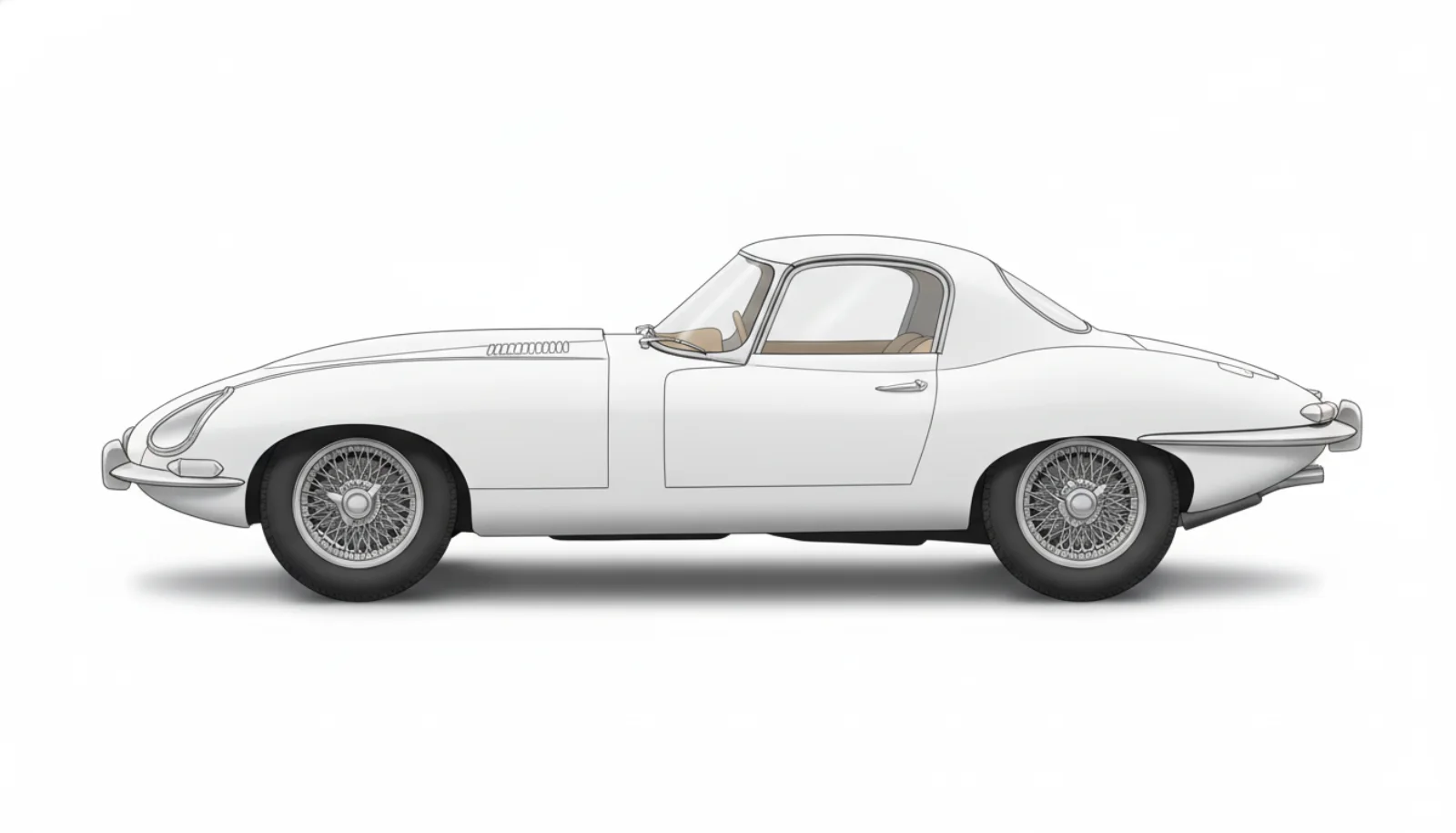
Illustrations are generated from period references and shown in the selected factory color; they are not photographs.
Where it was built
Where the cars went
- United States, 1961–1974: Motor Sport's figure for cars sold in the USA out of 72,507 built.
Against its rivals
Same class, same years. Each rival is shown in the specification and year a buyer would have cross-shopped.
Longer is better. Figures are for the variant and year named under each car, from the sources listed below.
In the comparison
Aston Martin DB4 · 1960 · United Kingdom
The British grand tourer of the day, with similar performance at nearly twice the price.
Ferrari 250 GT Lusso · 1963 · Italy
A 150 mph V12 coupé that cost well over twice as much in the United States.
Chevrolet Corvette Sting Ray (C2, 327 fuel injection) · 1963 · United States
The E-type's main competitor in its largest market, cheaper and quicker off the line.
Mercedes-Benz 230 SL · 1963 · Germany
A slower but more refined open two-seater at a similar price in export markets.
Factory options
| Option | Code | Years | Price | Built with it |
|---|---|---|---|---|
| Chromium-plated wire wheelsListed by the Jaguar Enthusiasts' Club for every series; wire wheels were the standard fitment on the six-cylinder cars. | — | 1961–1974 | — | — |
| Competition wire wheelsListed for Series 1 and 1½. | — | 1961–1968 | — | — |
| Detachable glass-fibre hardtop (open two-seater) | — | 1962–1974 | — | — |
| Radio installationThree installations with fitting kits were catalogued. | — | 1961–1974 | — | — |
| Sundym tinted glass | — | 1961–1974 | — | — |
| Front seat safety belts | — | 1961–1974 | — | — |
| Rear seat safety belts (2+2) | — | 1966–1973 | — | — |
| Electrically heated rear screenListed for the 2+2 on Series 1; generally listed on Series 2 and 3. | — | 1966–1973 | — | — |
| Clear glass rear door (fixed-head coupé) | — | 1961–1968 | — | — |
| Locking petrol filler cap | — | 1961–1974 | — | — |
| Bonnet- or door-mounted mirrors | — | 1961–1974 | — | — |
| Alternative tyres | — | 1961–1974 | — | — |
| 8:1 compression ratioLow-compression alternative to the standard 9:1 on the six-cylinder engines. | — | 1961–1971 | — | — |
| Automatic transmission (Borg-Warner 3-speed)2+2 only on the six-cylinder cars; any Series 3. | — | 1966–1974 | — | — |
| Power-assisted steeringFactory option on Series 2 (chassis prefix P); standard on Series 3. | — | 1968–1971 | — | — |
| Air conditioning | — | 1968–1974 | — | — |
| Front seat head restraints | — | 1968–1974 | — | — |
| Chromium-plated pressed-steel wheels | — | 1968–1974 | — | — |
| Steering column lock and ignition switchListed for the 4.2 Series 1 and 1½; standard on Series 2. | — | 1964–1968 | — | — |
| Electric radio aerial | — | 1971–1974 | — | — |
Known issues
Sill and floor corrosion
1961–1974majorThe outer sills and the underbody panels of the centre section are closed box sections that trap moisture and rot from the inside, so a car can look sound while its main structure is weak.
Fix Inspect on a lift and inside the sills; proper repair means cutting out and replacing the sections on a jig, ideally with photographic records from a known specialist.
Front frame mounts and bulkhead
1961–1974majorCorrosion where the tubular engine frame bolts to the front bulkhead, in the frames themselves and in the scuttle at the base of the windscreen compromises the structure that carries the engine and front suspension.
Fix Repair the bulkhead mounting points and renew corroded frames; have the work documented by a marque specialist.
Rear wheel-arch rot on coupés
1961–1973moderateOn fixed-head cars water collects where the inner and outer rear wings meet, attacking the wheel arch and the panel beneath the leading edge of the rear bumper.
Fix Replace the affected inner and outer wing sections.
Bonnet seam corrosion
1961–1974moderateThe large forward-hinged bonnet rusts along its seams.
Fix Repair or replace the bonnet and check its fit against the scuttle and sills.
Overheating and head-gasket trouble
1961–1967moderateEarly cars with a single cooling fan ran hot in traffic. Signs of a failing head gasket include emulsified oil under the filler cap, contaminated coolant and persistent smoke once warm.
Fix Twin electric fans, as fitted by the factory from the Series 1½ onward; check that the fan cuts in once the engine is warm and that oil pressure is steady.
Inboard rear brakes contaminated by oil
1961–1974moderateThe rear discs sit beside the differential, where leaking output-shaft seals contaminate them, and they are awkward to reach for servicing.
Fix Cure the oil leak and overhaul the rear brakes; access makes it a large job, so check that the car pulls up cleanly.
Brake servo on early cars
1961–1964moderateServo assistance was revised for the 4.2, which E-Type UK describes as more reliable than the 3.8 arrangement.
Fix Conversion to 4.2-type servo brakes is a documented upgrade; the 3.8 restored in Motor Sport's 1989 feature had it.
Clutch replacement needs the engine out
1961–1974minorThe clutch cannot be changed with the engine in place, so a worn clutch is an expensive job.
Fix Check bite and engagement before buying; budget for engine removal.
Moss gearbox on 3.8 cars
1961–1964minorThe four-speed Moss gearbox has no synchromesh on first and a slow, deliberate change.
Fix Not a fault as such. The all-synchromesh Jaguar gearbox of the 4.2 is easier to use, and Goodwood notes that some late 3.8s have it.
Heating and ventilation
1961–1974minorCabin heating and ventilation were weak throughout production, worst on the earliest cars.
Cramped footwells on flat-floor cars
1961–1962minorThe first cars have a flat floor that leaves little legroom for drivers taller than about 5 ft 9 in.
Fix Jaguar introduced recessed footwells during 1962.
How it was advertised
Jaguar launched the E-Type to the press in Geneva on 15 March 1961, initially for export only, and leaned far more on press reaction, motor shows and road tests than on paid advertising. In North America, where the car was sold as the XK-E by Jaguar Cars Inc. of East 57th Street, New York, the first magazine ads appeared within weeks of the launch: a 1961 tear sheet announcing "the new Jaguar XK-E" stressed disc brakes, independent rear suspension and the racing-derived monocoque. Early-1960s US ads were sober, photograph-led pages that sold the car as fully equipped at one price, with specifications laid out in dense type, while the factory issued brochures for each market and series.
Later advertising followed the business. As Jaguar became part of British Leyland, US ads leaned on wordplay and the big-cat image: "XKE topless" in Playboy in 1969, a 1970 comparison chart setting the XK-E's price against the Porsche 911, Mercedes-Benz and Maserati Ghibli (an approach later critics saw as cheapening the car), and for the 1971–1974 Series 3 the V12 sold as "the ultimate cat" in brochures and in men's-magazine ads such as "Nobody's Pussycat" and "Prowl Car", placed by British Leyland Motors Inc. of Leonia, New Jersey. UK brochures stayed restrained and typographic. No television campaign for the E-Type was found, and no agency of record was identified for either the UK or US advertising.
Where it ran: 4 documented placements
More advertisements, viewable at their source (10)
These are still under copyright, so we describe them and link to where they can be seen rather than reproduce them.
- 1961This is the New Jaguar XK-E!magazine · 1961-04 · The Henry Ford ↗Colour magazine tear sheet introducing the E-Type to Americans under its XK-E name, built around its racing-derived monocoque, independent suspension front and rear, and disc brakes.
- 1963Every Jaguar XK-E comes only one way—fully equipped (and ready to go!)magazine · Automotive History Preservation Society ↗Black-and-white page with three studio photographs (coupe in profile, roadster and coupe from above) over three columns of copy arguing that every XK-E arrives with the equipment other makers charge extra for, with roadster and coupe prices and Jaguar's overseas delivery plan.
- 1967The Jaguar 4.2 Litre E Typebrochure · Internet Archive (Car Brochures & Adverts collection) ↗UK brochure for the 4.2-litre car with a stark white cover: the title in a single line of serif capitals, the E set as a large black letter on a turquoise square.
- 1968Jaguar 'E' Type range Series 2brochure · 1968-10 · Internet Archive (Car Brochures & Adverts collection) ↗UK brochure for the Series 2 range; the cover shows only the nose of a red roadster entering the frame against a road and hedgerow blurred by speed.
- 1969XKE toplessmagazine · Playboy · 1969-10 · Internet Archive (Car Brochures & Adverts collection) ↗A silver Series 2 roadster photographed from above on wet tarmac, with a two-word pun as the headline and a single line giving the $5,534 East Coast price.
- 1970XK-E price comparison against Mercedes-Benz, Porsche 911 and Maserati Ghiblimagazine · Consumer Guide ↗A comparison chart setting the XK-E's roughly $5,500 price against far dearer rivals, selling one of the great sports cars as a bargain.
- 1971Jaguar Unlocks the Ultimate Cat (The 12-Cylinder Animal: Jaguar V-12)brochure · AutoPaper ↗Fourteen-page sales brochure for the Series 3 V12 2+2 and convertible, explaining the inherent balance and smoothness of the new V12 and closing with specifications.
- 1973Jaguar V-12: The ultimate cat.brochure · 1973-03 · Internet Archive (Car Brochures & Adverts collection) ↗US brochure for the V12 Series 3 with a close-up cover of the snarling Jaguar face badge in the centre of a chrome wheel.
- 1974Nobody's Pussycat.magazine · Esquire · 1974-04 · Internet Archive (Car Brochures & Adverts collection) ↗A dark blue V12 roadster with a woman standing in it, deep in a bank of ferns; the copy talks up the smoothness and acceleration of the V12 and its suspension and brakes. Placed by British Leyland Motors Inc. of Leonia, New Jersey.
- 1974Prowl Car.magazine · Playboy · 1974-06 · Internet Archive (Car Brochures & Adverts collection) ↗Head-on photograph of a yellow V12 roadster in tall grass with a woman behind it under a stormy sky; the copy plays on the big-cat theme, mentions the design's display at the Museum of Modern Art and Jaguar's Le Mans wins, and describes the V12.
No E-Type advertisement with a public-domain or open licence was found on Wikimedia Commons or in a museum open-access collection; all entries are link-only. UK press advertising for the E-Type (The Autocar, The Motor, national press) could not be documented from an accessible source; The Advertising Archives holds E-Type ads but blocked access. UK coverage here rests on two factory brochures. The 1971 brochure's market is not stated by the seller; the "Ultimate Cat" theme is confirmed for the US by a March 1973 US brochure in the Internet Archive. The often-quoted "Grace, Space, Pace" line was a general Jaguar slogan of the period; no source tied it to a specific E-Type ad, so it is not used here. Dealer listings mention a 1964 US ad citing a Car and Driver readers' award, but the page could not be opened, so it is not included. Internet Archive items are collectors' group uploads with no licence statement and are link-only; dates, markets and publications are as given in their titles.
Sources
- 1Research Guide No. 001F: Chassis Number Runs and Change Points by model, Jaguar E-type (Issue 3, January 2023) — Jaguar Daimler Heritage Trust factory
- 21974 Jaguar E-type Series 3 V12 Open Two-Seater HDU 555N (the last E-type built) — Jaguar Daimler Heritage Trust factory
- 3Jaguar Classic E-type 60 Collection drive honours memorable Geneva trip from 1961 — Jaguar Land Rover media archive factory
- 4XKE Car Numbers: A Guide (Roger Los) — XKEdata.com registry
- 5E-Type model catalogue: car number ranges by series, body and drive side — XKEdata.com registry
- 6E-Type colour catalogue — XKEdata.com registry
- 7E-type Series 1 (1961-1968): specifications, chassis numbers and production numbers — Jaguar Enthusiasts' Club club
- 8E-type Series 2 (1968-1971): specifications, chassis numbers and production numbers — Jaguar Enthusiasts' Club club
- 9E-type Series 3 (1971-1974): specifications, chassis numbers and production numbers — Jaguar Enthusiasts' Club club
- 10JCNA Series 1 E-Type Judge's Guide (draft), Appendices A, B and D: factory colour bulletins, production by year (Alan Karpovitch), transition to Series 1½ — Jaguar Clubs of North America club
- 11E-type Paint Codes by Roger Mills, E-type Club Newsletter Issue 6, May 2007 (archived copy) — Jaguar E-type Club club
- 12Info Guide: 1961-1967 Jaguar E-Type Series 1 (3.8L and 4.2L) — Classic Register reference
- 13Info Guide: 1968 Jaguar E-Type Series 1.5 — Classic Register reference
- 14The Jaguar E-Type 3.8, 4.2 & V12 (April 1989) — Motor Sport magazine reference
- 15Jaguar E-Type timeline, Part I (1961-1967) — web-cars.com reference
- 16Jaguar E-Type timeline, Part II (1968-1975) — web-cars.com reference
- 17Buyer's Guide: Jaguar E-type — Goodwood Classic Car Insurance reference
- 18The History of the Jaguar E-Type Series 1 — E-Type UK reference
- 19Jaguar E-Type — Wikipedia reference
- 20Aston Martin DB4 — Wikipedia reference
- 21Chevrolet Corvette (C2) — Wikipedia reference
- 22Ferrari 250 GT Lusso — Wikipedia reference
- 23Mercedes-Benz W113 — Wikipedia reference
Research notes: what is not documented, and where sources disagree (19)
- Chassis numbers: the Jaguar Daimler Heritage Trust guide prints the 4.2 and later numbers with a space after the prefix (1E 1001); they are written here without it, as XKEdata and the clubs do. The Trust states its change points and dates are approximate.
- Per-year serial entries give the Trust's first chassis number for each production year with no end number; the Trust does not publish last numbers by year. The JCNA table (Appendix B, Table 2) does give first and last numbers for 1961-68 and differs from the Trust on some year boundaries: 1962 FHC RHD starts 860139 (Trust 860134); 1964 starts 850801 OTS RHD (Trust 850808), 889751 FHC LHD (Trust 889752) and 861440 FHC RHD (Trust 861434).
- Last-number conflicts: 3.8 OTS LHD 881886 (Trust) against 881887 (XKEdata, JCNA); 3.8 FHC LHD 890872 (Trust, JCNA) against 890873 (XKEdata); Series 1½ last numbers are one higher in XKEdata than in the Trust guide on five of six runs.
- Production counts by run are XKEdata's (registry). The Jaguar Enthusiasts' Club table is one lower on eight runs (3.8 OTS LHD, 3.8 FHC LHD, Series 1½ OTS RHD, OTS LHD, FHC LHD and 2+2 LHD, Series 2 FHC RHD and 2+2 RHD) and prints 4,230 for the Series 1½ FHC RHD, an obvious misprint (XKEdata 375). Motor Sport, citing Paul Skilleter, gives 15,496 for the 3.8 (7,827 OTS, 7,669 FHC), which matches the club's rows.
- Total production: 72,507 is the published figure; XKEdata's rows sum to 72,516. Graham Robson's totals as quoted by Wikipedia differ again (15,490 3.8s, 17,320 4.2s, 10,930 2+2s, 13,490 Series 2, 15,290 Series 3). E-Type UK quotes 33,205 Series 1 cars.
- Where the Series 1 ends and the Series 1½ begins is a matter of definition. XKEdata and the JEC use the open-headlamp bonnet change points (1E1864, 1E15889, 1E21584, 1E34250, 1E50975, 1E77645; 6,720 cars); the Trust's September 1967 row and JCNA use the first Zenith-Stromberg cars (1E15980, 1E34583, 1E77709 for left-hand drive; 6,232 cars per JCNA). For the LHD coupé XKEdata gives 1E34250 but Service Bulletin P.198 as quoted by JCNA gives 1E34550.
- Units by calendar year for 1961-67 are from the JCNA draft Judge's Guide (Alan Karpovitch), counted from chassis numbers allocated, with left- and right-hand drive added together for each body. They total 32,181 for 1961-67, against XKEdata's 31,699 for the Series 1, because of the boundary difference above; JCNA also notes seven 1963 and two 1965 numbers allocated but not built, and splits 1967 into 726 'Series 1.0' and 2,585 open-headlamp 'Series 1.25' cars. web-cars.com publishes a different by-year series (2,013 for 1961, 6,253 for 1962, 4,010 for 1963) without a source.
- No reliable units by year were found for the Series 1½ split, Series 2 or Series 3, so those model years carry no unit counts. web-cars.com gives yearly 'sales' figures for 1968-74 that contradict themselves and were not used.
- Power and torque: Jaguar's 265 bhp figures are gross claims; the sources opened do not state the standard. Torque for the 3.8 is 260 lb ft in the JEC table and web-cars.com but 240 lb ft on Wikipedia. The V12 is 272 bhp in the JEC table and 266 bhp on the Heritage Trust page; the JEC gives 304 lb ft. The US Stromberg figure is 246 hp on Wikipedia and 245 hp on Classic Register.
- Performance: only the 3.8 (The Motor, 1961) and 4.2 (The Motor, October 1964; Autocar, May 1965, recorded 153 mph and 7.6 s) figures are traced to named road tests. The 2+2 and V12 figures are club and Heritage Trust figures with no test named. No 0-60 or top speed was documented for the Series 1½ or Series 2, so they are null. Motor Sport notes that the 150 mph press cars of 1961 were specially prepared.
- Weights and dimensions are Wikipedia's (from the Bentley official manual): Series 1 OTS 2,770 lb, FHC 2,900 lb, 2+2 3,090 lb; Series 2 OTS 2,750 lb, FHC 3,018 lb, 2+2 3,090 lb. The JEC table gives 24 cwt (3.8), 25.1 cwt (4.2) and 27.7 cwt (2+2). No weight was documented for the Series 1½.
- Prices: only the 1961 UK and US launch prices and an approximate 1969 US price were documented. UK and US prices for the 4.2, 2+2, Series 2 and V12 were not found in a source opened and are omitted. web-cars.com also converts the 1961 prices as £1,830 roadster and £1,954 coupé, which does not match Motor Sport's £1,480 and £1,550 basic.
- Colours: years are those XKEdata marks for each colour, adjusted where a factory bulletin or chart reproduced by JCNA shows the colour earlier or later; every such case is noted on the colour. Codes are Jaguar's own Q.A.D. reference numbers from service bulletins where one was found; most solid colours have only paint-maker references. Hex values are screen approximations. Units built per colour are not documented.
- Interior trim colours are documented only for 1961-68 (US market documents). Series 2 and Series 3 trim ranges, and option prices for any series, were not found.
- Rivals: figures are those of the Wikipedia article for each car. The Corvette unit figure is the whole 1963-67 C2 run (21,513 were 1963 models); the DB4 figure excludes the GT and Zagato. Nulls mean the article gives no figure.
- Series 2 production years: every Series 2 run ends in 1970 in the Heritage Trust guide; the series is dated to 1971 by the clubs because US 1971-model cars (2R prefix) were sold into that year, so a 1971 entry is kept with no production.
- Markets: only the United States total was documented. Wikipedia notes that delivery numbers by market and year are in Philip Porter's book, which was not available online.
- The Geneva drive by Norman Dewis is described as an 11-hour run by Jaguar Land Rover's media archive; other accounts say 17 hours.
- Assembly at Browns Lane and the 2+2's public launch month (March 1966, as Classic Register dates its production) rest on general references, not on the Heritage Trust guide, which records the first 2+2 chassis in September and October 1965.
23 sources. Paint swatches are screen approximations of the factory colors.