Model year
Generation
NA6 (1.6, Eunos Roadster NA6CE)
Built in 1989
Built in all, 1989–1997
Serial numbers, 1989
Not documented
Price new, 1989
¥1,700,000
Japan · Eunos Roadster standard model
Origin
Japan
Front-mid-engine, rear-wheel drive
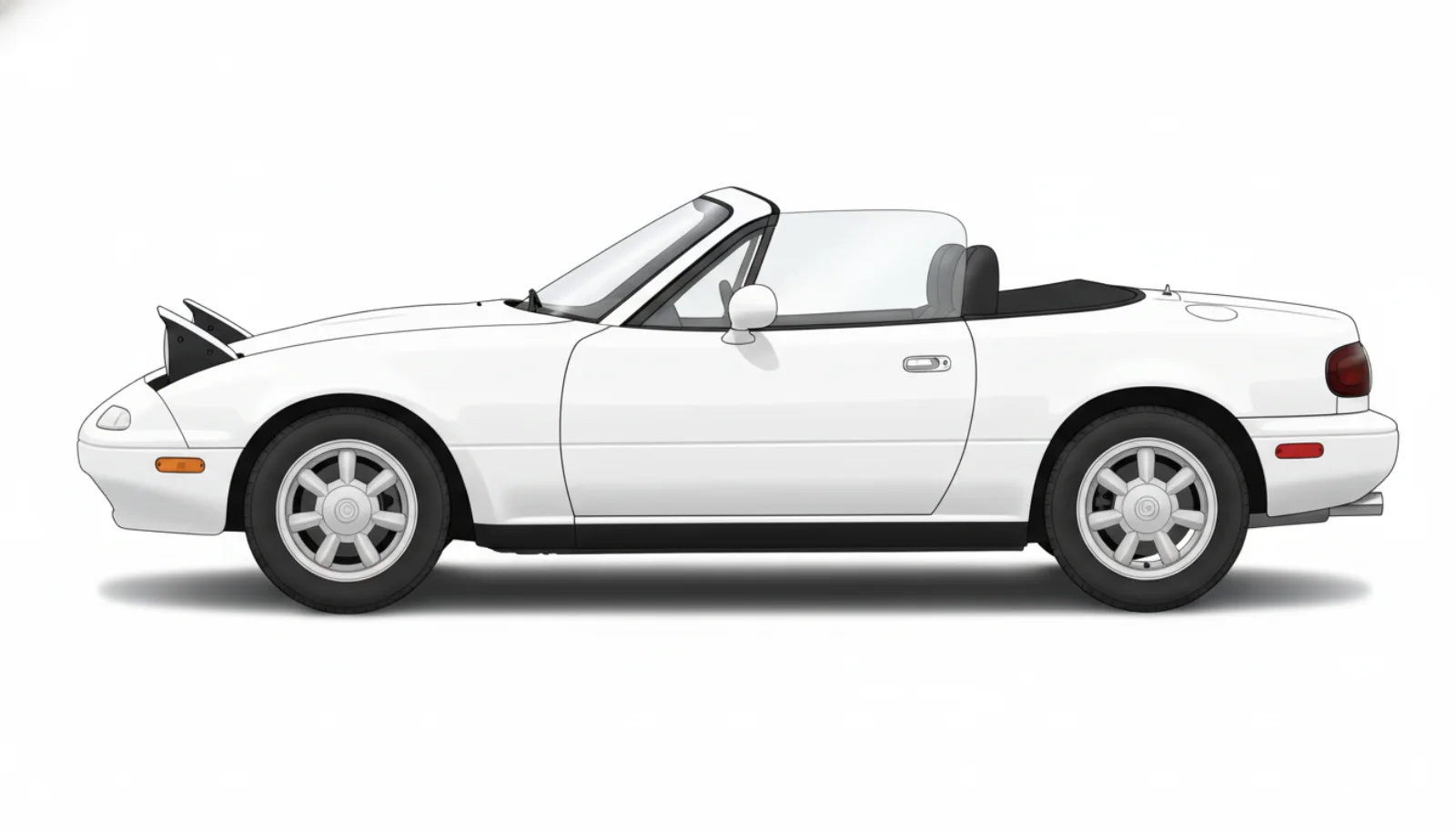
Mazda's first-generation two-seat roadster of 1989 to 1997, sold as the MX-5 Miata, the MX-5 and in Japan the Eunos Roadster, with 1.6- and 1.8-litre twin-cam fours.
Sports car46 sources
How it launched in 1989
- 01Mass-production project began in February 1986 and the design was approved in September 1987 (Mazda).
- 02Shown as the MX-5 Miata at the Chicago Auto Show in February 1989 (Mazda's press kit gives 9 February; Wikipedia 10 February). Production began in April 1989 at Hiroshima.
- 03First US deliveries in May 1989 as a 1990 model; Japanese sales as the Eunos Roadster from September 1989 at 1.7 million yen; Europe followed in 1990.
- 04Launch specification: 1.6-litre B6-ZE twin-cam (116 hp US), five-speed manual only, double wishbones all round, four-wheel discs, 14-inch wheels, black interior and black top only.
- 05Production: 12 pre-production cars in 1988 (S1-1 to S1-12) and 45,266 in calendar 1989 (Mazda).
NA6 (1.6, Eunos Roadster NA6CE), 1989–1993
The launch car: a steel monocoque two-seater with an aluminium bonnet, double wishbones at all four corners, four-wheel disc brakes, pop-up headlamps and a manual soft top. Power came from the 1.6-litre B6-ZE twin-cam four, mounted behind the front axle line and tied to the differential by an aluminium powerplant frame. North America took it as the Miata from the 1990 model year with A and B option packages; Japan sold it through the new Eunos dealer channel as the Eunos Roadster from September 1989; Europe and the UK received it as the MX-5 in 1990. An automatic arrived in 1990 (Japan) and for 1991 (US), ABS for 1991, a rear subframe brace for 1992, and a growing list of colour-themed limited editions in every market.
Body styles by year
Trim lines and engines, 1989
| Line | Power | Torque | 0–60 mph | Top speed | Weight |
|---|---|---|---|---|---|
1.6 L B6-ZE DOHC 16-valve inline-four (78.0 x 83.6 mm), electronic port fuel injection | 116 hp | 100 lb-ft | 9.2 s | 116 mph | 2,210 lb |
1.6 L B6-ZE DOHC 16-valve inline-four (78.0 x 83.6 mm), electronic port fuel injection | — | — | — | — | — |
Miata 1.6 (North America)
1989–1993
- Engine
- 1.6 L B6-ZE DOHC 16-valve inline-four (78.0 x 83.6 mm), electronic port fuel injection
- Displacement
- 1,597 cc
- Layout
- I4 · naturally aspirated · RWD
- Power
- 116 hp (SAE net, at 6,500 rpm, as quoted by Car and Driver (September 1989))
- Torque
- 100 lb-ft
- 0–60 mph
- 9.2 s — Car and Driver, September 1989 (manual, hardtop fitted); Motor Trend's July 1989 first test recorded 8.9 s
- Top speed
- 116 mph
- Weight
- 2,210 lb
- Gearboxes
- 5-speed manual; 4-speed automatic (Jatco), from the 1991 model year
- Length × width × height
- 155.4 × 65.9 × 48.2 in
- Wheelbase
- 89.2 in
- Body styles
- Roadster (soft top; removable hardtop optional)
- Price new
- $13,800 (1990, United States)
- Built
- Not documented
What this line added
- Base car: manual steering, 14-inch steel wheels, no radio, black cloth interior and black top
- A Package: power steering, leather-wrapped steering wheel, 14 x 5.5 alloy wheels, cassette stereo
- B Package: A Package plus cruise control, power windows and headrest speakers
Factory colors, 1989
4 of 22 documented colors were offered this year. Pick one to repaint the page.
Interiors, 1989
Units built by year
Left- and right-hand drive
The split is not documented.
Japan, the UK and Australia took right-hand drive and North America and continental Europe left-hand drive, but no source opened gives production by drive side.
Mazda Motor UK press kit (2014): first generation 1988-1998. Mazda's calendar-year production table sums to 433,963 for 1988-1997 (12 pilot cars plus 433,951), so a little of 1997's output was presumably NB; the split is not published.
Price when new
Lowest list price each year in United States, in USD of the day. Not adjusted for inflation.
Serial number ranges
Serial number ranges are not documented for this car.
The car
Mazda showed the MX-5 Miata at the Chicago Auto Show in February 1989 and began building it in Hiroshima that April. It was a deliberately simple open two-seater in the manner of 1960s British and Italian roadsters: a steel monocoque with an aluminium bonnet, double-wishbone suspension at each corner, four-wheel disc brakes, pop-up headlamps, a hand-folded soft top and a twin-cam 1.6-litre four mounted behind the front axle so the car balanced evenly front to rear. US deliveries began in May 1989 as a 1990 model at a base price of $13,800; Japan sold it from September 1989 as the Eunos Roadster, and Europe and the UK from 1990.
For 1994 (July 1993 in Japan) a 1.8-litre engine, passenger airbag, bigger brakes, a Torsen differential and extra chassis bracing arrived; US output rose from 116 hp to 128 hp and then 133 hp with OBD-II for 1996. Europe kept a detuned 1.6 as an entry model. Each market built its own run of limited editions: numbered colour-and-trim cars in the US (the 1991 British Racing Green car, the 1993 black-and-red Limited Edition, four M Editions and the STO), lottery-sold Japanese limited models including the M2 cars, and a long series of named UK specials ending with the Berkeley in 1998.
Mazda's figures put first-generation production at 431,506 cars, and its sales records show about half went to the United States. Production ended in December 1997; the NB that replaced it was shown at the Tokyo Motor Show in October 1997 and went on sale in Japan in January 1998. North America skipped the 1998 model year.
- Class
- Sports car
- Layout
- Front-mid-engine, rear-wheel drive
- Origin
- Japan
- Designers
- Tom Matano, Shunji Tanaka, Bob Hall, Masakatsu Kato, Toshihiko Hirai (programme chief)
- Also known as
- MX-5 Miata, Miata, Eunos Roadster, NA6CE, NA8C
- In production
- 1989–1997
Milestones
- 1986
February: Mazda starts the production project.
- 1987
September: design approved.
- 1989
February: shown as the MX-5 Miata at the Chicago Auto Show.
- 1989
April: production begins at Hiroshima; May: first US deliveries as a 1990 model.
- 1989
September: Eunos Roadster goes on sale in Japan.
- 1990
MX-5 goes on sale in Europe and the UK; automatic added in Japan (March); V Special launched (July).
- 1991
Mazda's 787B wins at Le Mans; Mazda UK marks it with 24 MX-5 Le Mans turbo cars.
- 1993
July: 1.8-litre NA8C replaces the 1.6 in Japan.
- 1997
October: second-generation MX-5 revealed at the Tokyo Motor Show; December: NA production ends.
- 1998
January: the NB replaces the Eunos Roadster in Japan; the UK sells the final 400 NA cars as the Berkeley.
Pictures
Illustrations are generated from period references and shown in the selected factory color; they are not photographs.
Where it was built
Where the cars went
- United States, 1990–1997: Sum of Mazda's US sales by model year 1990-97 (51,658 / 34,610 / 24,847 / 22,350 / 22,705 / 20,790 / 17,984 / 17,381). Mazda's US production by model year totals 215,364.
- Canada, 1990–1997: Sum of Mazda's Canadian sales by model year 1990-97.
- Japan, 1989–1997: Sum of Mazda's Japanese sales by calendar year 1989-97; the Eunos Roadster was still sold into January 1998, which this excludes.
- Australia, 1989–1997: Sum of Mazda's Australian sales by calendar year 1989-97 (the 2014 Mazda UK press kit has slightly different yearly figures).
- Germany, 1989–1997: Sum of Mazda Europe registrations by calendar year 1989-97.
- United Kingdom, 1990–1997: Sum of Mazda Europe registrations by calendar year 1990-97; excludes 1998 (the Berkeley and other run-out cars) and private Eunos imports.
- Italy, 1990–1997: Sum of calendar-year registrations 1990-97.
- Switzerland, 1990–1997: Sum of calendar-year registrations 1990-97.
- France, 1990–1997: Sum of calendar-year registrations 1990-97.
Against its rivals
Same class, same years. Each rival is shown in the specification and year a buyer would have cross-shopped.
Longer is better. Figures are for the variant and year named under each car, from the sources listed below.
In the comparison
Lotus Elan SE (M100) turbo · 1990 · United Kingdom
The other new small British-built roadster of 1989-90, front-wheel drive and much dearer; Wikipedia attributes its slow sales to the MX-5.
Alfa Romeo Spider 2000 (Series 4) · 1991 · Italy
The long-running front-engined, rear-drive Italian roadster the Miata drew buyers from.
MG F 1.8i · 1995 · United Kingdom
Rover's mid-engined two-seater, developed to sit at the MX-5's size and price.
BMW Z3 1.9 · 1996 · Germany
BMW's four-cylinder roadster, built in the US and aimed directly at the Miata's market.
Factory options
| Option | Code | Years | Price | Built with it |
|---|---|---|---|---|
| A PackagePower steering, leather-wrapped wheel, alloy wheels, cassette stereo (later power mirrors, headrest speakers and, for 1994, Torsen LSD). US cars by model year: 27,131 / 16,157 / 9,912 / 6,385 / 6,834. | — | 1990–1994 | $1,145 | 66,419 |
| B PackageA Package plus cruise control, power windows and headrest speakers (power antenna from 1992). US: 16,483 / 11,560 / 7,459 / 4,073 / 2,259. | — | 1990–1994 | $1,930 | 41,834 |
| C PackageB Package plus tan leather and tan top. US 1993 6,723 and 1994 4,853 (Mazda Marketing's 'C & STO' row, excluding the 1,500 STOs of 1997). | — | 1993–1994 | $2,285 | 11,576 |
| Leather PackagePopular Equipment Package plus tan leather and tan top ($2,595 with automatic). US 1995-97: 3,937 / 3,348 / 2,113 (the 'L & BRG' row, excluding the 3,997 BRG cars of 1991). | — | 1995–1997 | $2,985 | 9,398 |
| Popular Equipment PackagePower steering, leather wheel, power mirrors, alloys, Torsen LSD (manual), headrest speakers, cruise, power windows and antenna ($1,700 with automatic). US: 5,527 / 4,697 / 1,122. | — | 1995–1997 | $2,090 | 11,346 |
| Touring PackagePower steering, leather wheel, power windows and mirrors, alloys, door map pockets. Price not listed in the miata.net table. | — | 1997 | — | 6,846 |
| Power Steering PackagePower steering and wheel trim rings. | — | 1994–1997 | $300 | — |
| R PackageBilstein sport suspension, aero parts, alloys, Torsen LSD; no power steering or automatic. US: 1,218 / 465 / 111 / 47. | — | 1994–1997 | $1,500 | 1,841 |
| Special Touring Package (STO)The STO's equipment, Twilight Blue only. | — | 1997 | $1,100 | 1,500 |
| Removable hardtopSMC hardtop; Classic Red only and package-only in 1990, heated rear window and headliner from 1992 ($1,500). 519 of the 1,519 Sunburst Yellow cars had one. | — | 1989–1997 | $1,400 | — |
| Air conditioning | — | 1990–1997 | $795 | — |
| Viscous limited-slip differentialManual cars; replaced by the Torsen unit in packages from 1994. | — | 1990–1993 | $250 | — |
| Anti-lock brakesRequired the B Package (or the Black Miata) when introduced. | — | 1991–1997 | $900 | — |
| Four-speed automatic | — | 1991–1997 | $720 | — |
| Compact disc playerDealer item 1993-96; $350 in 1997. | — | 1991–1992 | $600 | — |
| Mazda Sensory Sound System with CD | — | 1993–1997 | $700 | — |
| Sunburst Yellow paint | — | 1992 | $250 | 1,519 |
Known issues
Short-nose crankshaft keyway failure
1989–1991majorEarly 1.6 engines use a small-diameter crankshaft nose with a short keyway. The key can wear the slot or the pulley bolt can lose its torque, especially after the bolt has been disturbed for a front-seal change; a wasted keyway cannot be repaired and failure stops the car. miata.net put reported failures at about 1% of owners. Applies to 1990 and 1991 North American cars up to VIN serial 209446 (European breakpoint 127442); a four-slot crank pulley identifies the short nose, an eight-slot pulley the later big nose.
Fix Leave the pulley bolt undisturbed during cam-belt changes if the seal is not leaking, check the pulley for wobble, and torque correctly (80-87 lb-ft on short-nose cars). A failed keyway means a replacement crankshaft or engine; a Loctite repair is the accepted stop-gap.
Sill and rear wheel-arch corrosion from blocked hood drains
1989–1997majorThe soft-top drain tubes ahead of the rear wheels block, water collects inside the sills and the rear sills and arches rot from the inside out despite galvanised panels. Structural repair can cost more than a tired car is worth.
Fix Keep the drain tubes clear; inspect sills, rear arches and any old welding before buying.
Corrosion elsewhere: front wishbones, crossmember, windscreen frame, boot lid
1989–1997moderateBuyer's guides also list rust on the front wishbones and crossmember, the windscreen surround, the lower edges of the boot lid, and door jambs of early cars where moisture is trapped under the kick plates.
Noisy hydraulic tappets
1989–1997minorTappet rattle at start-up, more common on the 1.8 and where oil changes were skipped; it should fade as the engine warms.
Fix Regular oil changes.
Oil leaks at cam cover and cam-angle sensor
1989–1997minorThe cam cover gasket and the cam-angle sensor O-ring commonly leak.
Fix Inexpensive gasket and O-ring replacement.
Clutch slave cylinder and rear calipers
1989–1997minorThe clutch slave cylinder often fails and the rear calipers' handbrake mechanisms seize.
Fix Both are cheap, simple replacements.
Water pump wear and cam-belt interval
1989–1997minorWater pumps on early cars wear and knock. The engine is non-interference, but the belt is due every five years or 60,000 miles (Octane; PistonHeads says 50,000 miles).
Fix Replace the water pump with the cam belt.
Soft-top wear and leaks
1989–1997minorHoods tear, zips fail and the plastic rear screen clouds; a worn hood lets water into the cabin. PistonHeads gives a hood life of three to five years.
Fix Replacement vinyl hoods are plentiful; a glass-window hood is a common upgrade.
Exhaust downpipe cracking
1994–1997minorOctane reports cracked downpipe welds on mid-1990s cars, plus rattling heat shields.
Boot-mounted battery
1989–1997minorThe battery lives in the boot; if not properly secured it can dent the right-hand wing from inside.
Fix Secure it correctly.
How it was advertised
The MX-5 was unveiled at the Chicago Auto Show on 10 February 1989 at about US$14,000 and went on sale in the US and Canada in May 1989 as a 1990 model, with demand running ahead of supply on the strength of the press reviews; in Japan it was launched on 1 September 1989 as the Eunos Roadster, sold through Mazda's new upmarket Eunos sales channel, and it reached Europe in 1990. The American launch advertising, carrying Mazda's "It just feels right" signature, sold the car on nostalgia as much as technology: a red Miata in the foreground, a translucent image of friends in an old roadster behind, and copy promising a glimpse of the 1990s that also took the driver back to classic open sports cars. Japanese Eunos literature was restrained and premium in tone.
Later NA-generation promotion leaned on awards and limited editions: Automobile magazine's 1990 Automobile of the Year and Car and Driver's 10Best list (1990–1992), anniversary and racing-themed editions in Japan and the UK, and the 1997 US Special Touring Option sold under the line "Still The One". Mazda also advertised the car on US television with spots focused on the driving experience and lease pricing. No agency of record was documented.
Where it ran: 4 documented placements
More advertisements, viewable at their source (7)
These are still under copyright, so we describe them and link to where they can be seen rather than reproduce them.
- 1989Eunos Roadsterbrochure · 1989-07 · Internet Archive (Car Brochures & Adverts collection) ↗Japanese launch brochure for the Eunos Roadster, its white cover carrying only the Eunos shield and the name in plain black capitals.
- 1989Mazda Miata (1990 US brochure)brochure · 1989-07 · Internet Archive (Car Brochures & Adverts collection) ↗First US brochure: a red Miata driving a coast road in a colour inset, above the same car on a misty, sepia-toned clifftop highway.
- 1989Introducing Mazda Miata. It not only gives you a glimpse of the '90s... it takes you back, as well.magazine · Time · 1989-08-21 · Internet Archive (Car Brochures & Adverts collection) ↗Two-page spread: a red Miata in profile on a gravel verge, overlaid with a faded, golden image of laughing young people in an older open roadster. The copy presents the car as a pure two-seat roadster evoking the classic sports cars, then lists the twin-cam engine, five-speed and double-wishbone suspension, signed "It just feels right".
- 1989Mazda MX-5 (1990 Australian brochure)brochure · 1989-10 · Internet Archive (Car Brochures & Adverts collection) ↗Australian-market launch brochure for the MX-5, dated October 1989.
- 1992Mazda MX-5 (UK brochure)brochure · 1992-01 · Internet Archive (Car Brochures & Adverts collection) ↗UK brochure with a tight, low close-up of a red MX-5's nose and windscreen glowing in autumn backlight.
- 1997Mazda Miata '97 television commercialtelevision · CBS / WOIO 19 (Cleveland) · 1997-02-19 · Internet Archive (TV News Archive) ↗Commercial for the 1997 Miata with a voice-over on the pleasure of driving the car and on-screen pricing and lease terms, as recorded off air in Cleveland.
- 1997Still The Oneother · Wikipedia ↗Mazda USA's line for the 1997 Special Touring Option, a run of 1,500 cars near the end of the first generation.
No NA-generation MX-5 advertisement with a public-domain or open licence was found on Wikimedia Commons; US ads from March 1989 onward carry automatic copyright, so none would qualify. All entries are link-only. The "It just feels right" signature is read from the 1989 Time ad itself; the agency behind the US campaign was not documented because the web-search budget for this run was exhausted. Brochure dates and markets come from the Internet Archive item titles (collectors' group uploads, no licence stated). The Australian brochure was not opened beyond its listing. The medium of the "Still The One" campaign is not stated by Wikipedia, hence medium other. Many more NA brochures (Japanese special editions 1990–1997, Netherlands, Germany, UK 1997) exist in the same Internet Archive collection and could be added.
Sources
- 1Long Live the Roadster! All-new Mazda MX-5 press kit (ref. 140904HA), incl. production and sales volumes 1988-2014 — Mazda Motor UK factory
- 2MX-5 chronology (History of Craft Spirit) — Mazda Motor Corporation factory
- 3Mazda Roadster / MX-5 / Miata Production and Exports by Calendar Year, 1988-2006 (official Mazda records, compiled by Brian Sundue) — Mazda, hosted by miata.net factory
- 4Mazda Roadster / MX-5 / Miata Sales by Calendar Year, All Markets, 1989-2006 (official Mazda records) — Mazda, hosted by miata.net factory
- 5Mazda MX-5/Miata Sales by Model Year, North America, 1990-2006 (official Mazda records) — Mazda, hosted by miata.net factory
- 6Mazda MX-5 Registrations by Calendar Year, Europe, 1989-2004 — Mazda, hosted by miata.net factory
- 7Miata FAQ: Production Information (US colour and package counts from Mazda Marketing, Irvine; sticker-price table by John Emerson) — miata.net club
- 8Special Edition and Limited Production Miatas (John Emerson) — miata.net club
- 9Miatas in America: 1990 (Chris Lambert) — miata.net club
- 10Miatas in America: 1991 — miata.net club
- 11Miatas in America: 1992 — miata.net club
- 12Miatas in America: 1993 — miata.net club
- 13Miatas in America: 1994 — miata.net club
- 14Miatas in America: 1995 — miata.net club
- 15Miatas in America: 1996 — miata.net club
- 16Miatas in America: 1997 — miata.net club
- 17What About Those Crankshafts? (Lance Schall) — miata.net Garage club
- 18Pantone Color Matches for Miata paint (K. Zack Broadbent) — miata.net club
- 19Mazda Miata (1990-1997) Paint Colors and Brochures — ImportArchive reference
- 201995 Mazda Miata touch-up paint colours — AutomotiveTouchup reference
- 21Tested: 1990 Mazda MX-5 Miata (William Jeanes, September 1989) — Car and Driver period-test
- 22Mazda MX-5 Miata 0-60 times (aggregated Car and Driver and Motor Trend tests) — 0-60specs.com reference
- 23Mazda MX-5 (NA) — Wikipedia reference
- 24マツダ・ロードスター (初代 NA系) — Wikipedia (Japanese) reference
- 25Mazda MX-5 BBR Turbo — Bourne Road Garage reference
- 26Mazda MX-5 Limited Edition — Bourne Road Garage reference
- 27Mazda MX-5 Le Mans — Bourne Road Garage reference
- 28Mazda MX-5 SE (1st Release) — Bourne Road Garage reference
- 29Mazda MX-5 SE (2nd Release) — Bourne Road Garage reference
- 30Mazda MX-5 California — Bourne Road Garage reference
- 31Mazda MX-5 Gleneagles — Bourne Road Garage reference
- 32Mazda MX-5 Monaco — Bourne Road Garage reference
- 33Mazda MX-5 Merlot — Bourne Road Garage reference
- 34Mazda MX-5 Monza — Bourne Road Garage reference
- 35Mazda MX-5 Harvard — Bourne Road Garage reference
- 36Mazda MX-5 Dakar — Bourne Road Garage reference
- 37Mazda MX-5 Classic — Bourne Road Garage reference
- 38Mazda MX-5 Berkeley — Bourne Road Garage reference
- 39Mazda MX-5 Mk1 (NA) buying guide, history and model review — Octane reference
- 40Mazda MX-5 (NA) 1989-1998: PH pocket buying guide — PistonHeads reference
- 41Your Guide To Every Special Edition Mazda Miata Ever Sold In America (Travis Okulski, 2015) — Jalopnik reference
- 42Road Test: Lotus Elan SE (December 1990) — Motor Sport period-test
- 43Lotus Elan: Elan (M100) — Wikipedia reference
- 44Alfa Romeo Spider (105/115): Series 4 and production table — Wikipedia reference
- 45MG F / MG TF: engine table — Wikipedia reference
- 46BMW Z3: engine table — Wikipedia reference
Research notes: what is not documented, and where sources disagree (17)
- Total production: 431,506 is Mazda UK's first-generation figure; PistonHeads' '421,107 built' is in fact Mazda's cumulative worldwide sales to the end of 1997, not production.
- Model-year `units` are Mazda's worldwide production by calendar year, which counts both engines in 1993 and includes the pilot run only in the 1989 note. US model-year production (Mazda Marketing, via miata.net) and US model-year sales are given in each year's changes. Production by engine (1.6 vs 1.8) and therefore by generation is not published; generation `units` stay null. The body-style count is the 431,506 total because the NA was built only as a roadster.
- Launch date: Mazda UK's press kit says the Chicago debut was 9 February 1989, Wikipedia says 10 February. Japanese Wikipedia says cumulative production reached 300,000 in February 1994, but Mazda's calendar-year table already passes 300,000 (301,807) by the end of 1993; not used as a milestone.
- Japanese launch dates: Mazda's chronology dates the V Special to July 1990 and the S Special to July 1992; Japanese Wikipedia's timeline says August 1990 and September 1992 (its body text agrees with July for both).
- US prices: the miata.net sticker-price table (John Emerson) marks 1990, 1991, 1996 and 1997 base prices with footnotes (a, b, f, g) whose text was not on the archived page. Wikipedia gives a $13,995 launch base price and $14,000 at the Chicago show; Car and Driver's September 1989 test and the miata.net table give $13,800, used here.
- US special-edition counts: BRG Special Edition 3,997 (Mazda Marketing; Mazda said limited to 4,000); Black Miata 4,626 (package and colour tables) vs 4,625 (special-edition table and Jalopnik); 1993 Limited Edition 1,505 vs the 1,500 numbered/announced; 1996 M Edition 2,968 (special-edition table) vs 3,000 (colour and package tables, Jalopnik); Sunburst Yellow 1,519 by VIN count vs 1,515 in the colour table; Laguna Blue 1,797 + 562 (special-edition table) vs 1,788 + 440 (colour table). The miata.net colour table also lists 122 'UC White' cars for 1995, which matches the Laguna Blue Leather Package count and looks like a misplaced row.
- Silver Stone Metallic: the colour table counts 10,758 US cars for 1990-92; Chris Lambert's 1993 page says approximately 18,000 silver Miatas were sold in the US. The table (Mazda Marketing data) is used.
- Canada: Wikipedia gives Canadian counts for the BRG SE (1,051), Sunburst Yellow (503), 1993 LE (300) and a 1997 Canadian Speedster Edition (150), citing Jalopnik, but the Jalopnik article as read gives only US totals. These are left out as unconfirmed.
- The STO's equipment differs between sources: John Emerson's FAQ says ABS and cruise control were not available, while Chris Lambert's 1997 page lists ABS as an option and describes it as Leather Package based. Emerson's list is followed in the variant text.
- Japanese limited editions: unit counts are from Mazda's own chronology (J Limited 800, M2 1001 300, M2 1002 100, S Limited 1,000, J Limited II 800, M2 1028 300, RS Limited 500, G Limited 1,500, R Limited 1,000, B2 Limited 1,000, R2 Limited 500, SR Limited 700). Japanese Wikipedia adds Tokyo Limited (40) and VR Limited, but gives VR Limited as 700 in one sentence and 800 for Combination B in the next; Mazda's chronology does not list it, so VR Limited units stay null. Mazda's chronology gives 100 for the M2 1002; English Wikipedia says 300. Japanese prices beyond the 1989 launch and the M2 1001 were not documented.
- UK special editions come from Bourne Road Garage, a Mazda dealer that reproduces Mazda UK brochures. Its Limited Edition page says the car was based on a 1.8 with 15-inch BBS wheels, but the car was built in 1991 when only the 1.6 existed, and Wikipedia (citing the same site's older page) gives 1.6 with 15-inch OZ wheels from Mazda Sports Workshop; the 1.6 is used. It also states 25 of the 250 may have been reserved for tax-free or export sales. Both SE releases are given the same April 1992 to August 1993 build window, which looks like a copying error. The BBR Turbo count is 'approximately 850' and stays null in the variant; its 6.8 s acceleration figure is to 68 mph. The Dakar (400, £17,210) and Classic (400, £17,495) pages give no dates, so those variants carry the whole UK 1.8 span (1994-98) rather than a guessed year.
- Paint codes are Mazda's US codes from the miata.net colour table (Mazda Marketing data), corroborated by ImportArchive. Merlot Mica is A1Q in miata.net and AutomotiveTouchup but A7 in ImportArchive. No codes were found for the Japan-only and UK-only colours except HQ (Blue Black, Japanese Wikipedia). Colour unit counts are US-market cars only. Hex values are screen approximations guided by miata.net's Pantone matches where one exists.
- VIN/serial ranges: no source opened publishes first and last serial numbers by year or market, so `serialRanges` is empty. Documented points: the model code NA occupies VIN positions 4-5 (miata.net), and the crankshaft change at North American serial 209447 (European 127442).
- Drive side: no LHD/RHD production split was found.
- Performance: the 1.8 figures (Car and Driver 8.8 s, R Package 8.2 s, M Edition 8.8 s; Motor Trend 9.7 s for 1994 and 8.7 s for 1996) were read from 0-60specs' list of magazine tests, not the original articles. No top speed or US curb weight was found for the 1.8 in a source opened. Japanese power ratings (120 PS and 130 PS) are left as notes rather than converted.
- Markets: per-country totals are sums of the yearly rows in Mazda's own tables, over the span named in each entry. The Europe-wide sales column in the global table (9,267 for 1990) differs from the Europe registrations table (10,015 for 1990), and the 2014 UK press kit's yearly sales differ slightly from the miata.net-hosted tables (e.g. Australia 1989: 657 vs 621). Europe outside the five named countries ('Other') is not listed because it is not a single country.
- Rivals: weights are left null because the sources give ranges (Elan turbo 1,075-1,110 kg; Z3 range 1,160-1,400 kg) rather than a figure for the specific variant. MGF 1.8i figures are from Wikipedia's engine table (citing mg-cars.org.uk), whose power is given in hp; BMW Z3 1.9 and Alfa Spider S4 power and torque are Wikipedia's conversions of 103 kW / 180 Nm and 126 PS / 166 Nm. Wikipedia's MGF prose says 118 hp for the 1.8i while its table says 120 hp; the table is used. Motor Sport's 1990 Elan SE test implies 160 bhp against Wikipedia's 162 bhp, and Wikipedia cites Autocar/Motor for 137 mph against Motor Sport's 135 mph.
46 sources. Paint swatches are screen approximations of the factory colors.